
A freight train was passing through points at above maximum authorised line speed. Part of the train derailed when a wagon wheel climbed the outer rail of a set of points. Key factors: track alignment & twisting, speed, suspension, centre of gravity. TAIC recommends KiwiRail identify, evaluate & rectify repetitive cyclic track twists. Drivers must always correctly control their trains.
Executive summary Tuhinga whakarāpopoto

What happened
- On Thursday 4 April 2019, Train 626, an express freight train consisting of two locomotives and 37 loaded wagons, was travelling north from Palmerston North to Napier.
- Because of the imminent arrival of a southbound train, the train controller routed Train 626 (the train) from the yard onto the Palmerston North-Gisborne line via the north arrival/departure road and number 29 crossover points.
- The train was travelling at the maximum authorised line speed of 25 kilometres per hour when the lead locomotive entered the crossover points. At about the same time, the driver applied more power by selecting power notch five while the train continued to descend the 1-in-120 gradient.
- The train speed had increased to 32 kilometres per hour when there was a sudden loss of brake pipe pressure. A few seconds later the train’s brakes were applied automatically, indicating to the driver that the train had parted.
- The driver radioed train control (the national train control centre housed in the Wellington Railway Station, where train movements and track occupations are authorised by train controllers) and was told that the traction overhead power line had been brought down. Shortly afterwards the train examiner confirmed that the train had also derailed.
Why it happened
- The Transport Accident Investigation Commission (Commission) found there was insufficient vertical load on the leading bogie of log-carrying wagon UKN143 to prevent it climbing the outer right-hand curved rail on 29B set of points.
- The Commission also found that no single factor led to this derailment. Instead, it is very likely that a combination of factors contributed to the wheel climb that resulted in the derailment:
- the track condition and its alignment
- the train travelling above the authorised line speed
- the condition of the wagon’s suspension system and its sensitivity to the track conditions
- the multiple cyclic track twists before the point of derailment
- the high, but within limits, centre of gravity of the loaded log wagon.
What we can learn
- The Commission identified a safety issue where there was no procedure for identifying, evaluating and rectifying track twists of a repetitive cyclic nature. As such, the Commission recommended that the Chief Executive of KiwiRail Holdings Limited identify cyclic track conditions on the national rail network and develop a standard that prioritises actions to be taken in order to reduce the likelihood of a derailment.
- Planned and preventive maintenance is a key safety requirement for any transport-related operation.
- A train driver must keep the train under control at all times.
Who may benefit
- Rail operators may benefit from the key lessons of this inquiry.
Factual information Pārongo pono
Narrative
- On Thursday 4 April 2019, Train 626, an express freight train, was travelling north from Palmerston North to Napier. The 638-metre (m) long train consisted of two DL-class locomotives hauling 37 loaded wagons, of which the rear 21 wagons carried logs.
- The train had been made up in the Palmerston North freight yard, and its inspection and terminal brake test were underway when the train driver booked on for work at about 2130, approximately 45 minutes before the scheduled start time for the shift. The driver picked up the train documentation and talked to the team leader before boarding and checking the locomotive.
- The driver set up the ‘Driver Advisory System (DAS)’ then radioed the train examiner at 2145:06 (times and speeds relating to the train operation have been downloaded from the locomotive’s event recorder) to confirm that the train was “all set to go”. The train examiner moved to a safe place ahead of the lead locomotive before the train movement started about 10 seconds later. Because of the imminent arrival of a southbound train from the North Island Main Trunk line onto the Branch Main line, the train controller routed the train from the yard onto the Palmerston North-Gisborne line via the north arrival/departure road and number 29 crossover points (see Figure 2).
- The train was travelling at 22 kilometres per hour (km/h) when the train examiner radioed the driver to say that the complete train had passed and the terminal roll-by train inspection was complete, and there were no issues with the train. At the end of the radio communication the driver applied additional locomotive power by moving the throttle handle from power setting notch one to notch three of the eight power-setting notches available.
- A few seconds later the train controller authorised the train to traverse number 29 crossover points by changing the indication on Signal 28RC/30RB (see Figure 2) to ‘proceed’, and changing the setting of the crossover points from normal to reverse. Although the train was nearly 900 m from the signal at that time, the driver saw the signal aspect change to green then applied more power by moving the throttle control from notch three to notch four.

- The train was travelling at the maximum authorised line speed of 25 km/h when the lead locomotive entered the crossover points. At about the same time the driver applied more power by selecting power notch five while the train continued to descend a 1-in-120 gradient.
- The downloaded data from the train’s event recorder showed the train speed had increased to 32 km/h when there was a sudden loss of brake pipe pressure further back on the train. The train brakes were applied automatically after the train parted. The driver moved the power control handle back to idle before the train movement stopped at 2152:07. The train’s vigilance system detected the sudden loss of brake pipe pressure and initiated an emergency radio call to inform train control.
- Once the train had come to a stop, the driver radioed train control and reported that the train had parted. The train controller told the driver to stay inside the locomotive cab because the traction overhead power line had been brought down near the Railway Road overbridge (see Figure 3). The driver radioed the train examiner and told them that the train had derailed. The driver stayed in the locomotive cab for nearly two hours until traction staff confirmed that the traction overhead power line had been earthed and isolated. A relief driver then arrived to take the front portion of the train on to Napier.

Site examination
- The point of derailment13 (POD) was on the outer rail of the rail for 29B crossover points in the direction of travel (see Figure 4).
- The 29B set of points had been laid in 1984, using heavyweight rail fixed to treated Pinus radiata sleepers with standard fastenings. The timber sleepers and fastenings were in fair condition, with signs of some sleeper deterioration.
- A witness mark14 on the rail indicated that the leading bogie of wagon UKN143, 28 wagons behind the locomotives, climbed the right-hand-side curved rail, in the direction of travel, and dropped into the ballast on the outside of the rail. The derailed wagon was dragged through two more sets of points before it came to rest on its side about 155 m past the POD. During the derailment sequence, the three wagons immediately behind wagon UKN143 also derailed (see Figure 5). There was a separation of about 136 metres between the last wagon of the front portion of the train and wagon UKN143.


Track inspections
- Track inspections are carried out to ensure a track is safe for the passage of rail vehicles at the authorised line speed until the next scheduled inspection. Elements of the multi-tiered inspection regime for an arrival/departure road are carried out at defined intervals that include:
- a visual and detailed inspection, either by foot or from a slow-moving hi-rail vehicle, every 13 weeks
- a track evaluation car run annually to measure, record and analyse defined geometric parameters such as cant, cyclic lines, gauge, line, top and twist
- a detailed engineering inspection of the track asset condition annually.
- KiwiRail had no record to show that it had inspected the north arrival/departure road at 13-week intervals. The most recent recorded combined visual/detailed track inspection of the north arrival/departure road had been carried out in April 2018, nearly 12 months before the derailment. The work order created from that inspection had required the tightening of loose bolts on 29B set of points. The service request had been reported closed on 28 June 2018. There were no other open service requests for the set of 29B points at the time of the derailment.
- The track evaluation car had last recorded the north arrival/departure road on 16 August 2018. Three maintenance work orders within the 29B set of points had been created following that recording, including two line exceedances and a 20-millimetre (mm) track twist on approach to the set of points.
- The KiwiRail Holdings Limited (KiwiRail) Track Geometry Standard T-ST-AM-5120 required these exceedances to be fixed within six months. The three work orders had not been reported closed at the time of the derailment.
Wagon UKN143
- The fleet of six UKN-class wagons had been operating on the rail network since 2011. The wagons are permitted to carry three bundles of logs weighing up to 11 tonnes each. The wagon class is fitted with Type 14 bogies and restricted to a maximum gross laden weight of 55 tonnes. The distance between bogie centres is 12.192 m.
- Wagon UKN143 had standard bogies that were commonly used on freight wagons around the world. The three main pieces of the bogie are one bolster (see Figure 6) and two side frames. The bolster is supported by two sets of two inner and outer coil springs at each end. The coil springs provide the vertical support and are the primary suspension. Bolsters also have small-diameter wedge springs fitted to reduce the oscillation (movement back and forth in a regular rhythm) of the moving wagon (see Figure 6).

- The wagon was carrying three bundles of logs with a declared nett weight of 29.28 tonnes for a gross laden weight of about 49 tonnes. The wagon had not passed over a weighbridge after it was loaded to confirm its actual gross weight. However, KiwiRail records showed the loading company’s declared weights had in the past been consistent with weighbridge readings.
- The KiwiRail Mechanical Code M2000 requires all freight wagons to be inspected at the following intervals:
- a pre-departure check
- a B-Check, whenever two or more brake blocks are changed
- a C-Check, every two years
- a detailed inspection of the body-mounted brake cylinders, every 10 years
- a full overhaul bogie check when the ride control element (wedge height) reaches the condemning limit of 39 mm, normally about every 10 years.
- A qualified person carries out the pre-departure check immediately before a train departs from a terminal. It covers a full terminal brake test and a check of the condition of brake hoses, confirms that all handbrakes are released and secure, observes draw-gear connections, wheels, springs, loose/hanging brake equipment, loads, and the end-of-train marker is working. The person carrying out the check then signs a train inspection certificate to confirm that the train is in a proper condition for safe running. The train certificate is attached to the train work orders and remains in the locomotive cab until the train reaches its destination.
- The two-yearly C-Check is to ensure that all maintenance has been carried out to specification so that a wagon can be released in a reliable, fit-for-service condition. The check includes a full structural inspection of the wagon and a detailed examination of the couplers, braking system, wheelsets and bogies.
- The most recent C-Check on wagon UKN143 had occurred at Palmerston North during March 2019. The Mechanical Code requires float readings for a wagon (see Figure 7) to be the same on each side of the wagon and when added together to be within the range of 6-10 mm at the handbrake end and 12-16 mm at the non-handbrake end.

- Float measurements recorded at the handbrake end were 5 mm on the A-side and 5 mm on the B-side, making a total of 10 mm, which was at the upper limit. The measurements recorded for the non-handbrake end were 5 mm on the A-side and 8 mm on the B-side. While the float of 13 mm at the non-handbrake end of the wagon was within tolerance limits, the respective measurements were not the same.
- During the C-Check, wedge heights on the leading bogie were recorded as 30 mm on the A-side and 31 mm on the B-side (see Figure 13 in Appendix 2). Wedge heights on the trailing bogie were recorded as 30 mm on the A-side and 29 mm on the B-side.
- A team leader had completed the final sign-off for the wagon’s C-Check on 11 March 2019. The sign-off confirmed that all items on the check sheet had been inspected, recorded and signed and that all items complied with Mechanical Code requirements.
- The team leader had identified significant surface defects on wheelset 4 and subsequently arranged a wheelset change-out. All four wheelsets on the wagon had been replaced with new wheels on a mix of new and refurbished axles before the wagon was returned to service on 29 March 2019, a week before the derailment.
- The leading bogie from wagon UKN143 had had its most recent full overhaul check in March 2007, 12 years before the derailment.
Key personnel
- The train driver had operated a hi-rail excavator for two years before starting the formal train driver training programme in November 2012. Full and final certification for train driver duties had been achieved on 3 March 2014. The train driver had worked out of the Palmerston North depot during his on-the-job practical training and since certification. The driver’s safety observations and certification were current for the role.
- The driver’s mandatory post-accident drug and alcohol test returned a negative result.
Previous similar occurrences investigated by the Commission
Inquiry RO-2003-114
- On Friday 21 November 2003, express freight Train 220 derailed near Shannon on the North Island Main Trunk line.
- Post-derailment track measurements identified opposing cyclic track twists, within acceptable maintenance tolerance limits, before the POD.
- An examination of the derailed wagon identified worn friction wedges but they were within Mechanical Code limits. The wagon float at the handbrake end was found to be 2 mm outside the code limit, not enough on its own to cause the derailment.
Inquiry RO-2005-103
-
On Thursday 20 January 2005, express freight Train 237 derailed near Hunterville on the North Island Main Trunk line.
- Post-derailment track measurements identified two contributory track conditions, previously identified by the track evaluation car but not repaired. Individually, the track exceedances would not have caused the derailment.
- An examination of the derailed wagon found two inner wedge springs and one outer spring shorter than the minimum length required for reuse.
- The Commission made recommendations to the Chief Executives of Ontrack and Toll Rail (predecessors of KiwiRail) to critically review current track and Mechanical Code standards and maintenance tolerances to ensure they were compatible and minimised the potential for derailments caused by dynamic interaction (009/05 and 010/05). Codes and standards for the track and wagons have since been changed and the status of the recommendations changed to ‘closed acceptable’.
Inquiry RO-2007-115
- On Wednesday 7 November 2007, express freight Train 533 derailed on the Stratford-Ōkahukura line.
- The Commission was unable to determine conclusively the cause of the derailment. However, both the track condition and the condition of the derailed wagon were at or near the code tolerance limits and were considered to be contributory factors.
- The Commission made a recommendation to the Chief Executive of the NZ Transport Agency to address the issue of the current track and mechanical standards and maintenance tolerances not being compatible, and there remained a high risk of derailments caused by dynamic interaction (029/09). In view of the actions taken in 2.36 above, the status of this recommendation has been changed to ‘closed acceptable’.
Analysis Tātaritanga
Introduction
- While the overall likelihood of a freight train derailment is low, a derailment can potentially cause significant damage and injury. In this accident the derailed wagons ripped up a section of track and points, damaged traction masts and brought down an overhead traction line while passing under an overbridge supporting a major roadway.
- The first wagon to derail was a UKN-class wagon converted from a general-purpose UK-class, container-carrying, flat-deck wagon with standard Type 14 bogies. The UK-class wagons had been assembled in New Zealand from kits supplied from Japan between 1971 and 1981.
- Wagons fitted with Type 14 bogies featured more frequently in the KiwiRail derailment statistics. For the year ending 30 June 2019, wagons fitted with Type 14 bogies ran 40% of the total track kilometres yet featured in eight of the 10 (80%) derailments on the rail network. The Commission found no evidence to suggest that the Type 14 bogies’ design contributed to the derailment.
- The following analysis discusses the safety factors that contributed to the derailment and the safety factors that were considered but found to be non-contributory.
Safety factors contributing to the derailment
- The movement of any type of wagon at speed along a track causes a range of motions and oscillations, of which some are undesirable. The amplitude and effect depend on many factors including the condition of the track, the train speed, the wagon design, the condition of the wagon suspension systems, and the height of the centre of gravity of a loaded wagon.
- Often, oscillations result from track irregularities, which can be accentuated on wagons with excessive float tolerances and/or broken suspension springs.
- In respect of this derailment, the Commission found there was an insufficient vertical load on the leading bogie of log-carrying wagon UKN143 to prevent it climbing the outer (right-hand) curved rail on the 29B set of points (see Figure 8).
- The POD was confirmed by a light, 1 m long wheel flange witness mark across the railhead. The absence of scuff markings on the inside of the rail indicated that the wheel lifted suddenly onto the railhead before dropping on the outside of the rail.
- The Commission found that no single factor led to this derailment. Instead, it is very likely that a combination of factors contributed to the wheel climb that resulted in the derailment:
- the track condition and its alignment
- the train travelling at nearly 36% above the authorised line speed, which was close to its critical rocking speed
- the condition of the wagon’s suspension system and its sensitivity to the track conditions
- the multiple cyclic twists that accentuated the wagon oscillation
- the high, but nevertheless within limits, centre of gravity of the loaded log wagon.

The effect of track condition and speed on the derailment
Effect of the track condition
Safety issue: There was no procedure for identifying, evaluating and rectifying track twists of a repetitive cyclic nature.
- An analysis of the post-derailment manual track measurements showed the following (see Figure 9):
- -20 mm twist, 31 m before the POD
- +8 mm twist, 24 m before the POD
- -18 mm twist, 19 m before the POD
- +7 mm twist, 12 m before the POD
- -18 mm twist, 6 m before the POD
- +14 mm twist, 2 m past the POD
- -17 mm twist, 6 m past the POD
- +21 mm twist, 16 m past the POD.

- The KiwiRail Standard T-ST-AM-5120, Track Geometry, effective since 3 March 2017, categorises manually found twists within a yard environment of 17-19 mm as Priority 4, requiring the condition to be fixed within 26 weeks. Twists of 20-23 mm are deemed to be Priority 3, requiring the repair to be completed within four weeks. The standard refers to individual track twists but makes no reference to the effects of cyclic twists.
- It was unlikely that each twist would have been identified during a scheduled visual inspection. The post-derailment track measure-up showed that the value of each twist did not meet the threshold for immediate repair action. However, the twists’ combined effects and contribution to wagon oscillation were not analysed. Currently there is no procedure for identifying, evaluating and rectifying track twists of a repetitive cyclic nature that promote the unintended oscillation of wagons, potentially resulting in a derailment. A recommendation has been made to the Chief Executive of KiwiRail to address this issue.
Effect of train speed
- Safe operation through a set of points requires a driver to comply with the authorised line speed in order to reduce the likelihood of wheel climb. Although the set of crossover points was designed for a maximum of 40 km/h running, these points were sited within Palmerston North station limits, where train speeds were permanently restricted to a maximum 25 km/h. The set of crossover points within the yard environment was maintained to standards appropriate for train speeds of 25 km/h.
- The driver was starting their third consecutive identical shift departing from Palmerston North Yard with Train 626. Although the maximum authorised line speed was 25 km/h for all three departures, the routes were not the same. For the first two departures the train was routed along the Branch Main line, which did not require it to pass over number 29 crossover points.
- On the third departure, just prior to the derailment, the train had been routed along the arrival and departure road, which required it to pass over number 29 points (see Figure 2). The train was travelling at the maximum authorised line speed when the lead locomotive passed over the crossover points. At about the same time, the driver applied more power. A combination of a gentle down gradient and the additional power allowed the train speed to increase to 34 km/h when the first wagon derailed.
- Train drivers who are trained and certified in the use of ‘DAS’ are required to use the system on all trains where the routes have been verified and the locomotives are equipped with fully functional units. The system provides a visual output of topographical and network data and provides drivers with information that includes the length of a train, the suggested speed and the operating mode. Speed restrictions are updated automatically into the DAS server.
- The KiwiRail Rail Operating Code required the driver to use the locomotive speedometer at all times to determine train speed, as the DAS global positioning system had not been approved. At the time of the derailment the locomotive’s speedometer was displaying a 1% error. The driver had not ensured that the rear of the train was clear of station limits before the train speed could exceed 25 km/h. In this case the train was travelling at 9 km/h or 36% above the maximum authorised line speed when it derailed, still within station limits.
Combined effect of track and speed
- In most cases wagon oscillation is minimal at speeds below 50 km/h. However, a combination of track irregularities and the natural roll frequency of a loaded wagon can result in unstable running conditions and wagon oscillation.
- Although the cyclic twists referred to in 3.10 were individually at the lower end of the allowed tolerances, they were evenly spaced at 12 m, corresponding to the distance between bogie centres. The combined effect of the train speed and the natural roll frequency of the wagon was at the boundary of instability and likely produced a low speed ‘rock and roll’ motion.
- On straight track, the oscillating motion is unlikely to result in a derailment, as there is no lateral force applied when the wheel load is reduced. However, on this occasion the applied lateral force increased as the wagon traversed the curved rail on the set of points. At the same time, the oscillating motion reduced the wheel load on the outside rail, which caused the wheel to lift onto and then pass over the railhead.
The post-derailment condition of wagon UKN143
- All rail wagons have some form of damping to minimise the amount of bounce associated with external influences such as track condition. The bogies of the UKN-class wagon use a suspension arrangement whereby the vertical movement is damped by friction. The key components are springs and friction wedges.
- The KiwiRail Mechanical Code requires all wagons that derail, along with the wagons immediately in front of and behind the derailed wagons, to be examined and measurements recorded. The post-derailment recorded measurements for wagon UKN143 can be found in Appendix 2. The post-derailment examination showed that the float on both bogies exceeded the allowable range and that there was a significant difference in values on either side of the wagon. Float above the prescribed values increases the possibility of a derailment.
Post-derailment examination of wagon UKN143 bogies
- Following the derailment, the bogies were transported to KiwiRail’s Hutt Workshops for further examination (see Figure 10). On 9 May 2019 the bogies were dismantled, their components were examined, and critical measurements of the components were recorded.

- The centre bowl liner on the leading bogie showed significant wear and distortion (see Figure 11). The trailing bogie was relatively undamaged. It was likely that the damage to the bowl liner on the leading bogie was sustained during the derailment sequence.
- Further examination of the leading bogie revealed two broken inner cylindrical helical springs on the right-hand side in the direction of travel. Both failures had occurred at similar heights, about one turn from the top (see Figure 12). The significant levels of corrosion on the fracture surfaces indicated that the springs had very likely fractured before the derailment.
- A similar fracture of an inner spring had also occurred on the right-hand side of the trailing bogie.
- The two broken inner springs on the leading bogie would have reduced the effectiveness of its suspension stiffness by about 8.5%. The reduced spring performance and its detrimental effects on the suspension would have likely contributed to the wagon’s inability to recover from an oscillation and, in doing so, likely contributed to the derailment.


Wagon inspection requirements
- The bogies from UKN143 were subject to routine maintenance and inspections, of which one was a C-Check, which was performed every two years. The C-Check inspection was less rigorous than a full overhaul. It included a visual inspection of the springs but did not include a complete breakdown of the bogie or any spring measurements. A full overhaul was only required when the C-Check identified wedge height measurements above 39 mm.
- The full bogie overhaul required a full breakdown of the bogie and an examination and measurement of the column liners, checking that the paired side frames were of the same length, and checking that no parts of the springs were broken or cracked and each spring passed the minimum-length test.
- Records provided by KiwiRail showed that the leading bogie from wagon UKN143 had last undergone a full overhaul in March 2007. The wedge height measurements from the most recent C-Check were between 29 mm and 31 mm. This showed that the ride-control elements were at about mid-life, with an expected five more years of operation before the next full bogie overhaul was required.
Centre of gravity of the loaded wagon
- A key objective when loading wagons is to maximise the load stability by keeping the centre of gravity as close to the wagon deck as possible. The higher the centre of gravity of a loaded log wagon, the greater the destabilising effect from the lateral force created when the wagon follows a curve such as that found at a set of points. The destabilising effect increases the chance of the wagon starting to oscillate and thereby increases the likelihood of a derailment.
-
The National Rail System Standard, Section 6, Engineering Interoperability Standards, Clause 7.4 stated in part:
The centre of gravity should be as low as practicable.
The centre of gravity height for any vehicle loading condition must not exceed 2.0m above rail level for bogie vehicles.
- Because the centre of gravity of a loaded log wagon can be relatively high, it can have the effect of lowering the speed at which a wagon can derail.
- The calculated combined centre of gravity for wagon UKN143, the log cradles and its declared load was about 1.75 m above rail level, within the maximum allowable 2.0 m. While within the allowable limits, the relatively high centre of gravity of wagon UKN143 was about as likely as not to have had a destabilising effect, which assisted its ability to climb the rail and lift onto and then pass over the railhead.
Non-contributing factors
Loading
- The KiwiRail Freight Handling Code set the maximum load capacity for UKN-class wagons at 33.0 tonnes. Although logs are generally of variable low density, it is unlikely that load capacity is exceeded on this class of wagon. In this case, the declared weight of 29.28 tonnes was 88.7% of the maximum permitted load. However, the distribution of the load was unknown because the loaded wagon had not passed over a weighbridge.
- The Commission found that the log-loading process and nett weight of the logs were unlikely to be contributory to the derailment.
Fatigue
- Fatigue is generally defined as a physiological state of reduced mental or physical performance capability resulting from sleep loss, extended wakefulness, circadian phase and/or workload that can impair a person’s alertness and ability to perform safety-related operational duties (ICAO Doc 9966 – Manual for the Oversight of Fatigue Management Approaches).
- It was the train driver’s practice to sleep soon after finishing a night shift. In this case, the driver had finished the previous night’s six-hour 10-minute shift and was asleep shortly after 0400. The driver was expecting visitors later that morning so woke shortly after 0800. The driver recalled having a two-hour sleep later that day and waking at 1700. The driver had an evening meal at home before making the 30-minute drive to work, arriving at about 2130. Therefore, the driver had been awake for about five hours prior to the derailment.
- The driver self-reported as ‘fit for duty’ on arrival at work and the derailment occurred within the Palmerston North station limits about 20 minutes after the driver had booked on for work and at a time when the workload was not overly high.
- At interview, the driver confirmed feeling alert but may have been ‘a bit lagged’ due to not having their usual sleep. The driver’s quantity of sleep was less than normal and this was the driver’s third consecutive night shift; both increased the potential for them to be experiencing the effects of fatigue. However, the low workload at the time of and prior to the derailment, and the short time on shift, countered this potential. Therefore, the Commission was unable to determine if fatigue contributed to the driver’s actions.
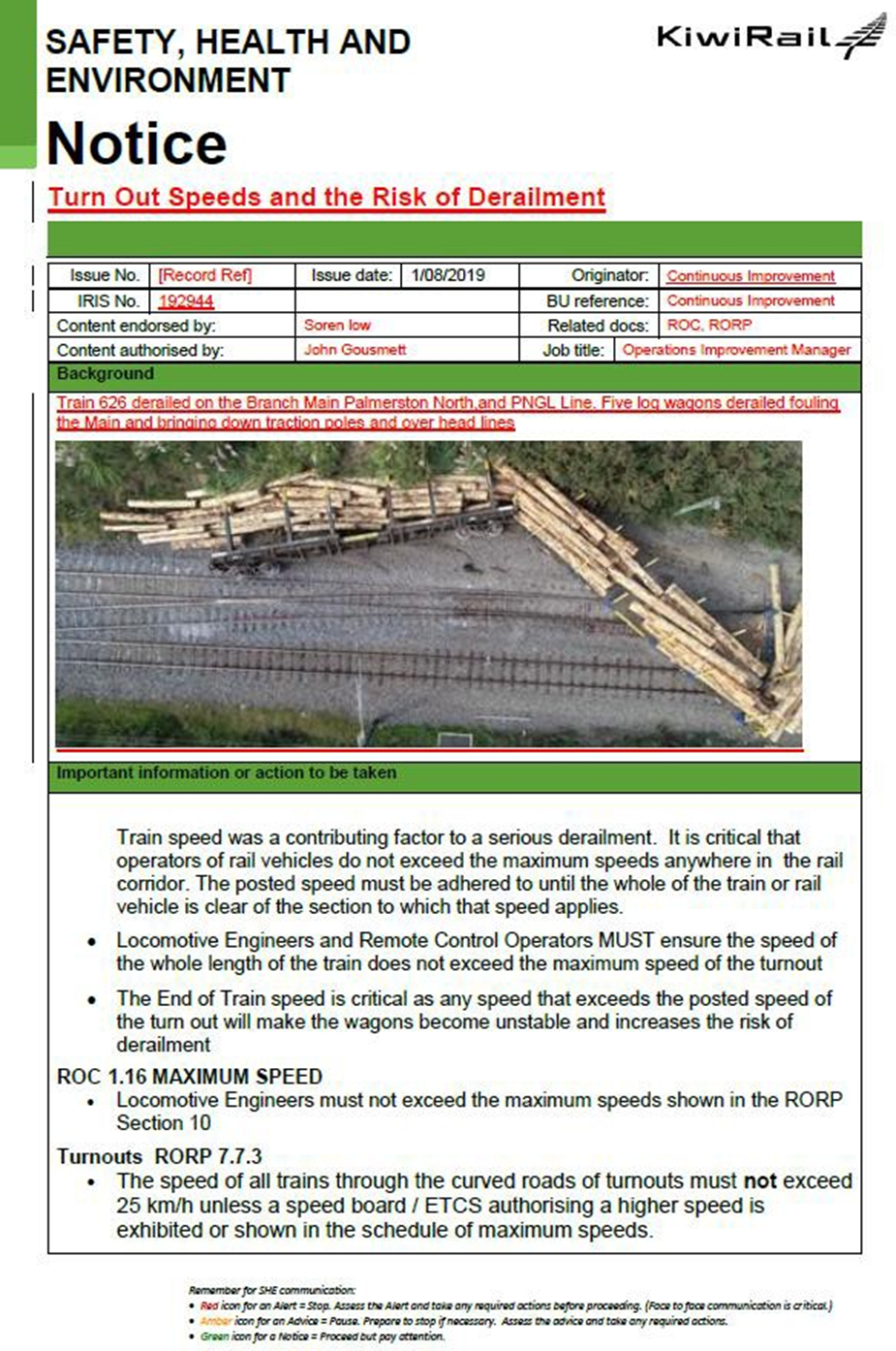
Appendix 1. Train driver notice
Appendix 2. Post-derailment wagon examination
Table 1 contains the measurements for wagon UKN143, the first wagon to derail.
‘Z’ is the thickness of the solid wheel rim. The condemning limit is 16. A low value is a thin rim.
‘X’ is the wheel flange thickness. A high ‘X’ value means a thin flange. The condemning limit is 40.
Float is measured on both sides of the bolster and the two figures are added together (see Figure 8). The acceptable float limit for the bogie at the handbrake end is 6-10 mm, and it is 12-16 mm for the bogie at the non-handbrake end.
The wedge height depot condemning limit is 39 mm and above. Figure 13 is a schematic showing the wagon and bogie layout.
Figure 13 is a schematic showing the wagon and bogie layout.

