On Thursday 27 February 2014 the Northern Explorer passenger train was on its journey from Auckland to Wellington. The train passed through Te Kauwhata station at 0937 with 108 passengers and five crew on board, heading towards the Te Onetea Road level crossing about 3.5 kilometres further south.
Executive summary

- On Thursday 27 February 2014 the Northern Explorer passenger train was on its journey from Auckland to Wellington. The train passed through Te Kauwhata station at 0937 with 108 passengers and five crew on board, heading towards the Te Onetea Road level crossing about 3.5 kilometres further south.
- Meanwhile a truck and long low-loader carrying a road roller was travelling along the no-exit Te Onetea Road, the driver looking for a suitable place to turn his long vehicle around. The truck was approaching the Te Onetea Road rail level crossing at the same time that the train was coming into view.
- The Te Onetea Road level crossing had passive controls protected by ‘Stop’ and ‘Look for Trains’ signs. The truck driver entered the level crossing without stopping and his trailer unit grounded on the rise leading up to the rail tracks. The truck became stuck, with its driving unit obstructing the track along which the train was approaching.
-
The train driver saw the truck begin to pass over the level crossing and stop in the path of his train. Despite his sounding the locomotive whistle and applying emergency braking, the train collided with the driving unit at a speed of 78 kilometres per hour.
- The truck was substantially damaged and the truck driver was killed in the collision. The train did not derail and suffered minor damage to the locomotive only. None of the train passengers or crew was injured.
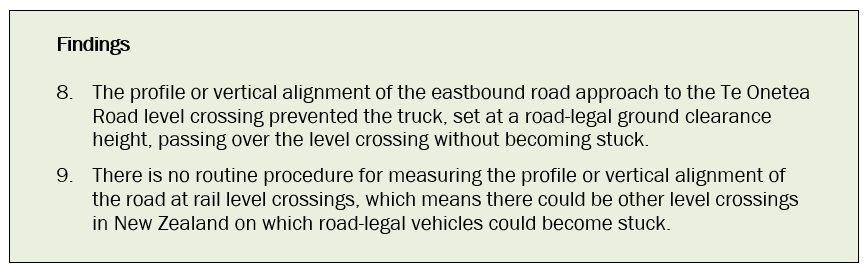
- The Transport Accident Investigation Commission (Commission) found that in this case the train, which had its headlight and side ‘ditch lights’ switched on, would have been visible to the truck driver as his truck reached the stop signs at the level crossing. Had the driver stopped his truck and looked for trains, the accident would likely not have happened. However, there were broader safety issues with the level crossing that in different circumstances may have resulted in the accident, even if the driver had stopped at the limit line of the level crossing.
- The Commission identified two safety issues. The first was that the view lines from the stop limit line on the road, along the rail tracks in both directions, did not comply with the minimum restart sighting distances set out in the NZ Transport Agency’s Traffic Control Devices Manual, Part 9, Level Crossings. It was therefore possible that when a train was just out of a truck driver’s view, a fully road-compliant heavy road vehicle would not have sufficient time to pass over the level crossing without being struck by the train.
- The second safety issue identified was that level crossing assessments do not require the road profile and the alignment of roads on the approach to and passing over level crossings to be routinely measured. Therefore, there are no checks made to ensure that all road-legal vehicles can pass over level crossings without becoming stuck, as happened in this case.
-
The Commission has made two recommendations to the Chief Executive of the NZ Transport Agency to address these safety issues.
-
A key safety lesson arising from this accident is that drivers of road vehicles must comply with compulsory stop signs at rail level crossings to give them ample opportunity to look for trains, assess the situation and consider any risk before proceeding.
Factual information Pārongo pono
Narrative
- On Thursday 27 February 2014, the express passenger train Northern Explorer (the train) was travelling southbound from Auckland to Wellington. The train departed from Auckland on schedule at 0750.
- The train passed through Te Kauwhata crossing station at about 0937. On board were 108 passengers, the train driver, a driver under training (in the cab with the driver), a train manager and two passenger attendants. The train’s headlight and ditch lights were switched on. The Te Onetea Road public level crossing is about 3.5 kilometres south of Te Kauwhata.
- Meanwhile at 0925 a truck consisting of a prime mover and a three-axle heavy ‘low-loader’ trailer (the truck) used for transporting heavy construction equipment had arrived at a Fletcher Construction site on Te Onetea Road, carrying a 23-tonne excavator on the trailer.
- With the help of an assistant the truck driver unloaded the excavator. They then loaded a roller from the worksite at Te Onetea Road that the driver was to transport to another Fletcher Construction worksite.
- The driver drove the truck off the Te Onetea Road worksite at 0938, heading eastwards towards the Te Onetea Road level crossing nearly 900 metres away in search of an area to turn the truck. The driver was the sole occupant of the truck when it left the worksite.
- The train was travelling at 85 kilometres per hour when 500 metres from the level crossing. The train driver saw the truck approaching the level crossing from his right-hand side (see Figure 1).

- The train driver observed that the truck had already begun crossing the northbound track and it appeared to him to be still moving when the train was about 250 metres from the level crossing. The driver gave a prolonged blast with the locomotive whistle to warn the truck driver.
- The train driver observed the truck continue to cross onto the southbound track and stop in the path of the train. The left-hand front wheel of the truck was between the rails of the southbound track (see Figure 2). The train driver made a full service brake application before moving the brake handle into the emergency position when the train was 161 metres (distance, times and speeds were taken from the train’s event recorder downloaded data) from the level crossing.

- The train driver warned the driver under training then vacated his driving position and placed himself in a ‘safe position’ between the brake pedestal and the rear wall of the locomotive cab. The train was travelling at 78 kilometres per hour when it struck the truck. The train stopped 270 metres past the level crossing. All the carriages and the locomotive stayed on the track. None of the 108 passengers or train crew was injured. The truck driver was thrown clear of the truck and sustained fatal injuries.
Site examination
- There was damage to the cowcatcher and the front structure of the locomotive (see Figure 3). The diesel fuel tank was punctured, resulting in slight seepage that was later contained.

- On impact, the truck rotated clockwise and slid in a southerly direction (see Figure 4). The driving unit was damaged beyond repair.

- The truck’s engine was torn from its mountings and came to rest 46 metres from the southbound line (see Figure 5).

- The semi-trailer had damage to the right front corner of the skid plate. Most of the hydraulic hoses and fittings at the front of the trailer were severely damaged.
- Passenger trains travelling south approach the Te Onetea Road level crossing on a 400-metre-long, 600-metre-radius curve at a maximum curve speed of 85 kilometres per hour.
- Te Onetea Road is a narrow, two-way, unsealed, rural no-exit road from Rangiriri. The road provides access to three properties on the eastern side of the double-track railway level crossing (northbound and southbound tracks). The road narrows to a single lane across the level crossing. It had no posted road speed but the road controlling authority, Waikato District Council, confirmed that the maximum speed limit of 100 kilometres per hour applied.
- The most recent Te Onetea Road level crossing site survey, carried out on 20 March 2012, had showed there were 28 road vehicle crossings and 31 train crossings per day.
- The Te Onetea Road public level crossing was equipped with passive controls. The NZ Transport Agency’s Traffic Control Devices Manual, Part 9, Level crossings, second edition, amendment 1 (Traffic Control Devices Manual), provided guidance on the use and placement of approved traffic signs at public level crossings.
- The Traffic Control Devices Manual required the road controlling authority to erect a ‘level crossing ahead’ warning sign consisting of a steam train symbol on the left-hand side of the road at a minimum distance of 160 metres before the level crossing. The ‘level crossing ahead’ warning sign was missing on the day of the accident.
- The road crossed the railway lines at a 55-degree angle. A sign (an acute-to-the-right WX42 advisory sign, indicating that the angle was less than 70 degrees) advising as such was positioned 75 metres before the level crossing, in accordance with the Traffic Control Devices Manual (see Figure 6).

- Pole-mounted railway stop assemblies, each consisting of a crossbuck ‘RAILWAY CROSSING’ mounted above a ‘STOP’ sign, were erected on each side of the road in both directions (four in total) (see Figure 7). Additionally, one pole assembly in each approach direction had a yellow ‘LOOK FOR TRAINS’ sign. Similarly, a ‘2 TRACKS’ sign warning drivers that there were two tracks to cross was attached to the other pole on either side of the crossing.

- The road surface of the eastbound approach to the railway level crossing, from where the truck was approaching, was generally unsealed with only a short section of chip seal just before the northbound track. The road surface under and between the two tracks consisted of loosely compacted track ballast (track ballast is crushed stone that forms part of the track bed upon which sleepers are laid).
- There was a short right-hand curve on the eastbound approach road to the level crossing (see Figure 6). The road was on a rising gradient of 4.46 degrees (7.8%) before levelling out across the two tracks. The railway lines sat above the track ballast. A faint yellow (stop) limit line marking on the road surface was 3.4 metres from the closest rail.
The road vehicle
- The truck consisted of a 2013-model, three-axle Kenworth driving unit towing a three-axle low-loading trailer with a 10-tonne load. The overall length of the combination was 18.85 metres.
- The driving unit was 7.6 metres long. The front axle was a single tyre steering axle and the rear two axles were dual tyre drive axles. The fifth wheel (trailer connection) was between the second and third axles, approximately 5.24 metres from the front of the truck. The tractor unit had a manual gearbox with a limited slip differential. The certificate of fitness was current and the vehicle was licensed until 1 September 2014.
- The low-loading heavy trailer had an adjustable deck height and deck width. It had been completely overhauled in December 2013. The 14.55-metre-long trailer had three axles with eight tyres on each axle. The trailer had a current certificate of fitness and was licensed until 12 August 2014.
-
It was fitted with a hydraulic suspension system that allowed for either side to be lifted or lowered to a height set by the driver. The operating height of the trailer at the time of the accident could not be established due to a disruption of the hydraulic lines caused by the collision.
Environmental conditions
- Sunrise at Rangiriri was at 0703 on 27 February 2014. The weather was fine and clear when the accident occurred at about 0942. At that time the sun’s azimuth was 76.3 degrees at an altitude of 30.81 degrees. On-site observation confirmed that the driver’s sighting of the train was unlikely to have been compromised by glare from the sun.
Personnel
The train driver
- The train driver had been employed by KiwiRail and its predecessors for almost 40 years. He had been driving freight and passenger trains for all but one year of his employment. His certification was current at the time of the accident.
- The driver’s post-accident drug and alcohol test produced a negative result.
The truck driver
- The truck driver had had two work periods with Porter Haulage, having been re-employed on 2 September 2013. He had no known health issues at the time of the accident and no issues were noted on his pre-employment questionnaire. He had completed a driver assessment at the start of his first period of employment.
- The truck driver held a current driver’s licence for the class of vehicle he was driving. His primary duties included the transport of heavy construction equipment such as bulldozers, excavators, forklifts, graders, loaders and rollers. He was also qualified to drive heavy motor vehicle combinations over weight-restricted bridges without the need for an accompanying certified pilot.
- Soon after arriving at work at 0543 (the truck driver’s work schedule was determined from a combination of workplace security cameras and the truck’s vehicle management system) he had checked his truck and then discussed his work schedule with the dispatcher, who noted nothing unusual in the driver’s demeanour. He departed from his workplace at 0616.
- There was no activity on the truck driver’s mobile phone at the time of the collision. Post-accident tests revealed no evidence of alcohol or other performance-impairing substances.
Analysis Tātaritanga
Introduction
- During 2013 and 2014 there was a total of 35 recorded train/motor vehicle collisions on public level crossings, resulting in eight fatalities.
- Of the 1,320 public road level crossings on the national rail network, 425 (32%) are protected by flashing lights and bells and 280 (21%) are protected by half-arm barriers plus flashing lights and bells. The other 615 public road level crossings are protected by passive signs. The Te Onetea Road level crossing was a public level crossing protected by a passive ‘STOP’ sign.
- Statistics show that the installation of active protection at public road level crossings does not eliminate train/motor vehicle collisions at level crossings. KiwiRail’s records showed that in the 10-year period before this accident, 12% of all level crossing collisions had occurred at crossings protected by half-arm barriers and flashing lights and bells, and 37% of the collisions had occurred at level crossings that were protected by flashing lights and bells (49% for all crossings installed with active protection).
- The Railways Act 2005 gives rail vehicles the right of way over road vehicles at level crossings. The train’s event recorder showed that at the time of the accident the driver was complying with operating procedures.
- The National Rail System Standard 6, Engineering Interoperability, requires that locomotive-hauled passenger trains be able to stop within a distance of 750 metres when travelling at a speed of 100 kilometres per hour. Data downloaded from the train event recorder showed that at the time of the accident the train was travelling at 85 kilometres per hour when the driver made a full service brake application. The train was brought to a stop within 430 metres. The train braking performance and handling of the train did not therefore contribute to the accident.
- The road vehicle was examined by a qualified inspector at a secure facility the following day. No faults were found on either the semi-trailer or the driving unit. It is considered unlikely that a defect in either unit contributed to the accident, although the disruption to the truck as a result of the collision meant the possibility could not be excluded.
- The analysis discusses what happened and the likely reasons for the collision occurring at the Te Onetea Road public level crossing.
- The analysis also considers the following safety issues:
- there was an insufficient sighting distance along the rail corridor available to a driver of a long vehicle to cross the Te Onetea Road public level crossing safely from the west side
- the road profile for the eastbound approach to the Te Onetea Road public level crossing did not allow the safe crossing of a road-compliant truck and semi-trailer combination without the vehicle becoming stuck.
What happened
- When the train was about 500 metres from the Te Onetea Road level crossing, it was travelling at the authorised curve speed of 85 kilometres per hour (23.6 metres per second). At this point the train driver first saw the truck slowly approaching the level crossing from his right-hand side. He maintained train speed as he negotiated the right-hand curved approach to the level crossing, expecting that the driver of the truck would stop at the level crossing and wait for the train to pass.
- When the train was about halfway around the curve the driver saw that the truck was still moving forward and was already obstructing the adjacent northbound track, so he sounded the train’s whistle to warn the driver of the truck that his train was approaching. The whistle was sounded 11 seconds before reaching the level crossing.
- Four seconds later, when the train was 161 metres from the level crossing, the driver applied full service braking followed by emergency braking. This was when the train driver saw that the truck was stopped with its left front wheel between the rails of the southbound track. The witness marks on the road and level crossing and the event reconstruction showed that the trailer had grounded and the truck had become stuck.
-
This hypothesis is further supported by two furrows made in the loose ballast, consistent with marks made by a rotating tyre. The location of the furrows was five metres from the centre of the southbound track, which is similar to the distance between the front axle and the tandem driving axles on the driving unit.
- The train collided with the truck seven seconds later, travelling at 78 kilometres per hour. It struck with sufficient force to eject the 500-kilogram engine 46 metres from the truck.
- The driver too was flung from the truck, and from the lack of trauma signs within the truck cab it appears likely that when the collision occurred he was standing outside the cab, possibly on the running board. The driver’s door was further evidence supporting this hypothesis. When it was examined at the accident site the door latch was noted to be in the open position. A more detailed examination of the door ‘catch’ and ‘latch’ system was carried out by a qualified vehicle inspector the day after the accident. The inspector determined that neither component had been forced, leading to the conclusion that the driver had opened it before the collision.
- It has not been possible to determine at what point the truck driver noticed the train, or whether he did at all. The possibility that he saw the train in the last seconds and was escaping the cab when it struck could not be excluded. Equally however, it would not have been unusual for him to have left the cab to investigate his truck becoming stuck on the level crossing.
- The reconstruction showed that with the train travelling at 85 kilometres per hour it would have been visible to the truck driver for 19 seconds before it reached the level crossing. An analysis of the timing of events showed that the train would have been visible to the driver when his truck reached the stop limit lines at the level crossing.
- The train headlight and the ‘ditch lights’ were alerting mechanisms that the driver may have noticed. Equally, the sound of the whistle could have alerted the truck driver. However, the post-accident examination determined that the truck windows were closed at the time. The accident reconstruction showed that with the truck engine running and the windows closed, it would have been difficult for the driver to hear the train whistle.
- The accident reconstruction included two scenarios: stopping at the (stop) limit line before entering the level crossing; and entering the level crossing without stopping. The trailer’s ground clearance was set at 200 millimetres to ensure that it passed over the level crossing without grounding and becoming stuck.
- From a standing start at the limit line it took an average of 14.3 seconds for the test vehicle to clear the level crossing. When the test vehicle was driven across the level crossing without stopping at the limit line it took an average 9.2 seconds to clear the level crossing. In the worst case scenario, if the train came in to view just as the truck started to move forward, there was a margin of less than five seconds for it to clear the southbound track. This small margin for error is discussed in the following section.
- The train driver observed that the truck did not stop before proceeding on to the level crossing. The road signage required that the driver stop his truck and look for trains before proceeding across the level crossing. Complying with the road rules for vehicles stopping at stop signs will reduce the risk of an accident by giving drivers more time to look for trains, assess the situation and consider any risk before proceeding. This is a key lesson arising from this inquiry.
- The roadside ‘level crossing ahead’ warning sign in the direction from which the truck was approaching the level crossing was missing. However, this is unlikely to have resulted in the driver being unaware that he was approaching a level crossing. The movement of a large vehicle down such a narrow road would have been slow, which is consistent with the train driver observing the truck approaching the level crossing at a slow speed. The missing sign is therefore not considered to have been a factor contributing to the accident.

Sighting distances at the Te Onetea Road level crossing
Safety issue – The sighting distance available to drivers of long vehicles to cross the Te Onetea Road level crossing safely did not comply with the NZ Transport Agency’s Traffic Control Devices Manual.
- The Australian Level Crossing Assessment Model (ALCAM) is an assessment tool adopted by New Zealand used to identify key potential risks at level crossings and to assist in the prioritisation of level crossings for upgrade. ALCAM is also used to assess compliance with the New Zealand Traffic Control Devices Manual. The ALCAM process involves the collection of data through a combination of level-crossing surveys and train and road vehicle information from the respective rail and road authorities. KiwiRail operates the level-crossing data management system that allows for the effective management of the ALCAM data.
- The most recent ALCAM site survey at the Te Onetea Road level crossing had been carried out on 20 March 2012. The survey had reviewed the road traffic control measures in place and measured and recorded various parameters that included the width of the road, the width of the railway tracks, the distance from the closest rail to the limit lines, the angle between the road and the railway track, the road approach gradient and the measured sighting distances.
- The survey data was used to calculate the minimum sighting distance that a motorist stopped at the level crossing and first seeing an approaching train would require in order to clear the level crossing safely ahead of the train. The measured and calculated sighting distances were compared to determine whether any corrective action was required.
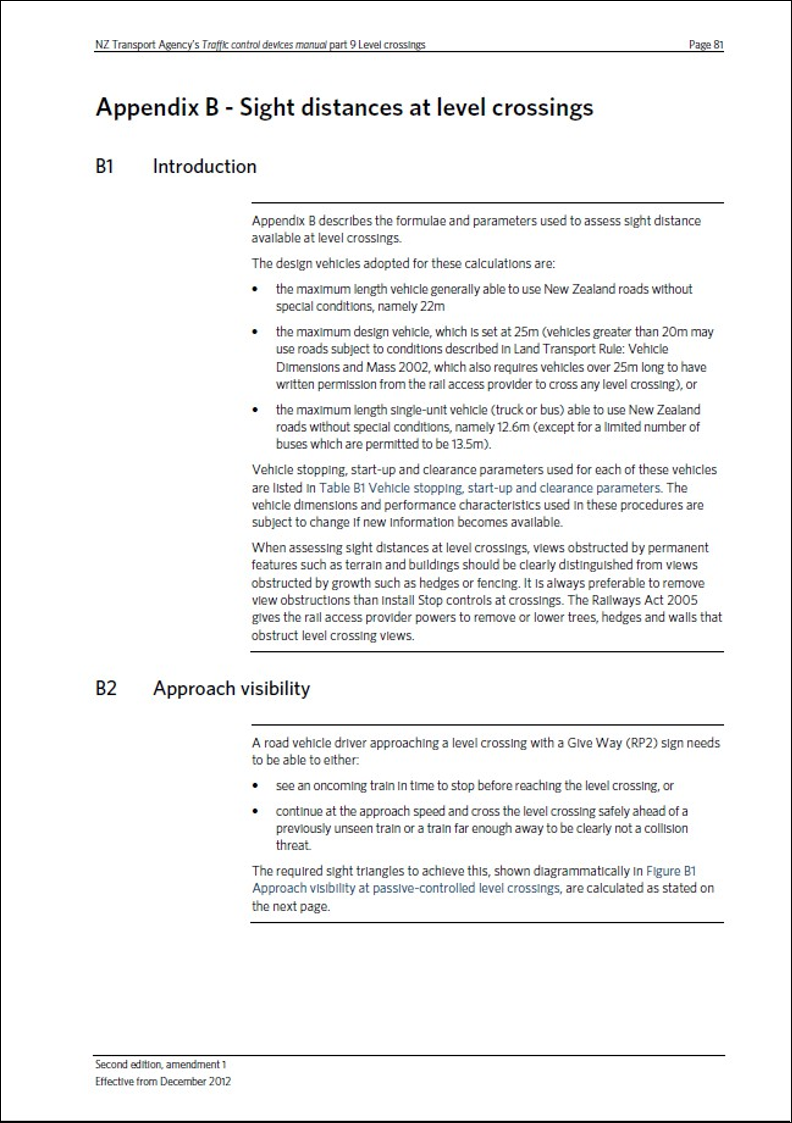
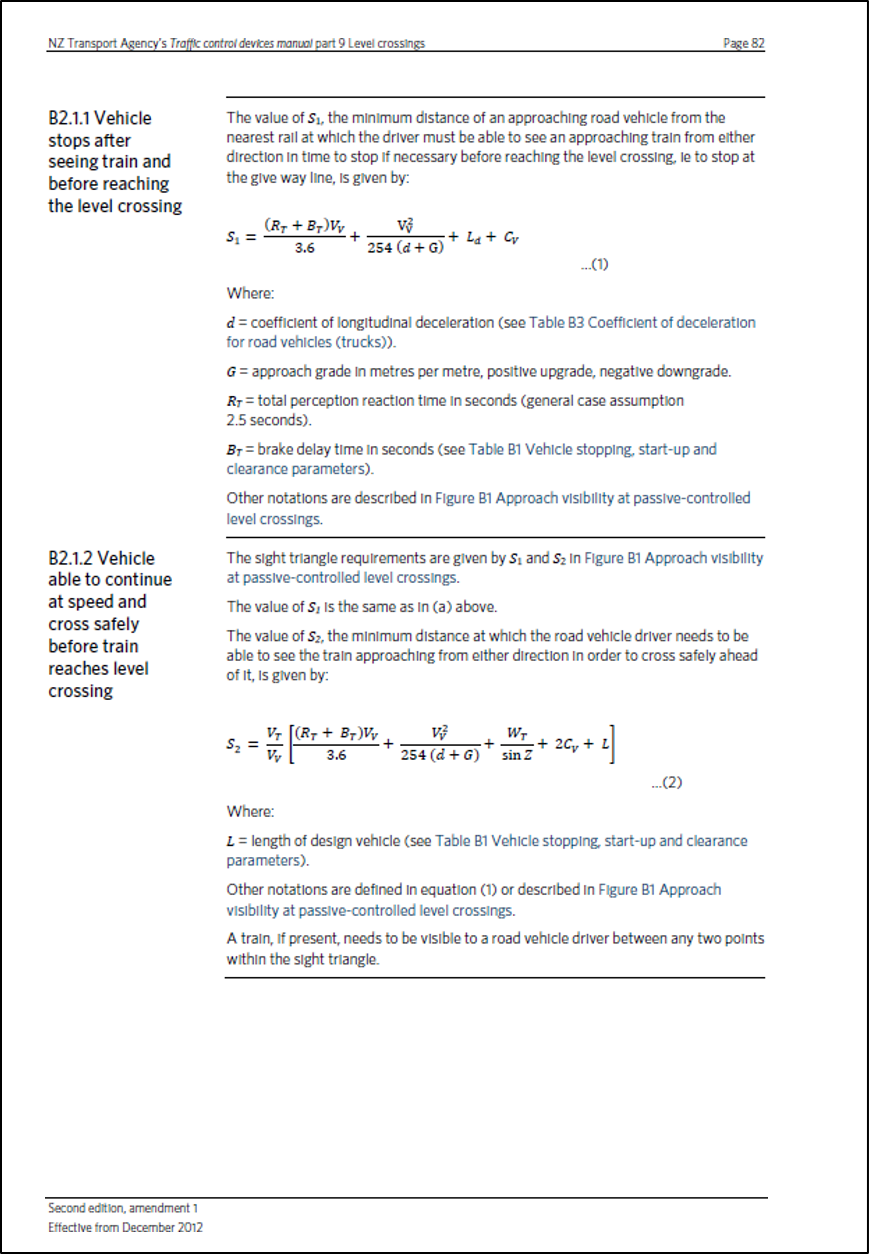
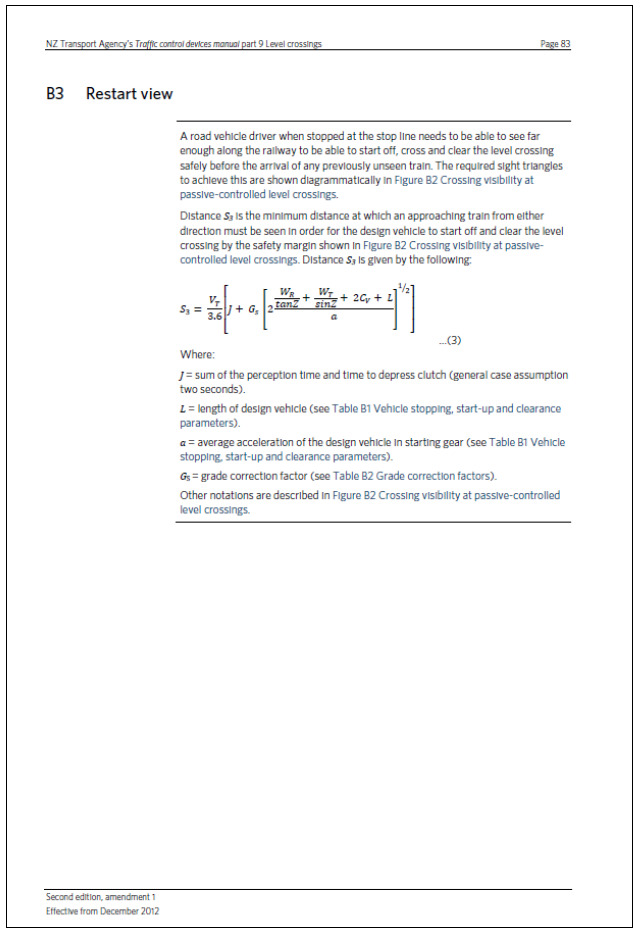
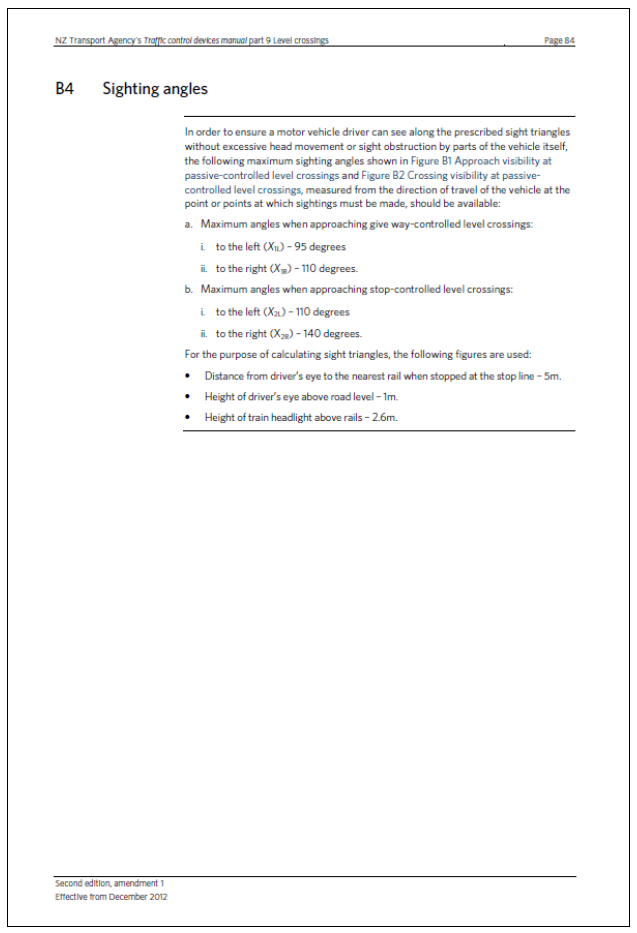
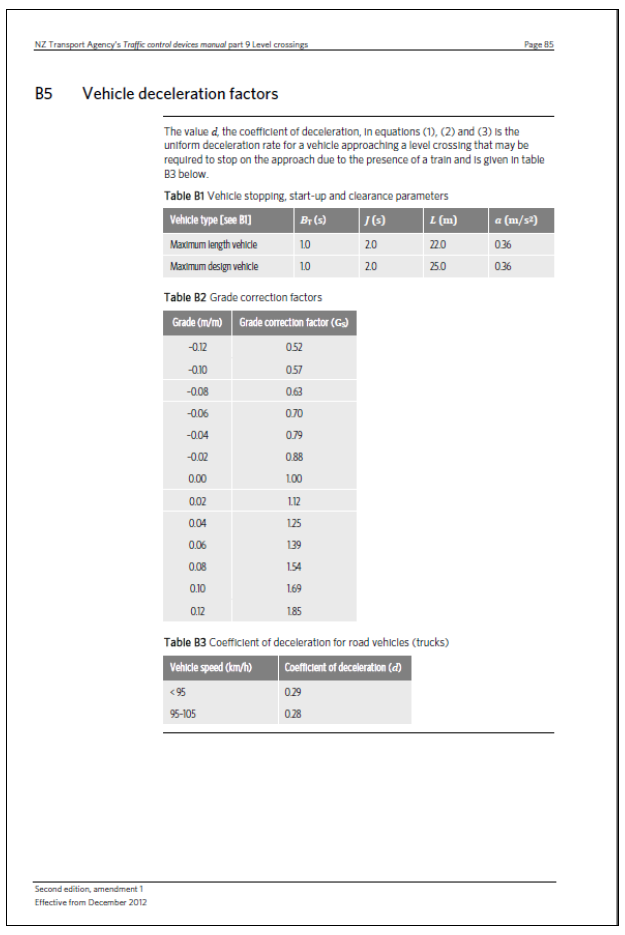
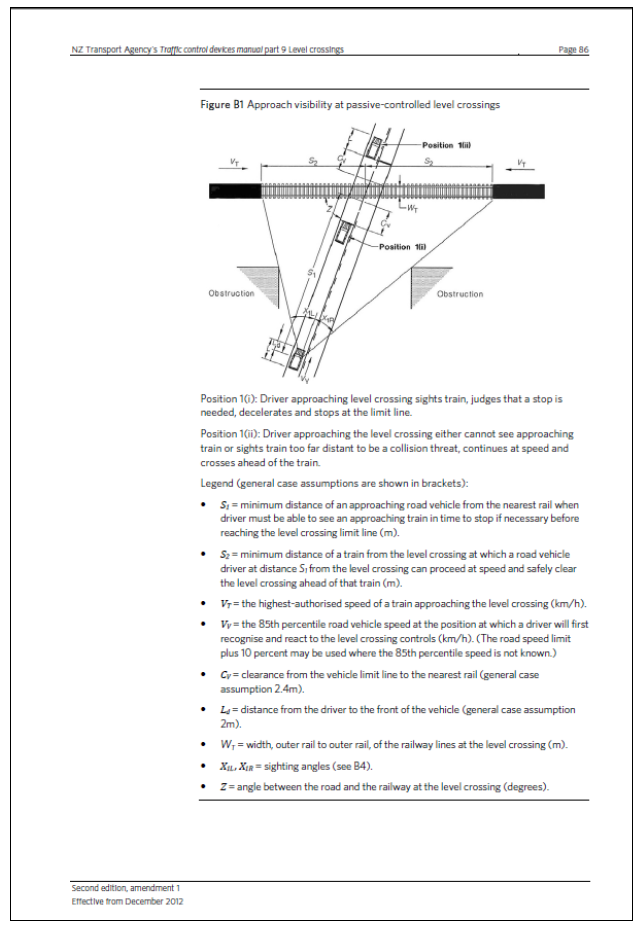
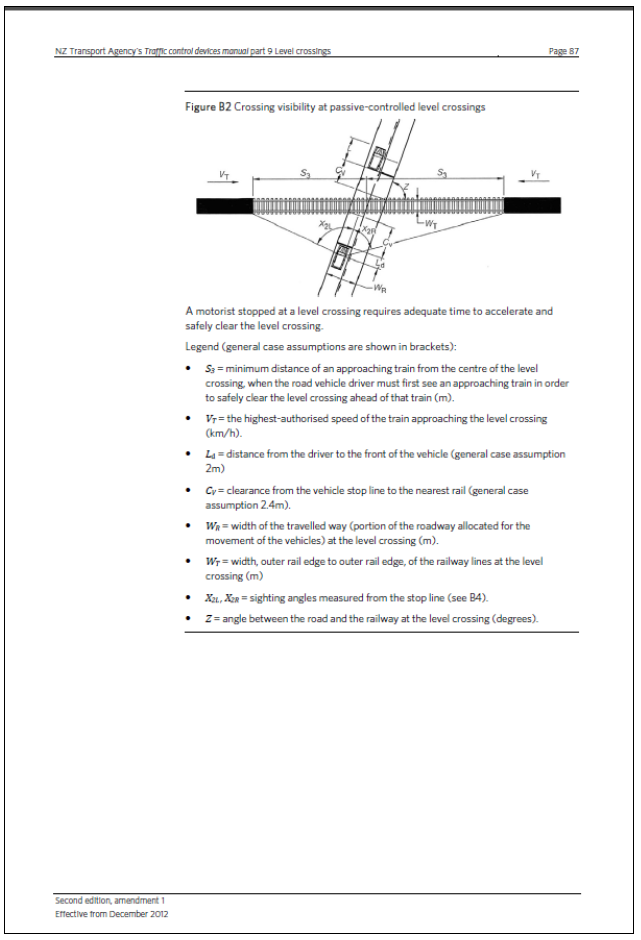
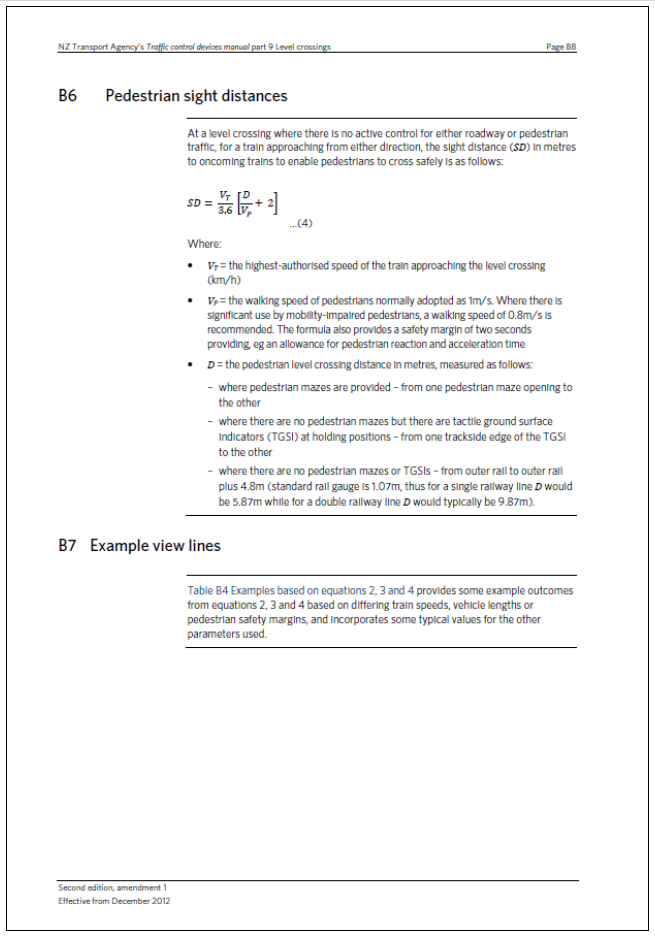
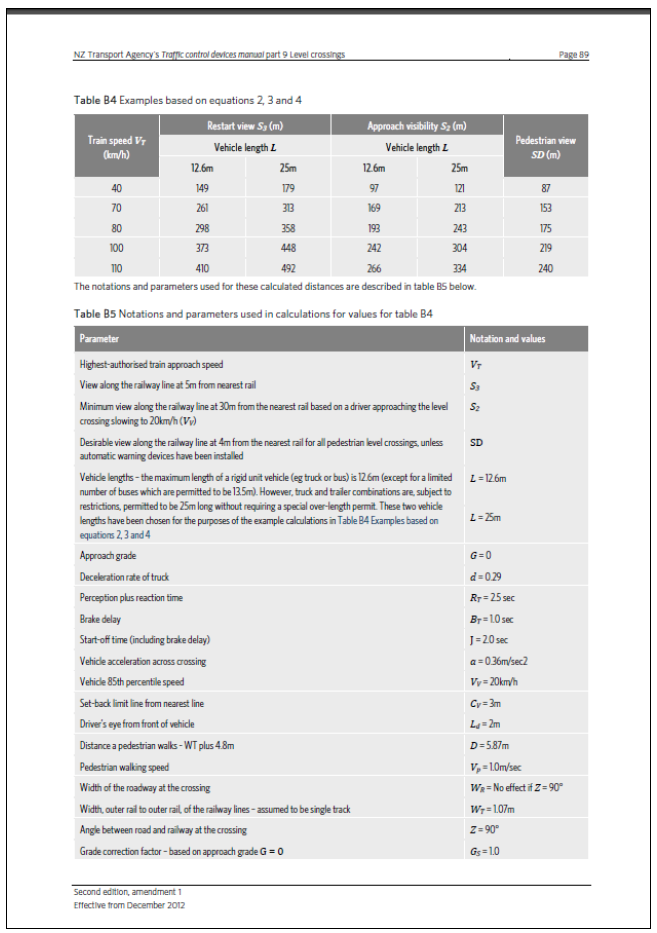
- Appendix 1 shows the procedure for calculating sighting distances at level crossings.
- In the case of the eastbound approach to the Te Onetea Road level crossing (the direction in which the truck was travelling) the calculated minimum restart sighting distance required for a long vehicle (up to 23 metres long) to cross the double track safely was 599 metres. However, the measured restart sighting distance available for a train approaching on the southbound track (along which the train was travelling) was calculated at 482 metres. As mentioned in the previous section, this gave only 19 seconds for the truck involved in this accident to pass over the level crossing once a train came in to view.
- The time available for a long vehicle to clear the level crossing for an approaching northbound train is less than for that of a southbound train. The maximum available sighting distance in that direction was 327 metres. The maximum speed for a northbound train approaching the level crossing was 95 kilometres per hour, or 26.4 metres per second. This provided a maximum of 12.4 seconds for a vehicle to clear the level crossing safely. For the truck involved in this accident there would have been insufficient time to clear the Te Onetea Road level crossing from a standing start.
- Neither of the measured restart sighting distances met the minimum requirements of the Traffic Control Devices Manual. A fully road-compliant long vehicle could not therefore use the level crossing with the recommended margins for safety.
- No remedial action to improve the view lines, decrease the speeds of trains passing over the level crossing, prohibit drivers of long road vehicles from using the crossing or warn them not to use it had been taken between the 2012 level crossing assessment and the day of this accident. The road controlling authority said that that was because KiwiRail had prioritised other level crossings for remedial action, based on their having higher risk scores. The Commission has recommended that the chief executive of the NZ Transport Agency address this safety issue.

The road profile
Safety issue – level crossing assessments do not require the road profile and the alignment of roads on the approach to and passing over level crossings to be routinely measured. Therefore there are no checks made to ensure that all road-legal vehicles can pass over level crossings without becoming stuck.
- The minimum ground clearance for a heavy motor vehicle (except where a vehicle is loading or unloading) on New Zealand roads is the greater of 100 millimetres or 6% (60 millimetres per metre) of the distance from the nearest axle to the point where the ground clearance is measured. For the truck involved in this accident the distance from the trailer’s leading axle to the low point of the trailer underframe was less than 1.66 metres, therefore a minimum ground clearance of 100 millimetres applied. The truck complied with this requirement.
-
At the reconstruction exercise the trailer’s ground clearance was lowered to the minimum 100 millimetres and the truck was driven onto the level crossing. The underframe in front of the trailer’s leading axle came in to contact with the road surface before the driving unit reached the southbound track. Despite the driver applying more power, the truck could not be driven forward.


- The gouge mark on the road surface (see Figure 10) had similar characteristics to the gouge mark identified on the day of the accident.

- The reconstruction exercise showed that the trailer grounded and the truck became stuck on the level crossing when the trailer height was set at the legal minimum height of 100 millimetres. The exercise was repeated with the ground clearance height set at 150 millimetres with similar results – the trailer grounded and the truck became stuck (see Figure 8). Only with the minimum ground clearance height set at 200 millimetres (twice the minimum legal standard) was the truck able to pass over the level crossing.
- The Commission has raised the issue of road profiles over level crossings in a previous report (Commission report 11-104) (Freight Train 261 collision with bus, Beach Road level crossing, Paekakariki, 31 October 2011).
- In that report the Commission found that “the profile of the Beach Road, Paekakariki, level crossing and the adjacent section of road leading up to the intersection with State Highway 1 were not well suited for long and low road vehicles”, and that “the bus [involved in that accident] complied with all aspects of the Land Transport Rule: Vehicle Dimensions and Mass”. The same issue arose with the Te Onetea Road level crossing.
-
The Commission also found that “changes in the Land Transport Rule: Vehicle Dimensions and Mass have been made with little formal consideration for the compatibility of long and low road vehicles with existing rail level crossings throughout New Zealand”.
- It is possible that the Te Onetea Road level crossing is one that has been affected by changes in the allowable dimensions of long, low road vehicles. Unless the profiles of all level crossings are assessed against the current allowable dimensions for long, low vehicles, the potential risk of this type of accident occurring will remain high.
- The ALCAM survey measures the gradient of the road leading up to the level crossing, but does not measure the rate of change in gradient in order to record the profile or vertical alignment of the road for the purposes of ensuring that road-legal vehicles can use the level crossing safely and without becoming stuck.
- It is important that rail level crossings are compatible with road vehicles, or that road users are made aware of limitations on the use of at-risk level crossings, in much the same way that drivers of over-dimension road loads are warned of low bridges and tunnels.
- The Commission has made a recommendation to the chief executive of the NZ Transport Agency to address this safety issue.
Appendix 1. NZ Transport Agency’s Traffic Control Devices Manual, Part 9, Level crossings, Appendix B – Sight distances at level crossings