KiwiRail’s system for work in the rail corridor should satisfy the needs of the contractors as well as KiwiRail, and it should not deter contractors from applying to enter the rail corridor. A fatal accident where a train impacted a road contractor’s truck on a level crossing happened because KiwiRail was unaware the road-marking crew would be there; they had not applied for a permit to work in the rail corridor.
Executive summary Tuhinga whakarāpopoto


What happened
- At about 1520 on Thursday 13 May 2021, a two-person team was engaged in road-marking activities at Saunders Road level crossing, some 5 kilometres northeast of Marton.
- The team consisted of a paint applicator operator (the operator), who was conducting work on the road next to a truck on the south side of the crossing. The operator was assisted by the truck’s driver, who was sitting in the right-hand side of the truck cab in readiness to move when instructed by the operator.
- The operator was in the process of painting yellow limit lines that designated the safe area for vehicles to stop at the crossing, when they felt the paint hose pulling away from them as it tightened up.
- The operator looked up to see that the driver had moved the truck and was proceeding towards the north side of the crossing.
- The operator called out to the driver to stop the truck as the work on the south side was not complete. The driver immediately stopped on the railway track.
- The operator then noticed a train rounding a bend approximately 260 metres northeast of the crossing.
- The operator shouted to the driver that a train was coming, but for reasons unable to be determined the driver did not get out of the truck or move it off the crossing.
- At 1526 the 556-metre-long, 699-tonne train was travelling at 72.7 kilometres per hour when it struck the truck on its right-hand side. The truck driver received fatal injuries.
Why it happened
- Although the crossing markings were within 5 metres of the railway track, a permit to enter had not been sought from the rail access provider (KiwiRail) by the road-marking company, as required by the Railways Act 2005.
- Had a permit to enter been sought, it is almost certain KiwiRail would have required additional protections to be in place before the commencement of the work.
- The reason for the driver moving the truck before they were instructed to do so by the operator could not be determined. It is about as likely as not that the driver was watching the operator painting the markings and moved the truck prematurely under the assumption that the operator had finished what they were doing.
- Safety for pedestrians and vehicles using level crossings is on the Transport Accident Investigation Commission’s (Commission’s) watchlist of serious transport safety concerns.
- As a result of this accident the Commission has recommended that KiwiRail review its permit-to-enter process by working with road-controlling authorities and those requiring permits to enter to ensure that provision is made for the practicable requirements for non-static and short-term work at multiple locations within the rail corridor.
- The Commission has recommended that KiwiRail review its permit-to-enter process to ensure that any associated costs and requirements are not prohibitive to the completion of safety-critical work, and that the charging of fees for permits to enter is in accordance with the Railways Act.
What we can learn
- Any work within the rail corridor poses an inherent but manageable risk, even if that work is not railway related. Undertaking this work without the knowledge of the rail access provider, and without appropriate protections for workers (including appropriate risk training), may increase that risk to a dangerous level.
- Anyone in the vicinity of the rail corridor, whether engaged in work activity or not, should expect rail traffic at any time.
- Safety-critical communication equipment should be designed and operated in a manner that avoids the potential for misunderstanding.
Who may benefit
- Road users, road-controlling authorities, roading contractors and people involved with the planning and approval of work around road/rail interfaces may all benefit from the findings and recommendations in this report.

Factual information Pārongo pono
Narrative
- At about 0730 (times used in this report are expressed in the 24-hour format based on New Zealand Standard Time) on Thursday 13 May 2021, a truck driver (the driver) commenced work at their place of employment in Palmerston North.
- The driver carried out various duties while waiting for the other member of their team, a paint applicator operator (the operator), to arrive at the Palmerston North premises.
- At about 1000 the operator arrived, and the two-person team began preparations to start their road-marking tasks at various locations in the Rangitīkei/Manawatū area.
- At about 1030 the team left the Palmerston North premises in a 2007 Hino Dutro truck (the truck), which had been fitted out as a mobile road-marking plant (see Figure 4).

- At about 1105 they arrived at their first road-marking location.
- At 1145 a KiwiRail train driver arrived at work at the Palmerston North depot and began preparations for their day’s duties.
- At 1230 the train driver drove by road to Hihitahi, 60 kilometres northeast of the accident location, to carry out a crew change with another train driver and take over the running of a freight train.
- At about 1350 the crew change took place at Hihitahi, and the train driver began driving Train 391, powered by locomotive DL9607, southwest towards Marton.
- At about 1510 the road-marking team arrived at Saunders Road to paint road markings on either side of the Saunders Road level crossing (the crossing), which was located at the 185-kilometre mark on the North Island Main Trunk railway line.
- After a brief assessment of the task, the operator began painting the road markings while the driver remained in the truck, parked to the right and in sight of the operator’s work area.
- At about 1525 the driver moved the truck from the position in which it was parked and started to drive over the crossing to the other side of Saunders Road.
- The operator, who was still in the process of painting the road markings, felt the paint hoses go taught as the truck moved.
- The operator called out to the driver to stop as they had not finished painting.
- The driver stopped the truck directly on the railway track and a short conversation took place between the driver and the operator.
- At this time Train 391 rounded a right-hand curve approximately 260 metres east of the crossing and the train driver sighted the truck.
- At 1526:01 the train driver sounded the locomotive’s horn for 5.4 seconds to warn the truck driver. The operator also called out to the driver that a train was coming.
- At 1526:06 the train driver applied the train’s emergency brake.
- At 1526:09 Train 391, travelling at 72.7 kilometres per hour, collided with the right-hand side of the stationary truck. The truck was shunted on impact about 30 metres southwest of the crossing and came to rest against a signal equipment box on the northern side of the track (see Figure 5).
- At 1526:36 Train 391 came to a standstill 348 metres past the point of collision.
- At 1526:47 the train driver contacted train control and emergency services were notified.

Personnel information
- The driver held a full Class 1 driver licence, which was appropriate for the vehicle being driven at the time of the accident.
- The operator held a level one Site Traffic Management Supervisor certificate.
- The train driver held all current certifications.
Train/Vehicle information
- The train was being driven from a DL class locomotive. The train was 556 metres long and weighed 699 tonnes. The train was travelling below the maximum line speed at the time of the accident.
- The Hino Dutro truck had recently passed a safety inspection and had been issued with a certificate of fitness. The truck was extensively damaged in the collision and resultant fire. No mechanical examination was able to be conducted on the truck post-accident.
Meteorological information
- The weather was clear and sunny. Sunstrike (a condition that occurs in vehicles when the angle of sunlight hitting a windscreen creates glare that is difficult for a driver to see through) was not considered a factor.
Recorded data
Train data recorders
- The locomotive was fitted with a data-recording system known as Tranzlog. The Transport Accident Investigation Commission (Commission) was provided with verified Tranzlog data. The verified information has been used in this report where required.
Site and wreckage information
- The truck was transported to a secure location by New Zealand Police. It was assessed as too badly damaged to be mechanically examined. A protection order was placed on the truck by the Commission, and it was further transported to the Commission’s secure facility.
Medical and pathological information
- The driver’s post-mortem report was supplied to the Commission. There was no indication of the presence of alcohol or drugs.
Previous occurrences
- No previous accidents had been reported at the crossing in records provided to the Commission. The accident had similarities to a previous Commission inquiry, RO-2019-108 Piako Road (https://www.taic.org.nz/inquiry/ro-2019-108), in which safety issues relating to the road/rail interface were identified.
Analysis Tātaritanga
Introduction
- The risks posed by roadwork activities in close proximity to the rail corridor3 were the subject of the previous Commission investigation, RO-2019-108.
- The circumstances that define a rail corridor are dependent on multiple factors, including:
- whether the rail existed first, and a road was built over it (road over rail)
- whether the road existed first, and the rail was built over it (rail over road)
- whether the rail access provider owns the land surrounding the railway track or the rail runs through an urban area.
- For the purposes of this report, the term ‘rail corridor’ refers to anywhere within 5 metres of the centre of the railway track (see Figure 6).
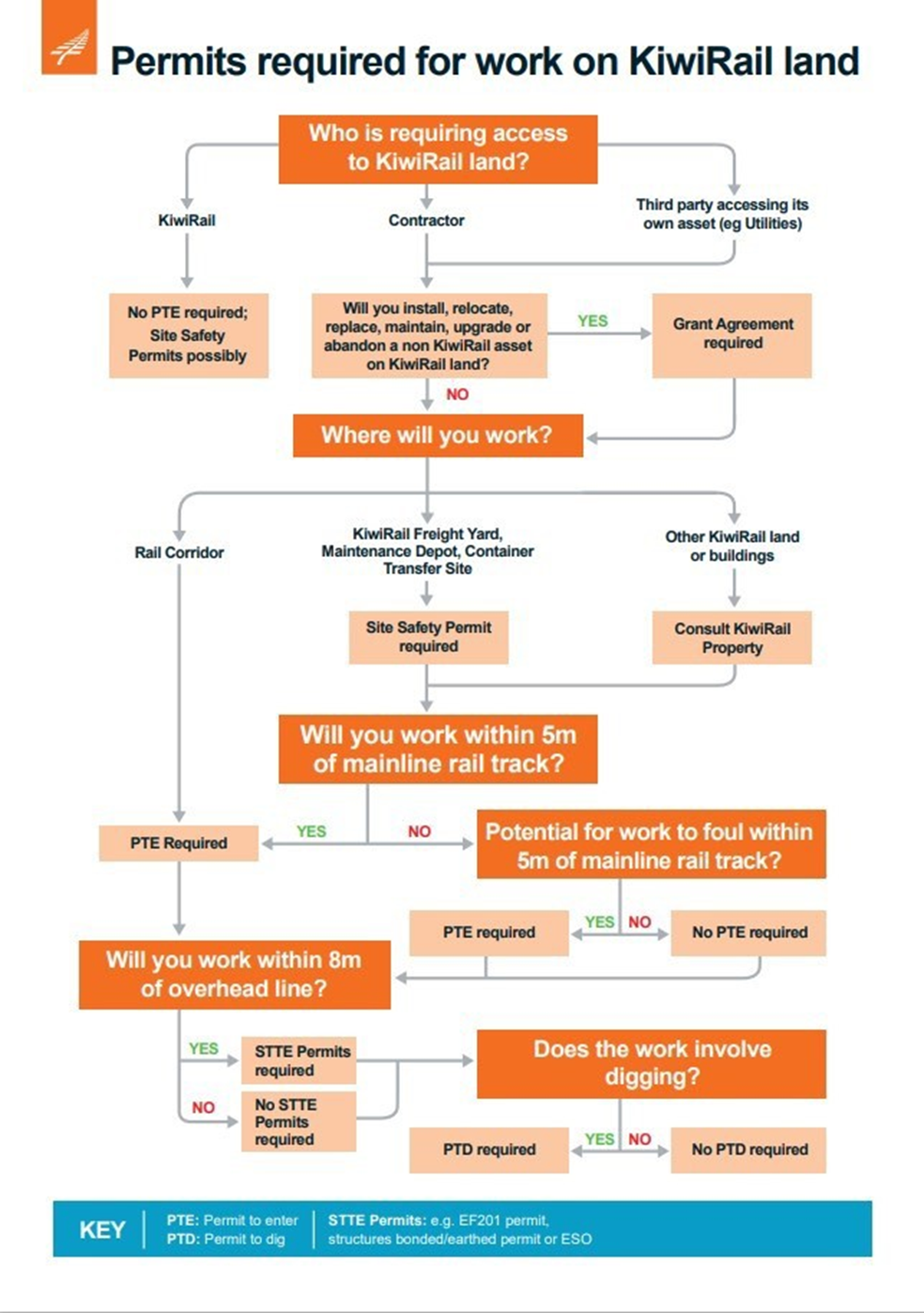
- Rail access providers have clear expectations that any work within the rail corridor will be notified, and where required a permit to enter (PTE) will be granted before the work can take place (see Appendix 2).
- The Commission has attributed the issue of people not seeking or not being aware of the requirement to obtain PTEs to conduct work to three deaths as a result of two fatal accidents since late 2019.
- While the reason for the driver moving the truck onto the level crossing could not be determined with certainty, the following section analyses the circumstances surrounding the event to identify those factors that increased the likelihood of the event occurring or increased the severity of its outcome. It also examines safety issues that have the potential to adversely affect future operations.
Background
- The road-marking crew assigned to carry out the contract for marking roads around various locations in the Rangitīkei/Manawatū area had been working together for several months. The crew consisted of the operator, who operated the paint applicator and carried out the road marking, and the driver, who acted as assistant to the operator. The driver remained in the truck and was tasked with ensuring the truck was correctly positioned and acting as a safety lookout for the operator.
- In the field, the operator was the senior person in the crew and acted in a team leader role, deciding how the work would be carried out and briefing the driver as necessary.
- The driver’s first language was not English but they were described as being proficient, although sometimes instructions would have to be drawn in diagram form to ensure they understood a plan of work.
- The crew reported to an operations manager. The operations manager was responsible for, among other things, organising the work, training employees and advising employees of any instructions required for the work they were tasked to do.
- Documentation provided to the Commission indicated that the contract on which the crew was working involved the marking of roads at 60 separate locations around the southern rural Rangitīkei region. Of those 60 locations, 12 involved work near level crossings.
- At Saunders Road the lines to be marked were measured at 4.75 metres from the centre of the track on the northern side, and 4.35 metres from the centre of the track on the southern side (see Figure 6).

- A PTE is required from the rail access provider (in this case KiwiRail) for any work being conducted within the rail corridor.
- KiwiRail advised the Commission that a PTE was not requested by the company engaged to complete the work (in this case Roadmarking Services Limited) (the company), and therefore was not granted for work at the crossing.
The work contract
Safety issue: Work within the rail corridor was undertaken without a PTE being obtained. As a result, potential risk-mitigation actions that were required prior to the issue of the PTE were not taken. Not obtaining a PTE increased the risks to road and rail users.
- On 20 August 2020 a contract had been issued by the Rangitīkei and Manawatū District Councils to the company to perform the maintenance of road markings in various locations in the Rangitīkei/Manawatū region.
- The contract stipulated a commencement date of 1 September 2020 and an estimated completion date of 31 August 2021.
- Documentation provided with the contract to work consisted of:
- a work access permit (WAP)
- a traffic management plan (TMP)
- a list of conditions.
- The documentation was grouped together as Corridor Access Request E697607 and approved by an authorising agent of the Manawatū District Council on 20 August 2020.
- Each of the documents provided a unique type of authorisation for the work to go ahead.
-
The WAP specified the details of the proposed work as:
Activity: Road Marking Maintenance
Address: 10 GENERIC - Various Roads & Streets, ROAD MARKING, MANAWATU & RANGITIKEI ZONES
Location in road: Carriageway
WAP valid period: 01 September 2020 to 31 August 2021.
- The TMP was classified as a ‘generic’ TMP. The term ‘generic’ in this context meant it was a pre-formatted form approved for use on the road in general, without diagrams pertaining to a specifically named road or worksite.
- The TMP included diagrams explaining the setting-up requirements for various road-marking situations, but did not include a diagram for working near a level crossing.
- The TMP form used by the road-controlling authority was the same form found in the Waka Kotahi NZ Transport Agency (Waka Kotahi) Traffic Control Devices Manual (TCDM) part 8 (Waka Kotahi is responsible for setting the requirements for the safe and efficient management and operation of temporary traffic management on all roads in New Zealand. At the time of the accident the Code of Practice for Temporary Traffic Management was the best-practice guideline for temporary traffic management in New Zealand) (the Code of Practice for Temporary Traffic Management, Section E, appendix A: Traffic management plans) (the Code).
- The pre-formatted form included checkboxes for applicants to complete. One of the checkboxes was titled ‘Road aspects affected’ and asked if pedestrians, property access, traffic lanes, cyclists or restricted parking would be affected, and a further checkbox asked if delays or queuing would be likely.
- Another checkbox was titled ‘Authorisations’ and asked if controlled street parking would be affected, if portable traffic signals would be used or permanent traffic signals be changed, if full carriageway closure would continue for more than five minutes and if a bus stop(s) would be obstructed by the activity.
- There was no checkbox in the document asking if the work would be taking place near a level crossing or within the rail corridor.
- If a checkbox for activity near the rail corridor had been included (the New Zealand Guide to Temporary Traffic Management is scheduled to begin release in early 2023. The Commission has been advised that this new guide will include the necessary checkbox), it may have prompted users of the TMP to take into consideration the potential dangers of working near the rail corridor, and to apply for PTEs.
- KiwiRail advised the Commission that, had a PTE been sought, the work would have required the presence of a rail protection officer (RPO) to accompany the road-marking team.
- Had an RPO been present it is almost certain that rail traffic would have been prevented from entering the worksite and the accident would not have occurred.
- The Commission has made a previous recommendation (007/21) that the Secretary for Local Government provide leadership to and work with local authorities to ensure that TMPs identify any rail crossings within the vicinities of proposed work and that the rail access providers have been consulted to ensure that any additional safety requirements in relation to the road/rail interface are met.
Non-application for a permit to enter
-
The list of conditions provided with the WAP detailed the responsibilities of the person conducting the work. Of note is condition 4(a), which stated:
4. The Utility Operator must:
(a) carry out all Work in Transport Corridors in accordance with the Code and KiwiRail’s Specifications for Working in Railway Corridors.
- In this case the term ‘utility operator’ referred to the road-marking company.
- The inclusion of clause 4(a) in the document placed the responsibility on the company carrying out the work to obtain the necessary permissions from KiwiRail. However, it was not noted anywhere in the suite of documentation provided to the company that 12 out of the 60 crossings (or 20 per cent) in the southern rural Rangitīkei contract were within the rail corridor.
- Not highlighting that work would be required near the rail corridor may have decreased the likelihood of the company considering the risks associated with this activity.
- The operations manager, in discussing the requirements of working near level crossings, referred to a document called ‘MOTSAM’ (Manual of Traffic Signs and Markings). The section of MOTSAM to which the operations manager referred had been replaced by Part 9 of the TCDM in 2009, some 12 years before this accident; however, it contained much the same information as the superseded MOTSAM
-
The TCDM was a document provided by Waka Kotahi that stated its purpose in part as:
… provides guidance on industry good practice including, where necessary, practice mandated by law…
-
The TCDM further stated, regarding Part 9 level crossings:
This part was developed with guidance from the Level Crossing Working Group, a standing group convened by the NZTA [NZ Transport Agency]. This group represents rail participants (KiwiRail and Federation of Rail Organisations of New Zealand (FRONZ)), road-controlling authorities (RCAs), the Ministry of Transport and the NZTA.
-
TCDM Part 9 section 5.3.4 Limit lines stated in part:
Limit lines must be marked at right angles to the approach road centrelines, unless site constraints make this impractical, and every part of the line must be at least:
- 2.4m from the nearest rail edge (3m from the centreline of the nearest railway line),
and further stated:
Limit lines should normally be installed at the minimum permitted clearance from the railway line to ensure drivers are encouraged to stop where adequate restart views are available and to minimise the time for vehicles to clear the railway after stopping.
-
During an interview, the operations manager stated they did not think a PTE was required for the work as they considered it was the council’s responsibility to ensure the lines to be marked were outside the rail corridor. This position was understandable given the information in section 5.2 of the TCDM – Responsibilities, which stated in part:
As road marking at level crossings is generally outside the rail corridor it will normally be the responsibility of the RCA. Specific exceptions to this apply where the level crossing is a private granted level crossing or a rail operations level crossing where the rail access provider is responsible. The RCA must liaise with the rail access provider before installing any new road marking in the vicinity of a level crossing. Road marking contractors must ensure any necessary permit to enter has been obtained for any work that encroaches on the rail corridor [emphasis added].
- Notwithstanding the operations manager being unaware of the change from MOTSAM to TCDM Part 9, it is of concern to the Commission that the best-practice document published by Waka Kotahi advised that markings should be positioned within the rail corridor for the purpose of road-user visibility, but did not include any advice or warning in that section that undertaking such work within the rail corridor would require permission from the rail access provider.
- Further to this, the section outlining road-marking responsibilities could have easily been interpreted to state that road markings were generally outside the rail corridor, and therefore would not require permits from the rail access provider.
- TCDM Part 9 Appendix C provides clear direction for working on or near level crossings; however, the presence of warnings or reminders in the relevant sections of best practice reference documentation could reduce the risk of road workers accessing the rail corridor without the necessary protections in place.
-
Waka Kotahi has taken action to address this safety issue, therefore the Commission has not made a recommendation.
The limitations of the permit-to-enter process
Safety issue 1: The permit-to-enter process does not adequately provide for the practicable requirements of non-static and short-term work within the rail corridor. This could disincline contractors from obtaining the necessary permissions.
Safety issue 2: The costs of obtaining correct permits and establishing protection within the rail corridor are disincentives to follow the requirements and may increase risks to the safety of people working within the rail corridor.
- KiwiRail, being the main rail access provider in New Zealand, has robust procedures in place for granting access to work in the rail corridor. TCDM Part 9 Appendix C also references this process in section C4 – Permits to enter rail corridor, which states:
- Anyone who wishes to work in the railway corridor must obtain a PTE issued by the rail access provider or railway premises owner. This permit is required for all access onto the railway corridor regardless of:
- the distance from the railway line
- whether the railway line is operational or not
-
work being in a rail facility (eg, marshalling yards, depots, workshops where railway lines and level crossings are present).
In electrified areas, the nature of the work to be undertaken may require an electrical safety permit to work. This permit will generally be required when working within 4m of overhead traction wires (train power supply lines).
Both these permits are subject to a fee and, depending on the nature of the work, may require the rail access provider or railway premises owner to provide a protection employee at the working party’s cost.
- As stated above, a working party is expected and required to pay a fee for the PTE and the cost of a protection employee. While this arrangement may be acceptable for static worksites with known hours of operation, it may be impractical for the type of work conducted by road markers.
- Given the nature of the contract in which the company had engaged, the road-marking crew was travelling to multiple locations without a particular schedule, and only spending a matter of minutes at each location to refresh the existing road markings.
- KiwiRail’s website contained a PTE portal (https://www.kiwirail.co.nz/how-can-we-help/access-the-rail-corridor/permit-to-enter) (see Figure 7).

- Of note in the portal are two pieces of information directly under the large ‘click here’ link, the first stating “Please ensure that you supply a Purchase Order or Credit Card details on the form” and the second stating “Failure to have a current Permit to Enter when in the rail corridor is a breach of s73(1) and (2) and s75 of the Railways Act 2005”.
- The implications of the above are that PTEs must be paid for, and not obtaining a PTE is a breach of the Railways Act (the Act).
-
Section 75(1) of the Act states in part:
Despite anything in any other Act, no person may exercise a right under an easement, or construct or carry out work on, over, or under any railway infrastructure or railway premises, without having first sought and obtained the written permission of the licensed access provider or railway premises owner concerned.
- This section of the Act is quite clear that no-one should be working in the rail corridor without permission.
-
Section 75(6)(b) of the Act states:
A licensed access provider or railway premises owner—may not charge any amount for considering or deciding on a permission sought under subsection (1).
- KiwiRail’s Corridor Access Request portal (see Figure 8) provides costings for both permit and protection rates.

- On this occasion, meeting KiwiRail’s requirements would have necessitated a PTE for each location within the rail corridor and also co-ordinating the timing to ensure the presence of an RPO before work could take place. In essence, the cost and availability of the PTE requirements may be prohibitive to many contractors.
- Further, section 75(6)(b) of the Act indicates that KiwiRail may not charge for a PTE.
- The costs of obtaining the correct permits and establishing protection within the rail corridor are a disincentive to follow the requirements and may increase risks to the safety of people working within the rail corridor.
- The marking of roads approaching level crossings is safety critical to both road and rail users. It is essential that this work be facilitated by both the road-controlling authority and the rail access provider to ensure a practical solution for those contracted to carry out the work.
- The Commission has made two recommendations in section 6 to address these issues.
Other factors
The driver
- During the inquiry the Commission investigated possible reasons for the driver to move the truck onto the level crossing. Interviews were conducted with work colleagues and the driver’s next of kin.
- These interviews indicated the driver had not been under any undue stress or fatigue leading up to the accident.
- Post-mortem results indicated the driver had not suffered a medical event or been under the influence of alcohol or drugs.
- Records of the driver’s mobile phone indicated that the phone was not being used at the time of, or immediately prior to, the accident.
- The Commission found that it was about as likely as not that the driver was watching the operator painting the markings and moved the truck prematurely under the assumption that the operator had finished what they were doing. The driver then stopped the truck on the crossing when the operator called out, likely without registering the danger of doing so.
- If the driver had at any time been aware of the approaching train, it is likely that they would have attempted to analyse the situation and decide on the correct course of action (either trying to move the truck, and thereby saving their employer’s asset, or escaping from the truck, leaving it in the path of the train). Another factor that the driver may have considered was that the operator, along with the paint applicator and hoses, was at that stage deployed behind the truck. Had the driver moved forward to clear the crossing, the hoses and applicator would have been dragged into the path of the train. Had the driver reversed off the crossing they would have risked running over the operator and equipment.
- This decision-making process may have taken too long for the driver to react either way and get to safety.
The work location
- The set-up of the work area was outside the usual operating method, in that the truck was parked beside the location where the operator was painting, instead of the usual position of the truck being parked in front of the operator (see Figures 9 and 10).


- This position to the side was necessary due to the geographical constraints of the available area approaching the crossing.
- Parking the truck to the side of the operator’s work area avoided the truck blocking the entrance to the neighbouring farm or placing the paint hoses over the crossing. It further avoided the truck potentially driving over wet paint as it manoeuvred through the work area.
- The truck was fitted with a boom that allowed the paint hoses to swing in an arc around the truck so work could be conducted to the side.
- The operator reported that they had briefed the driver on what was required for this particular location and drawn a diagram, as it differed from the locations at which they had previously worked. The driver had appeared to understand this briefing.
- The driver’s ability at this location to observe the operator directly as they were working, instead of the usual routine of relying on instructions from the operator, may have led the driver to believe that the line marking was finished and the truck needed to be moved to the next area.
The vehicle
- The Hino Dutro truck had a diesel engine and a manual transmission. It did not require drivers to have a special class of licence.
- Its tare weight was 2390 kilograms, but it would have been heavier with the addition of the road-marking equipment and paint containers.
- It had a current certificate of fitness and had been inspected recently. The company had owned it for seven years.
- Mechanical testing was unable to be carried out on the truck due to the amount of damage sustained in the collision and resultant fire.
Communication
Key lesson: Safety-critical communication equipment should be designed and operated in a manner that avoids the potential for misunderstanding.
- Due to the nature of the work, the road-marking crew did not use hand-held radios to communicate. The working environment could at times be noisy due to road traffic, the paint compressor operating and the truck’s diesel engine running. It was also impractical for the operator to use a hand-held radio while they were engaged with the paint applicator and hoses.
- Instead, the paint applicator was fitted with a buzzer button (see Figures 11 and 12). When pressed the buzzer sounded in the cab of the truck.


- The crew utilised a simple code for the buzzer: a short beep meant move forward, two beeps meant move back, and a sustained beep meant stop.
- In an interview with Commission investigators and in statements taken by Police at the scene, the operator stated they had not pressed the buzzer.
- The Commission considered the possibility that the buzzer had been knocked or bumped and sounded inadvertently, causing the driver to interpret a short beep to mean they were to move the truck.
- The Commission considered it unlikely that, even if the buzzer had been sounded inadvertently, it would have been enough of a prompt for the driver to move the truck forward immediately when, had they instinctively looked, they would have seen that the operator had not finished painting.
- Although it is not considered likely that the buzzer was activated inadvertently, there is a key lesson to the industry that safety-critical communication equipment should be designed and operated in such a manner that it avoids the potential for misunderstandings.
Sighting distance
Safety issue: The visible distance for road users at the crossing to sight approaching rail traffic was below the minimum requirement.
- There are 1388 public road level crossings in New Zealand. Of those public road level crossings, 715 (52 per cent) have active protection. In 2019 there were 419 crossings protected by flashing lights and bells and 296 had half-arm barriers and flashing lights and bells. The other 673 public road level crossings were protected with passive signs, either ‘Give Way’ or ‘Stop’ signs. The Saunders Road public road level crossing was one of 393 protected with ‘Stop’ signage.
- The Australian Level Crossing Assessment Model (ALCAM) is one of the assessment tools adopted by New Zealand that is used to identify key potential risks at all level crossings and to assist in the prioritisation of level crossings for upgrades. The ALCAM process involves collecting data by way of level crossing site surveys and collecting both train and road data from the respective rail and road authorities. The ALCAM assessment output data showed that the Saunders Road public road level crossing presented a relatively low risk; it rated 526 out of 1388 public road level crossings on the rail network.
- Level crossings in New Zealand are regularly assessed through various processes and issued risk scores. A risk score is part of an equation that determines the level of protection treatment required at a crossing. Protection treatments range from high-level active controls (eg, half-arm barriers with lights and bells) to low-level passive controls (eg, give-way signs) dependent on the levels of risk.
- Passive controls are generally used where there are low volumes of both road and rail traffic, which make the likelihood of a collision low. The Saunders Road public road level crossing met the requirements for passive controls.
- Stop signs are used at level crossings where road users have insufficient time to sight approaching trains and stop before reaching the level crossing limit lines.
- The Saunders Road protection treatment consisted of compulsory stop signs on each side of the crossing, consistent with the level of risk assigned through the assessment process.
- The methods used to assess level crossing risk scores and assign priority to protection treatments are complex. A detailed description of the processes can be found in the Commission’s previous report RO-2020-101. An abridged version of RO-2020-101 Appendix 1 is contained in Appendix 1 of this report for ease of reference.
- Sighting distance makes up part of the assessments. Against four criteria11 measured during the assessment, Saunders Road scored between 19.76 and 34.43 per cent of the minimum sighting distances required.
- However, other factors, such as the frequency of traffic over the crossing, also formed part of the assessment equation.
- Saunders Road had a low frequency of traffic, and the road terminated 20 metres south of the crossing at a cattle stop before a private roadway to farmland (see Figure 13).

- Although the responsibility for the maintenance of the road markings was under the jurisdiction of the Rangitīkei/Manawatū District Councils, the crossing essentially only existed to provide access to the neighbouring farm.
- As such, the risk score and level of protection treatment were considered adequate, and a higher level of protection treatment would not have been reasonably practicable for the crossing.
- KiwiRail advised the Commission that due to the crossing’s low risk rating it was not aware of any plans to change the level of protection treatment.
- The distance from the truck’s position on the crossing to the right-hand curve the train rounded before the train driver sighted the truck was measured as 260 metres. Based on the speed of the train, this distance would have taken eight seconds to travel. The train driver sounded the horn for 5.4 seconds before the collision.
- The train was travelling below the maximum line speed of 80 kilometres per hour for DL class locomotives when the train driver sighted the truck and began to brake.
- The time of 8 seconds from sighting, or 5.4 seconds from hearing the train, would have been sufficient for the 6.6-metre-long truck to clear the crossing had it started to move immediately from its stationary position across the track.
- The truck was stationary on the crossing prior to the train coming into view and did not move until the train collided with it. Therefore, although the sighting distance at the crossing was below the minimum requirement, it is not considered a contributory factor in this accident.
- The presence of passive protection in the form of compulsory stop signage was considered reasonably practicable for the risk level of the crossing, therefore the Commission has not made a recommendation on this safety issue.
Appendix 1. Level crossing risk management
Level crossing risk
The typically high masses and long stopping distances associated with trains and other rail vehicles mean that level crossing collisions have serious ramifications, and that their avoidance is heavily reliant on the road traffic and pedestrians using a level crossing.
This, combined with level crossing collisions being relatively low likelihood events, creates challenges both in the assessment of risk for individual level crossings and in the optimisation of overall risk reduction with available resources.
Level crossings, and the risk they pose, can be eliminated by grade separation. However, this is typically expensive to undertake and in some cases is impractical due to physical constraints (adjacent landowners and infrastructure etc).
Closure of level crossings similarly eliminates their risk, but is also impracticable in many cases because of the need for people, vehicles and livestock to cross railways.
Level crossings consequently remain a feature of New Zealand’s rail network and of many
others throughout the world.
Accepting the existence of level crossings, their available risk controls then fall into two categories:
- Active protection – where the approach of rail vehicles automatically activates warning devices, such as flashing lights and bells, or deploys physical barriers.
- Passive protection – warns users of a level crossing’s presence by signage and other means, but does not react to approaching rail vehicles, and instead relies on level crossing users to check for trains before traversing.
Active protection provides greater risk mitigation than passive protection but has greater associated cost. Level crossings with greater traffic volumes, poor sighting distances or other risk-increasing factors are more likely to have active protection systems.
Level crossing risk assessment tools in New Zealand
Australian level crossing assessment model (ALCAM)
ALCAM is an assessment tool first concepted in Queensland in 1999 and then adopted throughout Australia in 2003.
KiwiRail and Waka Kotahi undertook an extensive survey to collect ALCAM data for public level crossings in 2008-2012. It has since become an embedded part of New Zealand’s management of level crossing risk.
ALCAM applies separate models for roadway crossings and pedestrian crossings.
ALCAM scores roadway level crossings for safety risk according to an extensive range of factors, including level crossing characteristics, visibility, controls and protections, volumes and types of road/pedestrian/rail traffic, train and road vehicle speeds, and nearby rail and roading infrastructure.
ALCAM computes a risk score for roadway level crossings that is equivalent to the estimated annual probability of one equivalent fatality occurring, expressed as a decimal. ALCAM risk scores can be up to 16 decimal places, and so common reporting practice is to multiply them by 10,000 and then round to either a whole number or 1 decimal place.
The inverse of the ALCAM risk score can be used to express the estimated number of years
between equivalent fatalities. This is termed the ‘fatal return rate’.
ALCAM risk scores are available for all level crossings throughout New Zealand. However, there is an ongoing, resource-intensive need to maintain input data (average user volumes etc) meaning that the up-to-datedness of these risk scores can vary significantly.
ALCAM categorises level crossings into five risk bands (high, medium-high, medium, medium-low and low) based upon their risk score relative to all others within the same jurisdiction (ALCAM jurisdictions group level crossings by the entities responsible for their associated risk. New Zealand is its own jurisdiction within ALCAM, as typically are Australian states and territories), with each band always containing 20% of a
jurisdiction’s level crossings. This even distribution means that the thresholds between bands shift over time as risk scores amongst a jurisdiction’s level crossings evolve.
A global risk banding is also available in ALCAM, which uses the combined data of all
jurisdictions’ level crossings. However, this has limited applications within level crossing risk
management in New Zealand.
While ALCAM is a comprehensive tool for assessing level crossing risk, its overseeing committee acknowledge it is unsuitable for isolated application. It is not able to fully account for factors such as local knowledge, incident history and engineering judgement, and so instead it is only intended for use in support of wider decision-making processes.
Importantly, ALCAM does not attempt to set a risk threshold for mandated level crossing upgrade. Nor does it attempt to define a threshold for a ‘safe’, or acceptable, level of level crossing risk. That is, it does not define a boundary between the ‘Intolerable’, ‘ALARP or Tolerable’ and the ‘Broadly acceptable’ regions depicted in the ALARP Triangle.
Instead, ALCAM leaves these decisions for each jurisdiction’s risk owners. This depends on wider considerations such as the level of risk at other level crossings within a jurisdiction, what risk levels owners are prepared to tolerate, and the availability of funding and resources for risk reduction.
Level Crossing Safety Impact Assessment (LCSIA)
To further support decision-making, a Level Crossing Risk Assessment Guidance (LCRAG) document was developed for KiwiRail and Waka Kotahi. It was first published in July 2017 and has since been updated in October 2018, November 2020 and March 2021.
The document defines the methodology for conducting a Level Crossing Safety Impact Assessment (LCSIA) and details how to calculate a Level Crossing Safety Score (LCSS).
The LCSS value is an out-of-60 score that represents the estimated risk for a level crossing. It incorporates a converted ALCAM risk score (30 available points), but also considers three wider factors, each comprising 10 available points:
(3) Crash and incident history.
(4) Site survey observations.
(5) An engineers’ assessment (combined train driver and roading engineer).
LCSS values are then used to classify level crossings into five risk bands, as shown below.

Appendix 2. KiwiRail permit to enter flowchart