To enable a good run at the hill, the driver of a fully loaded coal train reversed past one red light and when warned stopped just before another, just avoiding a collision with an empty passenger train. The three KiwiRail staff directly involved neither knew nor followed correct procedure. One was not asked to undergo a post-incident drug and alcohol test. All staff should know and follow safety procedures; and ensure they jointly understand what’s being planned.
Executive summary Tuhinga whakarāpopoto

-
On 25 October 2016, a fully loaded coal train had routed from the North Island Main Trunk line to a steep climb on the Mission Bush Branch line at Paerata. The train suffered from wheelslip and stalled about 1.5 kilometres into the climb.
- The train driver radioed train control for assistance. Train control arranged for a Mission Bush-based pilot to guide the train as it reversed (set back) to Paerata, to attain more speed for a second attempt at the climb.
- To set back to Paerata the train had to pass two signals. Both of these signals were displaying red (‘Stop’) to protect another train that was passing through Paerata on the North Island Main Trunk line. Both the pilot and the driver believed that the train controller had set these two signals to green for their train to set back to Paerata.
- The train driver was driving from the locomotive at the front of the reversing train, from where he was unable to see the first of the two signals. The pilot was positioned further down the track behind the train, from where he too was unable to see the first signal. The train then reversed past the signal at ‘Stop’.
- The pilot then saw that the second signal near Paerata was displaying red and radioed the driver to stop the train. The train stopped with its rear-most wagon about 420 metres short of Signal 6RA and the North Island Main Trunk line. The other train passed through Paerata just as the train came to a stop. The potential for a collision between the two trains was high.
- The Transport Accident Investigation Commission (the Commission) found that the train controller did not follow the KiwiRail procedures for reversing a stalled train, which contributed to the incident. It also found that neither the train controller, nor the train driver, nor the pilot was familiar with the correct procedure for setting back a stalled train at Paerata.
- The Commission identified four safety issues:
- the setback movement was not planned and carried out in accordance with the operating rules and procedures
- KiwiRail had not communicated effectively to staff the replacement of an old procedure for recovering stalled trains at Paerata with the existing Operating Rule 124(d)
- the train controller, the train driver and the pilot did not have a shared understanding of the limit for the setback authority, or of the method of protecting the movement
- the train controller was performing a safety-critical role and was directly involved in the incident, yet he was not asked to undergo a post-incident drug and alcohol test.
- The Commission has made two recommendations to KiwiRail: to review its change management process to ensure that changes in policies, procedures and rules are communicated effectively to staff; and to ensure that all personnel directly involved in an accident and/or operating incident are asked to submit to drug and alcohol testing.
- Key safety lessons arising from this incident are:
- it is important that rail participants are familiar with and follow the approved rules and procedures that have been put in place to achieve safe railway operations
- it is important that all staff involved in a railway operation have a common understanding of what the plan is and how it will be carried out safely, which is an essential aspect of non-technical skills.
Factual information Pārongo pono
Narrative
- On 25 October 2016, the train was conveying 22 loaded coal wagons. The route was set for the train to travel from the North Island Main Trunk line (NIMT) to the Mission Bush line via the Link Road (the Link Road is the direct connection track used by trains travelling between the northbound line of the NIMT and the Mission Bush line) at Paerata (see Figure 1).
- The weather was overcast when the train entered the Link Road at 0843. The Link Road track alignment was a tight radius curve with a rising gradient of 1 in 50. Trains were restricted to a maximum line speed of 50 kilometres per hour (km/h) through the Link Road.

- The train was travelling at 45 km/h (information on train speed and handling was sourced from the train event recorder) when it entered the Link Road. As the train travelled across Bridge 2 the locomotive developed wheelslip and sand was applied automatically (when wheelslip is detected, sand from a reservoir is automatically deposited onto the rail head in front of the driving wheels) to improve traction (see Figure 2). The train driver made a brake application and progressively reduced the power demand from the maximum notch 8 to notch 6 to maintain traction.
- The train stopped at 0846 with the locomotive at about the 1.5 kilometre (km) mark on the Mission Bush line, some 100 m from the top of the incline. The train driver then made two unsuccessful attempts to move the stalled train.
- At 0848 the train driver radioed train control. He reported that his train had stalled at about the 1.5 km mark on the Mission Bush line and requested assistance. The train controller said that he would call a rail operator (pilot) from the Mission Bush Terminal to pilot the train back on to the NIMT at Paerata via the Branch Main. This was a procedure that had been used on numerous occasions when trains stalled on this gradient. By setting back along the Branch Main, the train could attain a higher speed and thus more momentum to climb the gradient. The pilot was required to act as the ‘eyes’ for the driver, because the driver was in the locomotive at the head of the train and unable to see the track and signals behind the train as it reversed.

- The pilot drove to a location where he could see number 11 points (number 11 points at Paerata is a structure designed to divert trains from one line to another, in this case from the Mission Bush line to the Link Road) at Paerata (the points). He had telephoned and asked him to have the train driver select local radio channel 45 so they could communicate. On arrival, he carried out a radio check with the train driver, then informed him that he was in position for a setback movement. He also confirmed that the points were correctly set for the setback movement to the Branch Main.
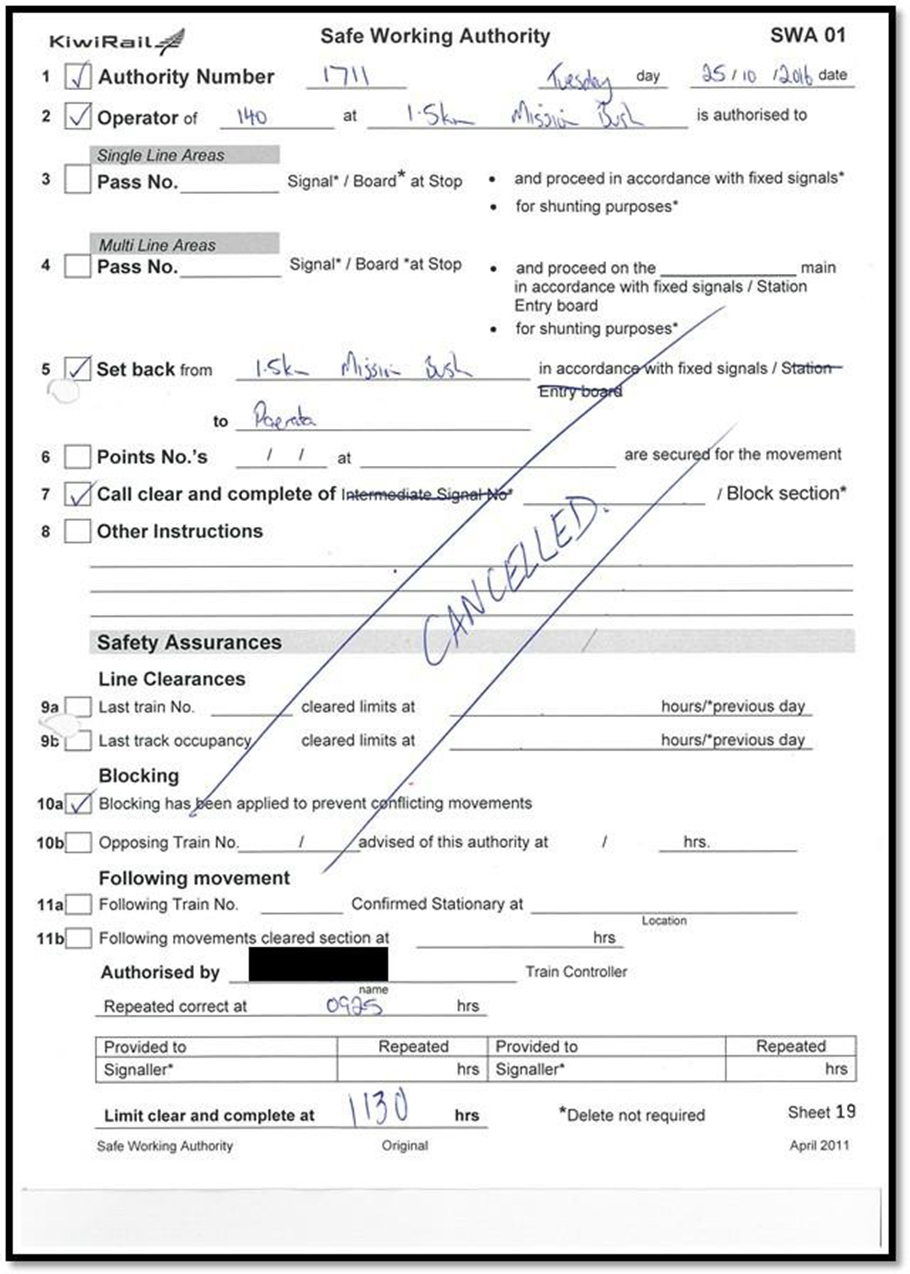
- At 0921 the train driver switched radio channels to communicate with train control. He reported that the pilot was in position, confirmed his location and requested authority to set back. The train controller issued verbal instructions to the driver, who recorded them on a Safe Working Authority form. At 0925 the train controller acknowledged that the driver had read back those instructions correctly. The authority authorised the driver to set back from the 1.5 km mark on the Mission Bush line in accordance with fixed signals to Paerata. The train controller said that [signal] blocking had been applied to prevent any conflicting movements. Analysis of the signal log output data showed that signal blocking had not been applied before the train controller authorised the setback movement. See Appendix 1: Safe Working Authority Number 1711, as recorded by the driver.
- The driver then switched back to the local radio channel to communicate with the pilot. He told the pilot that he had been issued with the authority to set back. They agreed on a radio protocol, where the pilot would transmit every 10 seconds during the setback movement and the driver had to stop the train if those radio transmissions ceased.
- On 19 September 2012, KiwiRail issued Special Bulletin 624, Hazard Alert – Rail Bridges, that required all rail personnel to avoid walking on rail bridge/viaduct sleepers and only use designated walkways and footways. Bridge 2 on the Mission Bush line had not been fitted with such footways, and for safety reasons field staff had been instructed by local management not to walk across this bridge.
- The train driver released the automatic brake and the setback movement started at 0927:10. The train gradually picked up speed and at 0929:33 it was travelling at 16 km/h when the rear wagon passed Signal 10R, which was displaying a red aspect (‘Stop’) (see Figure 3).

- Signal 10R was displaying red because an empty northbound passenger train was approaching Paerata on the NIMT. The coal train was required to stop at Signal 10R. However, because of the curve in the track the driver was not able to see the signal from his driving position at the head of the train. The pilot was also not able to see from where he was positioned beside 11 points that Signal 10R was displaying a ‘Stop’ indication (see Figure 4).

- Once the reversing train came into his view, the pilot relocated to the eastern end of the Branch Main, where he saw that the next signal, Signal 6RB, was displaying a red aspect. He immediately radioed the driver shouting, ‘STOP, STOP, STOP’. The train stopped at 0931:19, with the front of the locomotive some 80 m past Signal 10R and the rear-most wagon about 420 m short of Signal 6RB.
- Meanwhile, the train controller noticed on his display that the track past Signal 10R was now occupied. He checked on another computer screen and saw that the train was moving. He immediately made a radio broadcast to the train driver but the call was not responded to. He made a further attempt, this time stating, ‘Urgent, urgent, one, four, zero, one, four, zero, receiving?’. Again there was no response from the train driver.
- The northbound empty passenger train was travelling on the adjacent NIMT line and was passing Signal 6RA at the exact time that the setback train stopped (see Figure 5).

Drug and alcohol testing
- KiwiRail had introduced its post-incident drug and alcohol testing policy and associated procedures during 2009, with agreement from the Rail and Maritime Transport Union. The policy required employees directly involved in serious accidents and/or operating incidents to be asked to submit to testing.
- The KiwiRail national train control centre had a supporting document, Train Control, Traction Control and Signal Box Mandatory Relief and Support Matrix, which described the action to be taken when a train controller/traction controller/signaller’s action or inaction could have been a contributing factor in an occurrence. The matrix included a requirement for the train controller to undergo a drug and alcohol test when a train was authorised to set back without the correct authority.
Key personnel
The train driver
- The Te Rapa-based driver had gained certification to drive freight trains on 17 July 2015. On 22 August 2016, he had sat and passed seven separate theory revalidation papers, each with 10 multi-choice questions.
-
His most recent safety observation assessments had been carried out on 27 July 2016 and 19 September 2016. The observer had recorded the following comment at the conclusion of the latter assessment:
… [he] has a very cautious approach to signals at Stop, calls all signals.
-
The train driver said that he had not previously stalled a train on the Mission Bush line, but he was familiar with the setback procedure. He was aware that coal wagons were not fitted with safe riding positions, but thought that the pilot had been stationed to ensure the safety of the setback movement.
- The train driver had been off duty on Saturday 22 October 2016. He had worked a 9.25 hour shift from 0200 the next day, finishing at 1115. At 0200 on 24 October he had received a text message from the drivers’ roster centre asking him to phone back. He had done so and been told that his 0400 start shift had been cancelled, but he had been requested to start work as soon as possible to relieve the driver of a late-running train. He had been at work by 0230 and had worked a 13.25 hour shift, finishing at 1545.
- He said that he had been feeling a bit tired when he was woken by his alarm at 0315 to prepare for his scheduled 9.75 hour shift starting at 0400 on 25 October 2016.
- He underwent a KiwiRail post-incident drug and alcohol test, which returned a negative result.
The pilot
- The pilot was qualified to carry out piloting duties. His initial training for the Automatic Signalling Rules and Track Safety Rules had been provided on 10 April 2011. He had passed the respective theory examinations the same day.
-
KiwiRail could not provide the records for his two-yearly theory revalidations, which had been due before April 2013 and April 2015.
- He had been trained to pilot trains that had stalled on the Mission Bush line. During the practical training he had been instructed to not cross Bridge 2 because there were no handrails fitted.
- The pilot said that he had piloted trains on 20-30 previous occasions, assisting drivers of stalled trains to set back from about the 1.5 km mark along the Branch Main to the northbound line of the NIMT. He had always positioned himself beside the points before the train setback movement started, and train controllers had always set Signals 10R and 6RB to green for the setback movements.
- He underwent a KiwiRail post-incident drug and alcohol test, which returned a negative result.
The train controller
- The train controller’s certification was current. He had gained his initial certification on the East Coast Main Trunk line train control desk on 22 July 2010. On 7 June 2011, he had demonstrated competency to operate the Waikato and Taumarunui desk, which included the Mission Bush line. He had gained further certification to operate the Auckland metropolitan train control desk in mid-2012.
- His most recent desk observation assessment had been carried out on 13 September 2016. He had undergone a desk handover assessment on 21 September 2016. No areas of concern had been identified during these assessments.
- KiwiRail did not arrange for the train controller to undergo a post-incident drug and alcohol test. Train control managers had determined that there was no evidence that the train controller’s actions had breached any operating procedures.
Analysis Tātaritanga
Introduction
- Although there are commercial considerations for repeated train stallings on the Mission Bush line, a train stalling does not compromise safety provided there are good, safe procedures to effect a recovery and those procedures are adhered to.
- The following analysis outlines what happened and then discusses four safety issues that have implications for rail safety:
- the setback movement was not planned and carried out in accordance with the operating rules and procedures
- KiwiRail had not communicated effectively to staff about the replacement of an old procedure for recovering stalled trains at Paerata with the existing Operating Rule 124(d)
- the train controller, the train driver and the pilot did not have a shared understanding of the limit for the setback authority, or of the method for protecting the movement
- the train controller was performing a safety-critical role and was directly involved in the incident, yet he was not asked to undergo a post-incident drug and alcohol test.
What happened
Train stalling
-
Trains can stall for a number of reasons: train overloading; locomotive performance; driver skills; and low-adhesion track conditions. Low-adhesion track conditions are likely to occur when there is a combination of wet, windy weather and leaf drop onto the railhead (see Figure 6). These conditions were present on the morning of this occurrence.

Figure 6. Overhanging vegetation near the 1 km mark - KiwiRail operates three coal trains per weekday from Rotowaro to the Mission Bush Terminal. Each train consists of a single DL-class locomotive hauling 22 wagons. The tonnage hauled by a single DL-class locomotive from Paerata to Mission Bush was restricted to a maximum of 1,520 tonnes.
- The declared weight for the train was 1,470 tonnes, within 3% of the maximum allowable tonnage. The train was made up of three separate classes of wagon, each class with its own tare and maximum gross weight. An average gross wagon weight had to be used in the calculation of the train weight because there was no weighbridge for the wagons to pass over before departing. The actual gross wagon weight could vary due to the moisture level of the coal and the height to which each wagon was loaded, so the true train weight could not be determined accurately.
- There had been 33 reported train stallings on the Mission Bush line between 12 April 2015 and 25 October 2016, of which 26 had occurred within the first 2 km of the line. Further analysis showed that 23 of the 26 trains that had stalled were the first trains of the day.
-
KiwiRail reviewed the event recorder downloads from a number of trains that had stalled on the Mission Bush line. A common theme was that drivers had been maintaining notch 8 (maximum power demand) for too long.
- Following trials on the Mission Bush line in mid-2016, KiwiRail had developed and documented an optimum driving method for the DL-class, locomotive-hauled coal trains for best adhesion control under poor rail-adhesion conditions. This optimum driving method required a driver to make a brake application when the train speed fell to 30 km/h, then select a lower power demand at predetermined speeds as the train slowed further.
- A copy of the optimum driving method had been distributed by local management on an informal basis, without discussion and without conducting a formal safety assessment.
- The event recorder for the train involved in this incident showed that the driver entered the Link Road at the prescribed 45 km/h, then generally followed the optimum driving technique. He made a brake application when the train speed dropped to 44 km/h before reducing power demand as the train speed continued to fall.
-
Driver technique is therefore unlikely to have contributed to the stall. It was likely that the train weight exceeded the capability of the locomotive in the track-adhesion conditions.
- Following this incident KiwiRail reduced the maximum number of wagons permitted to be hauled by a single DL-class locomotive on the Mission Bush line from 22 wagons to 20. Since then there have been no further reports of train stallings (see paragraph 6.3).
Train recovery
- The train controller had three options for managing the recovery of the train:
- attach an additional locomotive to the head of the train
- attach an additional locomotive to the rear of the train
- authorise the train to set back along the Branch Main to the northbound line of the NIMT, under controlled conditions, before signalling its return on the longer and more gentle gradient on the Branch Main.
-
There were no other locomotives available, so the train controller decided to authorise a train setback movement. He knew that operating staff on duty at the Mission Bush Terminal were appropriately qualified and that they had assisted drivers of stalled trains many times before.
Procedure for setting back at Paerata on the NIMT towards Papakura
Safety issue – the setback movement was not planned and carried out in accordance with the operating rules and procedures.
- On 7 February 2012, KiwiRail had issued Semi-Permanent Bulletin 69, which deleted the Local Network Instruction, Section L1.1, Clause 6.1.4, Setting back at Paerata on the NIMT towards Papakura. A KiwiRail risk assessment had found that this and numerous other local instructions for setting back were adequately covered by the current Operating Rule 124, Propelling of Vehicles on Main Line.
- Special Bulletin 624, effective from 19 September 2012, required all rail personnel to avoid walking on rail bridge/viaduct sleepers and only use dedicated walkways and footways. With no dedicated footway fitted to Bridge 2, local operational management had interpreted the Bulletin to mean rail personnel were not to walk over this bridge and field staff were instructed accordingly. The pilot was positioned beside 11 points when the setback movement started and from that location could not see the ‘Stop’ indication displayed on Signal 10R.
- Trains stalling before reaching the 2 km mark on the Mission Bush line was not uncommon. More than 30 trains had stalled on that section of track in the 18 months before this incident.
-
Operating Rule 124 stated in part:
(a) A locomotive may propel a train or vehicle upon the main line when:
(ii) a train is stalled and has to set back
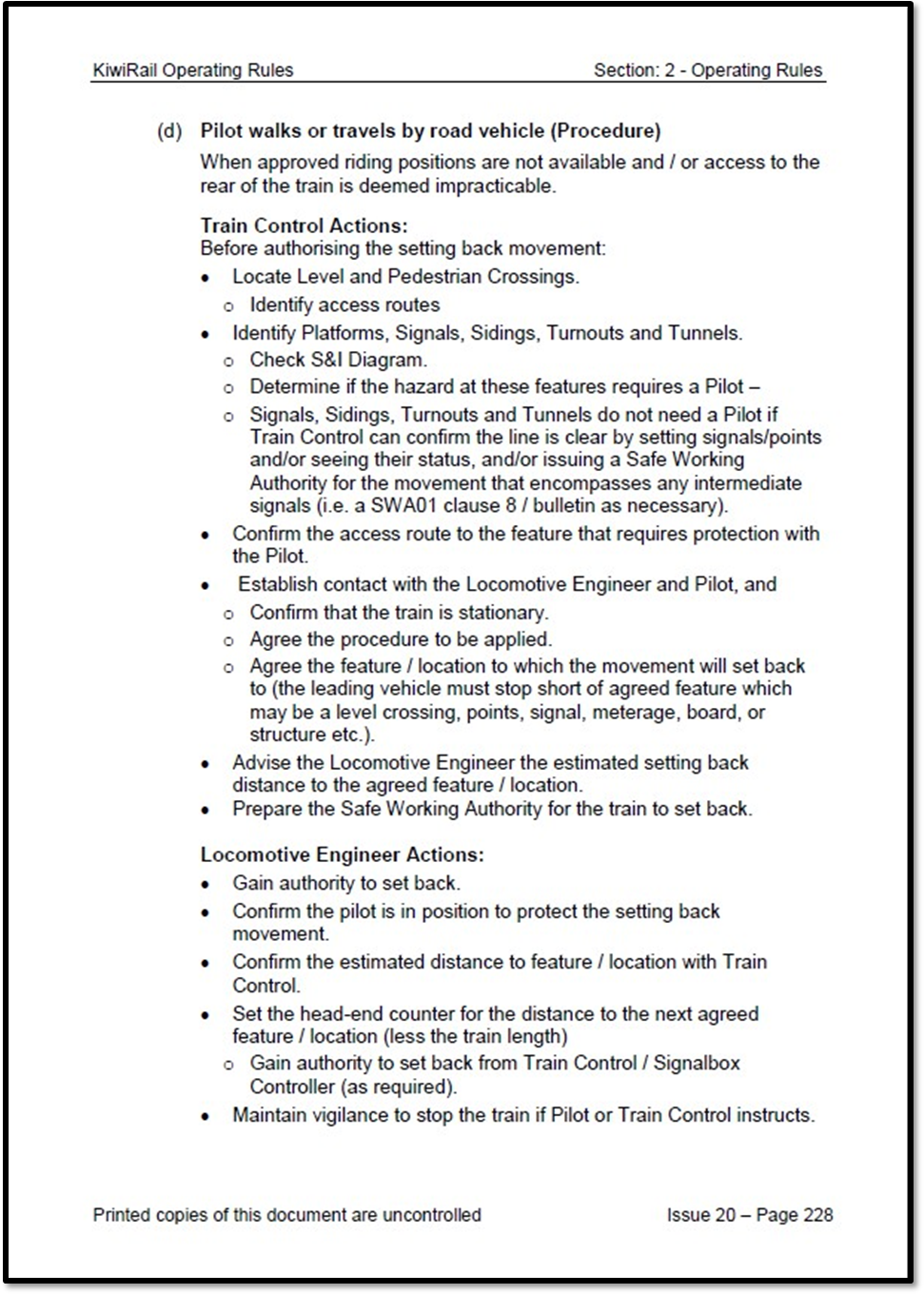
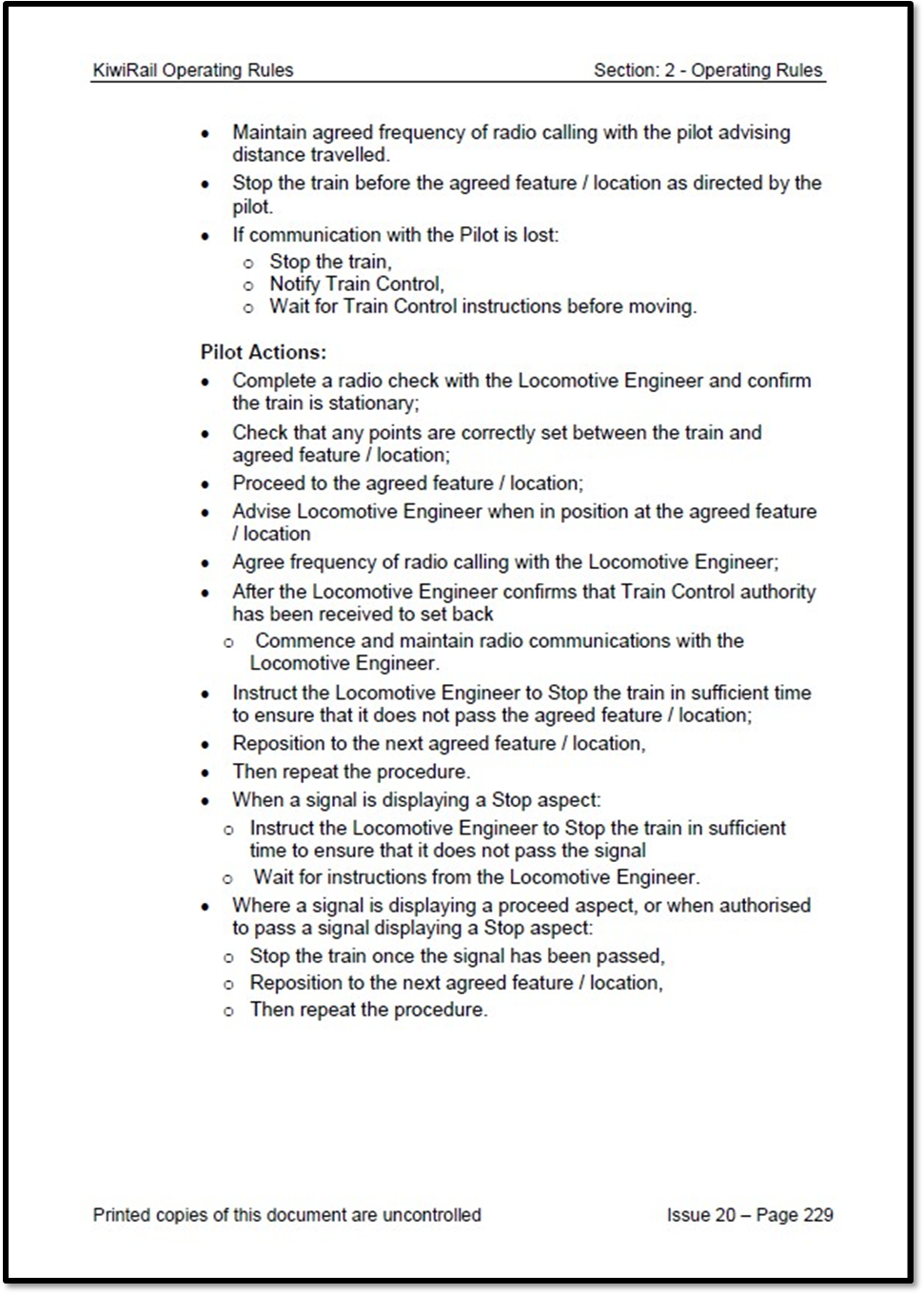
- The coal wagons on the stalled train were not fitted with safe riding positions. Under such conditions setback movements are carried out in accordance with Operating Rule 124(d) that requires the train controller, the driver and the pilot to carry out a number of checks before the train controller authorises the setback movement, including:
- all three confirming the access route to the feature that required protection with the pilot
- the train controller establishing contact with the driver and pilot and agreeing the feature/location to which the movement would set back (which could be a level crossing, points, signal, metrage, board, structure, etc)
-
the train controller advising the train driver of the estimated setting back distance to the agreed feature/location.
In this case, none of these checks was carried out before the movement authority was issued.
From the train controller’s perspective
- The train controller issued the movement authority as shown in Appendix 1. The Safe Working Authority form, in part, instructed the train driver to:
- set back from 1.50 km on the Mission Bush line in accordance with fixed signals to Paerata
- call ‘clear and complete of block section’.
- The train controller’s instruction. ‘in accordance with fixed signals’ contained in the movement authority, required that either the driver or the pilot sight all the signals, including Signal 10R.
- The train controller did not identify the feature/location when he stated the limit for the setback movement. ‘Paerata’ covered a wide area and therefore could not be considered a clearly identified feature or location for the purpose of this setback movement.
- The train controller had already given priority to the northbound empty passenger train through Paerata on the NIMT. In doing so, the signalling system had prevented him placing Signal 10R at ‘proceed’.
- At that time there were only two options available to the train controller if the KiwiRail procedures were to be followed. The first was to set back the train to Signal 10R, being the only clearly distinguishable feature. The second was to wait for the passenger train to clear the section so that he could change Signal 10R to green, at which time the train could set back to another clearly distinguishable feature within the Paerata area.
- An analysis of the signal logs showed that the train controller did not block any signals to prevent conflicting movements before he issued the movement authority, but he did so some four minutes after the train passed Signal 10R at stop and two minutes after the train had stopped. Instead he authorised the passenger train to enter the section of the NIMT that the coal train would have occupied had the pilot not seen the red aspect on Signal 6RB. It is a concern that the train controller told the driver that he had applied blocking to the signals when he had not.
- Had the train controller authorised the limit of the setback authority as Signal 10R, he would have needed the train driver to identify the precise location of the front of the stalled train so he could determine the distance of the intended setback movement. However, the distance from the rear of the stalled train to Signal 10R was only 401 m, so there was minimal benefit in doing this.
- Had the train controller stepped through the required procedure, it is highly likely that he would have realised that waiting until the passenger train had cleared Paerata would have been the logical choice. Had he done so, the incident would not have happened. Once the passenger train had passed, the train controller would have been able to set Signals 10R and 6RB to ‘proceed’, thereby enabling the stalled train to set back in one continuous movement past Paerata Station entry board number 1 (a clearly distinguishable feature) on the northbound line of the NIMT.
- Following the incident the train controller had difficulty recalling the specific requirements of Operating Rule 124(d) to the Commission investigators. The train controller had not undergone any special training in or assessment on Operating Rule 124(d) after the Automatic Signalling Regulations were introduced.
From the train driver’s perspective
- Operating Rule 124(d) required the train driver to carry out a number of actions, which included:
- confirming the estimated distance to the feature/location with train control
- setting the head-end counter for the distance to the next agreed feature/location.
- The train driver and the train controller did not agree on a clearly distinguishable feature to which the setback movement would be authorised. As a consequence, the distance to that feature was not provided by the train controller, and the train driver could not enter a parameter into the locomotive distance counter.
- The train driver was expecting to have green signals for the entire setback movement to Paerata for two reasons. The train controller had told the driver that he had applied blocking on the signals to prevent any conflicting movements and that he was required to call ‘train control’ when the train was clear and complete of the block section. The driver said that this was the first time that he had made the setback movement on the Mission Bush line and he had been told by other drivers that the setback movement never started without first having authority to pass Signal 10R.
- The driver displayed limited knowledge of the requirements of Operating Rule 124(d). He had only been driving for about 17 months at the time of the incident and had not driven a train that had stalled before.
From the pilot’s perspective
- According to the KiwiRail procedure, the pilot should have been issued with a radio capable of working on the train control frequencies. However, the pilot had been issued with a hand-held radio only capable of receiving and transmitting on the local channel. Consequently, he could not listen to the train controller issuing the authority for the setback movement over the ‘open’ radio channel or have radio communication with them. The procedure as described in Operating Rule 124(d) required the train controller, the driver and the pilot to agree on the procedure and the feature or location where the setback movement would terminate. This non-adherence to the procedure resulted in a lost opportunity for the incident to be prevented through the intervention of the pilot.
- Like the train driver, the pilot had assumed that the signals would be clearly displaying ‘proceed’ (green) for the entire setback movement. This was the first time out of about 30 that he had piloted such a movement when the the setback train had been required to stop at Signal 10R.
- His knowledge of Operating Rule 124(d) was limited, similar to the train controller and the driver. His perception was that all signals would be displaying green for the entire setback movement, which was a situation that he was used to. It could not be established whether he had been assessed for his knowledge of Operating Rule 124(d), as KiwiRail was unable to produce the records of his most recent assessments, which is a concern.
From KiwiRail’s perspective
Safety issue – KiwiRail had not communicated effectively to staff the replacement of an old procedure for recovering stalled trains at Paerata with the existing Operating Rule 124(d).
-
Neither the train controller, nor the train driver, nor the pilot was sufficiently familiar with KiwiRail’s Operating Rule 124(d), which had replaced the withdrawn local procedure for setting trains back at Paerata. When a change is made within an organisation, it is important that it is communicated effectively and checks are made to ensure it has been fully implemented.
- It is generally not sufficient to make a change, broadcast it by way of a Bulletin, and then assume that all staff will have read and fully understood what is required. This is particularly if it involves a change to a long-established procedure, and one that has implications for transport safety.
- This incident is an indication that KiwiRail’s system for change management could benefit from a review. A recommendation has been made to KiwiRail to address this issue. Since this incident, KiwiRail has revised its procedures to ensure that pilots are equipped with radios capable of transmitting and receiving on the open train control frequencies.
-
After this incident, KiwiRail issued a Special Bulletin on 3 November 2016, stating in part:
Trains stopping on the Mission Bush Branch between 0.00km (Paerata) and 11.80km (Glenbrook) MUST NOT setback/change direction.
Note; this is an interim instruction until a review is completed.
This Special Bulletin was still current at the time this report was published.
- The three safety actions taken by KiwiRail have effectively eliminated the risks posed by a train stalling and setting back on the Branch Main. Reducing the tonnage of the coal trains has reduced the frequency of trains stalling on the Mission Bush line. Prohibiting the setback procedure at that location has eliminated the hazards associated with piloting trains at a location where pilots have had difficulty positioning themselves where they can be the ‘eyes’ for the train drivers. Issuing the pilots with radios capable of receiving and transmitting on the train control frequencies will enhance communication between pilots, train controllers and train drivers in any operations requiring pilots.
Non-technical skills
Safety issue – the train controller, the train driver and the pilot did not have a shared understanding of the procedure that was to be followed and the limit for the setback authority.
- The Rail Safety and Standards Board of Great Britain define non-technical skills as, ‘the cognitive, social and personal resource skills that complement technical skills and contribute to safe and efficient task performance’. While technical skills describe what you need to do and know for a given safety-critical task, non-technical skills describe how you do that task. The non-technical skill components can be broken down further to sub-categories that include situational awareness, conscientiousness, communication, decision-making and action, co-operation and working with others, workload management and self-management.
- Analyses of incident and accident reports within the rail industry conducted by the Rail Safety and Standards Board showed that most errors that occurred related to people at the frontline (63%), rather than management (30%) and design factors (7%). Making mistakes is inevitable, but the use of non-technical skills has been shown to help mitigate and manage these errors. For example, Queensland Rail reported that trainee drivers who did not complete non-technical skills training were more than twice as likely to pass a signal at danger within their first month than those who had received the training. Similarly, Canadian Pacific Railway reported a 46% reduction in human-caused incidents following non-technical skills training.
- To carry out the train recovery movement in a safe manner at Paerata, all participants were required to have a common understanding and shared mental model of all aspects of the setback movement, but this was not the case.
- While the train driver was aware generally of the recovery procedure, he had not previously stalled a train at that location, so relied on the instructions given to him by the train controller.
- The train controller was clear in his mind that he had authorised the setback movement for the train to be carried out in accordance with fixed signals, and that was initially only to Signal 10R.
- The train driver had recorded on his movement authority that, ‘Blocking has been applied to prevent conflicting movements’. This led him to believe that he had been given the authority to set back to the northbound line of the NIMT.
- The train driver, after advising the pilot that he held a valid setback authority and agreeing on radio protocols, thought that the pilot was near the rear of the train and able to see all facing signals. In reality, neither of them was able to observe the displayed aspect. However, the driver had already discounted the possibility that the train controller had placed Signal 10R at ‘Stop’.
- A review of the train control voice recordings from the previous four train stallings on the Mission Bush line showed that the movement authorities had been to Station Entry Board 1 on the NIMT, as both the driver and the pilot were expecting on this occasion. It is essential that all parties are aware of, fully understand and comply with operating procedures when undertaking train recovery movements.
- Although the train controller had been certified on the Waikato desk for more than five years, he had not undertaken a site visit to the Paerata triangle and surrounds. He therefore had a limited understanding of the environment and challenges under which the field staff were working during the setback movement. Had he been more aware, he may have waited until the empty passenger train had passed through Paerata before authorising the setback movement.
- The Commission has raised the issue of non-technical skills training in three recent rail occurrence reports that are ready for publication. All these reports include a reference to an open recommendation made to the Chief Executive of the NZ Transport Agency during 2012. The recommendation required the practice of non-technical skills to be recognised within the National Rail System Standards.
- On 3 April 2017, the NZ Transport Agency stated that it was continuing to work with KiwiRail on this issue. It added that it had issued a safety improvement plan notice during December 2016 in accordance with section 36 of the Railways Act 2005, requiring KiwiRail to prepare a safety improvement plan to address the implementation of non-technical skills in its standard rail operations.
- At the time of publication the recommendation remains ‘open’.
Drug and alcohol testing
Safety issue – the train controller was performing a safety-critical role and was directly involved in the incident, yet he was not asked to undergo a post-incident drug and alcohol test.
- KiwiRail policy is that staff must present for work free from the influence of drugs and/or alcohol, including prescription and over-the-counter drugs. KiwiRail conducts drug and alcohol testing: pre-employment; when staff transfer from non-critical to safety-critical roles; following accidents and incidents; for reasonable cause; and on a random basis.
- KiwiRail requires all personnel directly involved in accidents or incidents to submit to drug and alcohol test procedures. Personnel are required to sign forms consenting to the tests. The alcohol test is to be conducted within one hour of an occurrence and a urine sample collected for the drug test within three hours of it.
- In this case, the train driver and the pilot were tested and found to be clear. However, the train controller was not asked to submit to drug and alcohol testing, even though he was directly involved in the incident and was performing a safety-critical role.
- It will not always be immediately apparent whether a person’s actions or inactions have contributed to an occurrence. It sometimes only becomes apparent during an investigation. For this reason, managers should not be able to exercise discretion about whether their staff are asked to submit to drug and alcohol testing. All safety-critical staff involved in the circumstances of an accident or incident should be tested. A recommendation has been made to KiwiRail to address this issue.
Appendix 1: Safe Working Authority Number 1711
Appendix 2: Operating Rule 124(d) – Pilot walks or travels by road vehicle