Two Dash-8 passenger aircraft avoided collision on approach to Wellington Airport (saved by human and last-defence automated systems) after one Dash-8 followed the wrong lead aircraft. Nobody hurt, no damage. All safety issues addressed, so no new recommendations
Executive summary Tuhinga whakarāpopoto


What happened
- On 12 March 2019, three aeroplanes on scheduled passenger flights were sequenced to land on Runway 34 at Wellington International Airport. The first aeroplane in the sequence, an Airbus A320, was approaching from the south-west. The other two aeroplanes, both Bombardier DHC-8-311s (Dash-8s), were joining from the north-east.
- When the first Dash-8 aeroplane (callsign LINK235) was parallel with the runway, the flight crew requested approval for a visual approach, rather than a full instrument procedure. This was approved and the aeroplane continued downwind to position behind the A320.
- The second Dash-8 (callsign LINK285), following about two minutes behind the first, also requested a visual approach. This was approved to follow the first Dash-8. However, the second Dash-8 identified the A320 as the Dash-8, then turned towards the runway to position behind the A320. This put it into a conflicting flight path with the first Dash-8.
- As the two Dash-8s approached each other, the air traffic controllers were alerted to a potential conflict by an automatic short-term conflict alert warning presented on their radar displays. The approach controller tried to resolve the conflict but could not contact the second Dash-8. They then contacted the Wellington tower controller. The Wellington tower controller broadcast a message to resolve the conflict. At about the same time the respective Dash-8 flight crews saw each other, and both took evasive action to ensure adequate separation was maintained. While taking this evasive action, the flight crews of both Dash-8s received automatically generated, traffic-collision-avoidance alert messages from their onboard systems that advised them to take evasive action to avoid conflict.
- Both Dash-8 flight crews avoided the potential conflict and all three aeroplanes landed without further incident.
Why it happened
- The Transport Accident Investigation Commission (Commission) found that the crew of LINK285 mistakenly identified another aeroplane in the sequence to land for the preceding aeroplane they had been instructed to follow. The Commission found that the flight crew had insufficient situational awareness in relation to their position in the circuit pattern before they took on the responsibility of maintaining their visual separation from the aeroplane ahead. The lighting and visual conditions prevailing at the time made it more difficult for the LINK285 flight crew to visually identify the preceding aeroplane, and they had not used other means they had available to validate their visual interpretation.
- In addition, the Commission found that the automatic and human defences incorporated into the air traffic control and aircraft systems detected the potential conflict and prevented the situation escalating.
- The Commission found three safety issues. Two safety issues were related to the situation where a flight operating under instrument flight rules changed to make a visual approach to land. The first of these was that critical information for a flight crew to conduct a visual approach was not required to be passed on to the flight crew. The second was that air traffic control procedures could create a situation where an approach controller would be unable to contact a flight crew when the controller was still responsible for monitoring that flight crew’s compliance with an instruction. A third safety issue was that, after a serious incident, the operator’s current practice allowed potentially critical evidence contained in two separate aircraft cockpit voice recorders to be lost.
- The Commission considered that the actions taken by the respective operators adequately addressed these safety issues, so has not made any safety recommendations.
What we can learn
- The visual identification of other aircraft can be challenging. Pilots should use all available resources to build situational awareness.
- When a controller issues a clearance, it is important to monitor the flight crew’s initial compliance to check it has been interpreted as intended.
- Traffic Collision Avoidance System equipment is an effective defence against mid-air collisions, and its display is also a useful instrument that flight crew can use for their situational awareness.
Who may benefit
- Commercial pilots, air service operators, air traffic service providers and air traffic controllers will benefit from this report.
Factual information Pārongo pono
Narrative
- On 12 March 2019 at 1732 (times are in New Zealand daylight time (co-ordinated universal time + 13 hours) and expressed in the 24-hour format), three aeroplanes on scheduled passenger flights were sequenced to land on Runway 34 (runways are identified by their magnetic alignment, rounded to the nearest 10° increment. Runway 34 is aligned about 340° magnetic) at Wellington International Airport. The first aeroplane in the sequence, was an Airbus A320. Two Bombardier DHC-8-311 (Dash-8) aeroplanes operated by Air Nelson (the operator) were conducting a visual approach (an approach to a runway at an airport conducted under instrument flight rules, but where the pilot proceeds by visual reference with the ground and clear of clouds to the airport) under instrument flight rules (rules that allow a properly equipped aircraft to be flown under instrument meteorological conditions (conditions expressed in terms of visibility, distance from cloud, and ceiling less than the minima specified for visual meteorological conditions)) (IFR) to follow the Airbus. The rear aeroplane in the approach sequence of three mistakenly turned base early; this set its flight path to conflict with the aeroplane ahead.
- The air traffic controllers were alerted to the potential conflict but were unable to contact the rear aeroplane’s flight crew. The onboard Traffic Collision Avoidance Systems (a Traffic Collision Avoidance System is based on secondary surveillance radar (SSR) transponder signals, and operates independently of ground-based equipment to provide advice to pilots on potential conflicting aircraft that are equipped with SSR transponders) (TCASs) fitted to the Dash-8 aeroplanes detected the potential for a collision and issued TCAS Resolution Advisory (an indication given to flight crew recommending a manoeuvre intended to provide separation from all threats; or a manoeuvre restriction intended to maintain existing separation) (TCAS-RA) messages to the flight crews to take evasive action. A collision was avoided and both aeroplanes landed without further incident.
- Both aeroplanes were scheduled passenger flights operating under IFR in Class C airspace (Class C airspace is a type of controlled airspace. For more details see Civil Aviation Rule 71.105. https://www.aviation.govt.nz/assets/rules/consolidations/Part_071_Consolidation.pdf).
The approach sequence
- The two Dash-8 aircraft were following an IFR approach on a standard arrival route (STAR) called DOGAD THREE ALFA to Runway 34 (see Appendix 1). The last phase of the STAR from the TURAK waypoint was changed to a visual approach with a standard right-hand joining pattern. This continued the downwind leg from TURAK followed by a right turn onto the base leg then right again onto a final leg that would line up the aeroplane for the runway centreline (see Figure 3). The circular marked points in Figure3 identify waypoints used by air traffic controllers to manage air traffic in their areas. In this incident a third aeroplane was sequenced ahead of the two Dash-8 aeroplanes. The approach controller had set the landing sequence for Runway 34 with an Airbus A320 (JST290) as ‘number one’, the Dash-8 LINK235 (this report has referred to the aircraft involved by their call signs rather than their flight numbers to match extracts taken from controller recordings) as ‘number two’ and the rear Dash-8 LINK285 as ‘number three’.

Positions immediately before the conflict
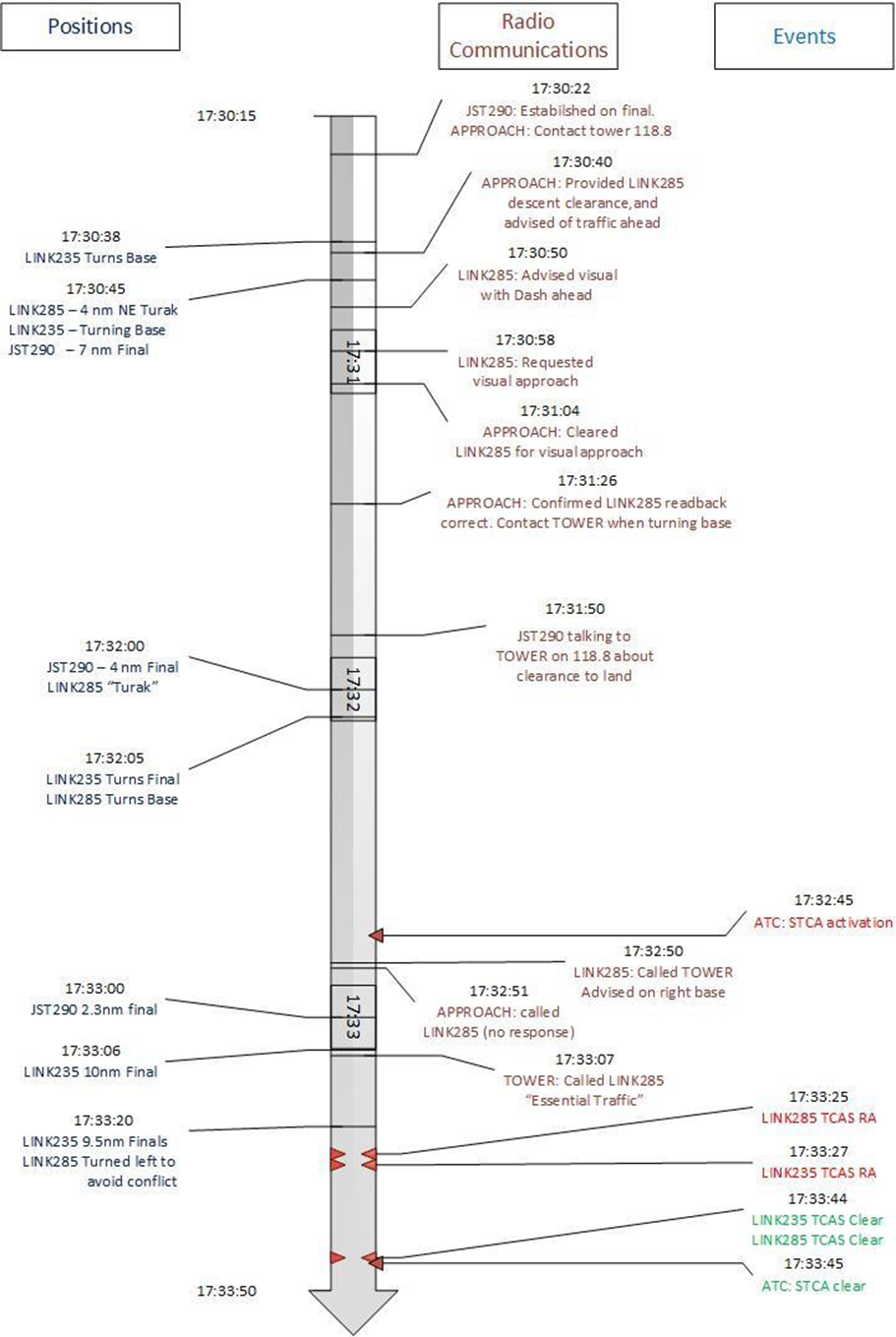
- The following descriptions are of the aircraft positions at 1730:45 as shown in Figure 4. A more detailed timeline is provided for reference in Appendix 2.
JST290 (No.1)
- The first aeroplane in the approach sequence was JST290, an Airbus A320 scheduled flight from Christchurch to Wellington. JST290 was cleared to approach via a different STAR from the south-west to land on Runway 34.
- At 1730:45 JST290 was established on its final approach and about seven nautical miles (distances in aviation are measured in nautical miles. One nautical mile =1.852 kilometres) (nm) from the threshold of Runway 34. It was on a northerly heading, descending through an altitude of 2,275 feet (altitude is referenced to feet above mean sea level, in accordance with Annex 2 to the Convention on International Civil Aviation).
LINK235 (No.2)
- The second aeroplane in the sequence was LINK235, a Dash-8 scheduled flight from Rotorua to Wellington. LINK235 had been cleared to approach from the north-east via the DOGAD THREE ALFA STAR.
- LINK235 was following the STAR when the Wellington approach controller advised that a visual approach11 was available. Once the flight crew of LINK235 were satisfied that visual conditions were suitable, the pilot flying requested a visual approach (Civil Aviation Rules Part 172.255 provides for visual separation between aircraft provided that a specific request is made by the pilot) to Runway 34. This would require the flight crew to maintain their own visual separation from the aircraft ahead. The controller cleared LINK235 for a visual approach behind JST290, routing via the LYALL (this was an historic waypoint but no longer used formally. See section 2.42 for an explanation of the history of this waypoint) waypoint with the instruction to contact Wellington tower when turning base.
- After passing over the TURAK waypoint, LINK235 turned onto a southerly heading to extend downwind to sequence behind JST290. At 1730:45 LINK235 was approximately 3.5 nm south of TURAK at an altitude of 3,950 feet.

- LINK235 then turned right onto the base leg to intercept the extended runway centreline, and changed the active radio frequency to contact Wellington tower.
LINK285 (No.3)
- The third aeroplane in the approach sequence was LINK285, a Dash-8 scheduled flight from Gisborne to Wellington. LINK285 had also been cleared to approach from the north-east via the DOGAD THREE ALFA STAR. At 1730:45 LINK285 was 4.3 nm north-east of TURAK, on a south-westerly heading at 6,800 feet.
- The approach controller gave LINK285 a standard descent clearance to continue along the STAR. That clearance was followed with a description of the traffic ahead: “… and the company Dash just turning onto base, ahead of you by about 6 miles”. The crew responded with, “Visual Dash ahead, LINK285.” This was positive confirmation to the controller that the flight crew had seen and identified the relevant aeroplane ahead.
- The approach controller offered the option of a visual approach: “is available to follow. Advise?”. The flight crew of LINK285 then requested a visual approach.
- The approach controller’s clearance for the visual approach required LINK285 to “extend downwind as required to follow the Dash-8 ahead then to route via LYALL”. After confirming the readback was correct, the approach controller said, “When turning base leg, contact Wellington tower on 118.8 [megahertz].” The approach controller then attended to another aircraft on their screen that was approaching from the south-west.
- LINK285 flew over the TURAK waypoint at 1732:00 then commenced a right turn onto the base leg and changed radio frequency to contact the tower controller.
Air traffic control short-term conflict alerts
- LINK285’s right turn onto the base leg brought it into potential conflict with LINK235. The conflicting flight paths triggered short-term conflict alerts (STCAs) at 1732.45 on the approach controller’s and Wellington tower controller’s screens, which drew their attention back to LINK285.
- Approach and tower controller radar displays (see Figure 5) show outlines of the terrain overlaid with the controlled airspace boundaries. Aircraft within an approach controller’s area of responsibility are displayed as moving targets, representing their actual positions. A data block was displayed for each target with relevant information related to that target (such as the flight call sign, altitude, speed, aircraft type, destination, flight plan and controller’s notes). A two-minute speed vector shows where the target will be in two minutes at the current speed and heading.

- An STCA (or ‘CA’ in Figure 5) is a software conflict alert system built into the air traffic control (ATC) system. The system constantly monitors aircraft predicted trajectories and raises a conflict alert on a responsible controller’s display if any target vectors are convergent (Airways Corporation of New Zealand Manual of Air Traffic Services (MATS), Rules of the Air and Air Traffic Services (RAC) 6, section 23).
- Five seconds after the STCA (at 1732:50), LINK285 broadcast on the Wellington tower frequency that it was “right base for 34, visual approach, visual Dash ahead”.
- The approach controller attempted to call LINK285 on the approach frequency at 1732:51, but the flight crew were not monitoring it at that time. The approach controller then contacted the tower controller by phone, at 1732:55.
- The tower controller answered the telephone call from the approach controller and did not respond to the radio call from LINK285.
- On the conclusion of the phone call between the controllers, the tower controller broadcast at 1733:07 to LINK285: “Essential traffic on your left is a Dash-8 on a nine-mile final [approach] descending through 2,400 feet, maintain 3,000 feet.”
- The flight crew of LINK285 did not respond on the radio to the ‘essential traffic’ warning from the tower controller, but commenced a left-hand turn to the south within 10 seconds of that call.
- A subsequent attempt by the approach controller to contact LINK285 on the approach frequency also went unanswered.
TCAS Resolution Advisory
- At 1733:25, five seconds after commencing the left turn, LINK285’s onboard TCAS issued an audible message (Resolution Advisory) to the flight crew to “climb climb”. At the same time the TCAS on board LINK235 issued an audible message (Resolution Advisory) for that flight crew to “descend, descend”. The flight crews of both LINK235 and LINK285 took evasive action as directed by their TCASs.
- LINK235 advised the tower controller of a TCAS-RA, which the tower controller acknowledged. LINK285 then acknowledged the same by stating its call sign, “LINK285”.
- Air traffic radar records showed that the two aeroplanes came within 0.8 nm (1.5 km) of each other horizontally and 475 feet (145 m) vertically.
- At 1733:44 LINK235 advised the tower controller that it was clear of conflict. That was followed immediately with a similar message from LINK285.
- The tower controller then instructed LINK285 to contact the approach controller on 122.3 MHz and for LINK235 to continue on to land.
- 122.3 MHz was a published Wellington alternate approach frequency on the STAR. At the time it was being used by the departure controller, who sat immediately adjacent to the approach controller at the Wellington control desk in Christchurch. The departure controller was aware of the STCA incident due to their proximity to the approach controller, and immediately assumed control of LINK285 without comment. The departure controller directed LINK285 to continue heading south, then repositioned it for a visual approach behind LINK235. Once LINK285 was established on its final approach, it was passed back to the tower controller for a landing clearance.
- All aeroplanes involved landed without further incident.
Personnel information
Pilot experience

Controller experience
- The approach controller had more than 20 years’ experience as a controller at the time of the incident. The approach controller was located at the Christchurch national ATC centre at the Wellington sector control workstation. Three controllers operated that workstation.
- The tower controller had more than 20 years’ experience as a controller at the time of the incident. The tower controller was located in the Wellington control tower near Wellington Airport.
Aircraft information
Dash-8
- LINK235 and LINK285 were both Bombardier DHC-8-311 aeroplanes being operated by Air Nelson. The Bombardier DHC-8-311, commonly called a Dash-8 after its developmental history, is a twin-engine turboprop aeroplane operated by two pilots and with seating capacity for 50 passengers.
- Both aeroplanes were fitted with Collins TCAS-94 TCAS II, Traffic Alert Collision Avoidance Systems (TCAS IIs).
A320
- The A320 was a twin-turbine passenger jet aircraft manufactured by Airbus and operated by Jetstar Airways, with a seating capacity of 180.
Meteorological information
- The Wellington aerodrome automatic terminal information service (ATIS) broadcast the conditions at the time as:
- surface wind 340° magnetic at 14 knots19 varying between 280° magnetic and 360° magnetic
- cloud broken (5/8ths – 7/8ths coverage) with the cloud base at 1,700 feet
- visibility 20 kilometres
- temperature 21° Celsius
- dew point 16° Celsius
local barometric pressure (QNH) 1,015 hectopascals.
- Sunset on 12 March 2019 was at 1947. At 1730:45 the sun was low in the west at 24° above the horizon.
Aerodrome and airspace information
- Wellington International Airport is located on the south-east side of Wellington city (see Appendix 1). The airport has a single runway aligned approximately north to south named runway 34 or 16 respectively. The terminal control zone extends from the surface to 2,500 feet, and 10 nm to the south.
- The Wellington terminal area sits above the control zone and provides defined air corridors to the control zone from upper cruising levels. Both these sections of airspace are designated Class C.
Lyall waypoint
- The LYALL waypoint was a GPS waypoint located six nm from the threshold of Runway 34. It was a flyby point used to establish a standard route on a visual approach. It was once published on a visual arrival chart, but that chart has since been discontinued. It also existed as a designated waypoint but was not depicted on any approach charts. Controllers used it for domestic traffic.
- Air New Zealand advised that LYALL was not programmed into the Q300 or ATR72 flight management systems. Flight crew must rely upon crew knowledge and experience when ATC issued a clearance through LYALL and it required the crew to manually program the point rather than selecting a pre-set waypoint. The final fix (point F134) for an instrument landing to Runway 34 was 0.2 nm away from LYALL and sometimes used instead.
- Airways reviewed the LYALL waypoint after this incident and it has since been deleted from the Air Navigation Register.
Traffic Collision Avoidance System (TCAS)
- The Collins TCAS-94, TCAS II identifies and displays potential and predicted collision threats. The system protects a volume of airspace around an aircraft by interrogating transponders20 in nearby aircraft and provide appropriate aural and visual advisories to a flight crew when another aircraft is predicted to infringe on the protected airspace.
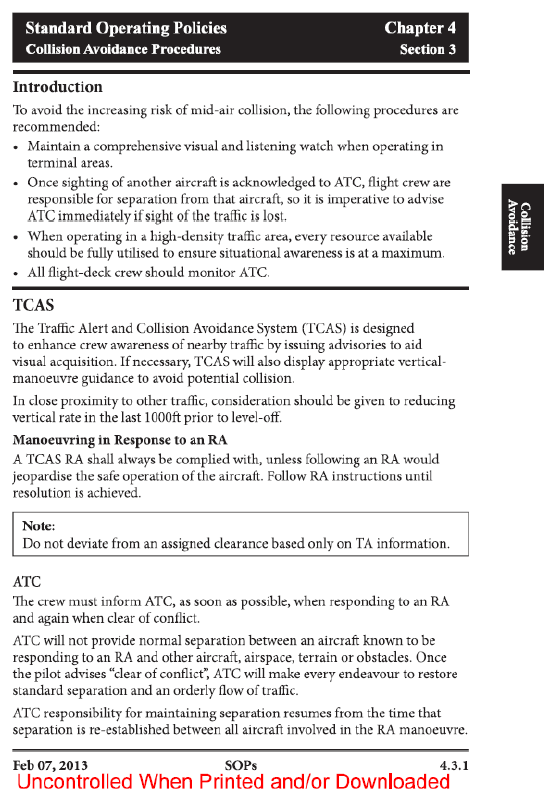
- TCASs provide two advisory levels to flight crew. The first advisory level, Traffic Advisory, displays and annunciates the relative positions of intruding aircraft that are 12 nm (approximately 40 seconds) from the closest point of approach. A TrafficAdvisory provides the flight crew with adequate time to visually locate the intruding aircraft and initiate evasive manoeuvres. The second advisory level, Resolution Advisory, displays and annunciates a vertical manoeuvre that increases separation when the intruding aircraft is approximately 25 seconds from the closest point of approach. When in receipt of a TCAS-RA the flight crew must initiate evasive manoeuvres based on the TCAS-RA unless compliance is unsafe (Air New Zealand Flight Crew Operating Manual Vol. 2). If both aircraft have TCASs, the equipment coordinates avoidance advisories to maximise separation, for example by instructing one aircraft to climb and the other to descend.

Visual approach under IFR
- Under an IFR approach procedure, the flight crew may request to fly all or part of the procedure by maintaining their own visual separation from other aircraft, rather than continue with the published procedure where the controller provides the separation. Approval is conditional, among other things, on certain meteorological conditions existing. In this incident, changing to a visual approach meant that the last two waypoints, RONGO and UMAGA (see Appendix 1), could be excluded.
- Visual approaches while under IFR are available at controlled aerodromes when meteorological conditions are suitable. The benefits can include reducing controller and flight crew workload and reducing time and costs with a shorter flight path over the ground. One consequence of changing to a visual approach is the flight crew should have a full appreciation of their position in the sequence and take responsibility for their own separation from aircraft they have been instructed to follow.
-
The air traffic rules for IFR flight are based on internationally agreed standards and recommended practices, which are then usually incorporated into local rules for each jurisdiction. New Zealand aligns the Civil Aviation Rules for air traffic management with ICAO’s standards and recommended practices prescribed in Annex 11 and 2 to the Convention. These Annexes govern the application of the Procedures for Air Navigation Services – Air Traffic Management (Doc 4444) and the Regional Supplementary Procedures – Rules of the Air and Air Traffic Services (Doc 7030), which are incorporated into Airways’ Manual of Air Traffic Services. The International Civil Aviation Organization (ICAO) Document 4444, Procedures for Air Navigation Services, states that:
6.5.3.1… clearance for an IFR flight to execute a visual approach may be requested by a flight crew or initiated by the controller. In the latter case, the concurrence of the flight crew shall be required.
6.5.3.4 Separation shall be provided between an aircraft cleared to execute a visual approach and other arriving and departing aircraft.
6.5.3.5 For successive visual approaches, separation shall be maintained by the controller until the pilot of a succeeding aircraft reports having the preceding aircraft in sight. The aircraft shall then be instructed to follow and maintain own separation from the preceding aircraft (ICAO Doc 4444, 16th edition, 2016, p.133) (ICAO, 2016).
- ICAO Document 4444 is incorporated into the New Zealand publications to define airspace control in this country. Airways Corporation of New Zealand (Airways) provides a Manual of Air Traffic Services (MATS) for guidance for its controllers. MATS states that the controller is responsible for ensuring that “there is no possibility of incorrect identification” when giving clearance to operate by visual separation (MATS 202.2 Visual separation beyond the vicinity of aerodromes).
-
MATS also states that:
when requiring a pilot to sight another aircraft prior to the application of visual separation, controllers shall provide such of the following information that is available and appropriate to the situation:
- Aircraft type
- Position of the other aircraft relative to a navigation aid or prominent geographic feature, a procedure or traffic circuit being flown, or a relative bearing (clock reference) and distance
- Level information, relative height, or Mode C24 readout
-
Any other pertinent information such as direction of flight, company name, colour, intentions, etc. in circumstances where there might be a possibility of error in sighting the correct aircraft.
Due to recognised difficulties in sighting another aircraft, such as size, colour, aspect, speed, sun position, background contrast, etc., controllers should not give sighting information until the aircraft are known or believed to be within 10nm of one another.25
ATC separation responsibilities
- Airways has standard operating procedures (Wellington Terminal Procedures, 28 February 2019, RAC part 2, sections A and C) for the control of aircraft movements in and out of Wellington and for the handover of control responsibility to each IFR aircraft as it crosses control boundaries.
- When IFR aircraft are sequenced to land at Wellington, the approach controller determines the sequence and is responsible for separation between these aircraft until landing. An exception to this exists when an IFR aircraft has been cleared for a visual approach and has agreed to follow a preceding IFR aircraft, in which case the responsibility for separation is passed to the flight crew of the following aircraft. Aircraft on a visual approach can be released from approach control to tower control by various means, allowing tower control to resolve conflicts with VFR traffic in the control zone.
- The tower controller takes responsibility for providing visual separation within 5 nm of the threshold, but only to ensure that the runway is clear and available for each aircraft sequenced to land. The tower controller issues the sequenced aircraft a clearance to land if the runway is clear.
- The flight crew on a visual approach are responsible for maintaining their separation from the aircraft they have been directed to follow, including for wake turbulence. They are also required under right-of-way rules (Civil Aviation Rules 91.229) to maintain a visual lookout at all times to see and avoid other aircraft.
- In this incident, LINK285 was still within the approach controller’s area of responsibility to maintain IFR separation between it and other aircraft when the STCA and TCAS events occurred.
Recorded data
- The flight data recorder (FDR) data records of both aeroplanes were downloaded under the Transport Accident Investigation Commission’s (Commission’s) supervision. These records covered the entire incident flights for both aeroplanes.
- The cockpit voice recorder (CVR) systems fitted in both aeroplanes were capable of recording two hours of crew communications in a continuous loop format (this was for the cockpit-area microphone and combined individual channels. The captain, first officer and public address channels were on a 30-minute cycle). The previous recording was progressively overwritten by the next two-hour period. The CVRs in both aeroplanes were not disabled until the end of the next leg. As a result the incident flight record for LINK285 was lost and only the last 12 minutes of the incident flight for LINK235 were available for analysis.
- Airways provided recorded surveillance data compiled from Secondary Surveillance Radar (SSR) and Automatic Dependent Surveillance-Broadcast (ADS-B) flight tracking data, audio recordings and images of the radar controller’s display screens to the Commission for analysis.
Analysis Tātaritanga
Introduction
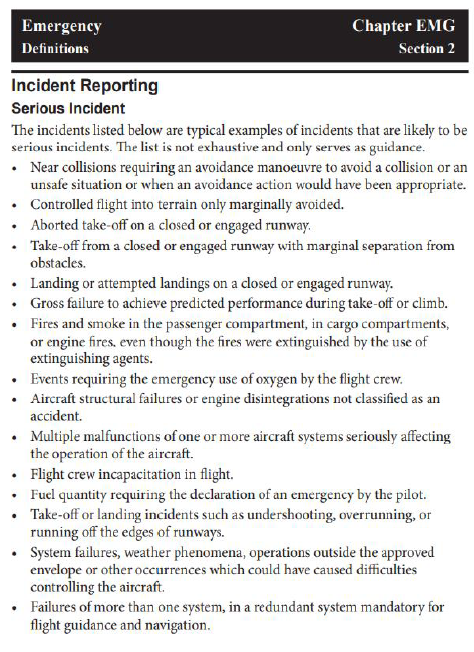
- The main purpose of controlled airspace, air traffic control and IFR is to create safe pathways for air traffic and to avoid potential collisions. Therefore, when two aircraft converge too closely in controlled airspace, causing the activation of aircraft or ATC-based alerts, it is classified as a serious incident.
- This incident resulted in a STCA alert to the air traffic controllers followed by a TCAS-RA warning to the two flight crews involved. The automated activation of these important safety warning systems is evidence that they worked correctly in the background and as intended to prevent accidents.
- The potential aircraft conflict was detected and avoided. The two aircraft subsequently landed without further incident and the passengers were very likely unaware of what had occurred.
- This analysis examines the circumstances and events leading up the TCAS activation and why the aeroplanes were on conflicting flight paths within controlled airspace. It looks at the circumstances and factors that increased the likelihood of the event occurring and those that were intended to prevent the incident. It also considers if any safety issues exist that could have the potential to adversely affect future operations.
- Three safety issues were identified:
- the approach sequence position is critical information for pilots conducting visual approaches under IFR, but controllers are not required to provide that information in a visual approach clearance
- the association of radio handover to a tower controller with other clearance actions can result in an approach controller losing radio contact with IFR traffic in their sector
- the operator did not preserve and protect potentially critical evidence contained in the CVRs immediately after this serious incident (an incident with a high probability of leading to an accident. A sample list is provided in ICAO Annex 13, Attachment C (ICAO, 2016)).
What happened
- LINK285 was following a STAR to Runway 34 when the approach controller advised that a visual approach would be available. The weather at the time was suitable for a visual approach into Wellington and the flight crew had visually identified an aeroplane ahead.
- The pilot flying subsequently requested a visual approach. Once approved, the pilot set a course to follow the aeroplane they had identified ahead.
- The flight crew of LINK285 had mistakenly identified JST290 as the aeroplane ahead that they were to follow in the STAR procedure. They had not seen LINK235, which was also ahead and was the aeroplane they were meant to follow. The flight crew proceeded to position LINK285 with appropriate separation, behind JST290. They turned onto the base leg and changed frequency, then called Wellington tower in accordance with their clearance.
- This movement took LINK285 onto a flight path that would conflict with LINK235’s flight path, and it activated the STCA. The STCA drew the approach controller’s attention back to LINK285, just as it was intended to do. As the flight crew had changed to the tower frequency, the approach controller could not make radio contact with LINK285.
- In the meantime, LINK235 was on its final approach behind JST290. The flight crew were scanning their instruments and saw the other Dash-8 appear on the TCAS display within their airspace and approaching from their right-hand side. They were planning to descend below glideslope to increase separation clearance.
- The crew of LINK285 reported to the Commission that they saw an unexpected aircraft on a conflicting flight path from their left and that they immediately commenced a left turn to avoid it. The flight recorder data confirmed that the aeroplane started a left turn approximately five seconds before the TCAS-RA activation.
- The left turn by LINK285 initially brought the two aircraft into more direct conflict, but as the turn progressed it took them further apart. The TCAS activated in both Dash-8s, and the respective flight crews took action as the systems directed to avoid the conflict.
Responsibility for separation of aircraft
- There are several safety barriers to prevent regular passenger transport aircraft flying too close to other aircraft. Pilots and air traffic controllers are responsible for managing the safety barriers that are applicable to their operational areas. In this case the first responsibility was with the approach controller. In Class C airspace, the controller is responsible for maintaining separation between IFR aircraft and between IFR aircraft and all other air traffic. This changed when the flight crew of LINK285 decided to accept responsibility for their separation from the aircraft ahead and conduct a visual approach. The approach controller’s responsibility was now to monitor that LINK285 was complying with their instruction, so maintained a general awareness of LINK285’s progress.
- Once the flight crew of LINK285 were cleared for the visual approach, they were primarily responsible for ensuring their own separation from the aeroplane they had been instructed to follow. For this to work, they had to identify the correct aeroplane to follow. When the flight crew misidentified the aircraft ahead and followed the wrong aeroplane, the remaining safety barriers came into effect.
- The next safety barrier to take effect was the automatic STCA. It was successful in detecting a potential conflict between LINK285 and LINK235 and in drawing the attention of both the approach and the tower controllers to it in sufficient time for the approach controller to act. However, the approach controller was unable to contact LINK285 on the radio because the flight crew were in the process of transitioning from approach to tower frequency as instructed and were no longer monitoring the approach controller’s frequency. This delayed the approach controller in re-establishing contact and potentially issuing traffic information or instructions to resolve the conflict.
- The tower controller was also aware that the STCA had activated and was assessing the situation. When the STCA activated, LINK285 had not yet contacted the tower controller. Normal procedure for handover between controllers is that aircraft released to the tower will have a suitable form of separation in place with no action required by the tower controller. The STCA created doubt for the two controllers about the sequence and separation.
- The next safety barrier to take effect was the tower controller advising LINK285 of ‘essential traffic’ in its vicinity. This call was initiated by the approach controller’s telephone conversation with the tower controller. It was successful in further raising the LINK285 flight crew’s awareness of the conflict. The tower controller’s message included guidance actions for the flight crew to avoid the conflict.
- The next safety barrier to take effect was the ‘see and avoid’ actions of the respective flight crews. These were also effective, as the flight crews of LINK235 and LINK285 saw each other and initiated their own avoiding action slightly before their respective TCASs had warned them of the potential conflict.
- The last safety barrier to take effect was the TCAS. It worked as designed and alerted both flight crews to a potential mid-air collision and provided visual and aural instructions for them to avoid it.
How did the flight crew of LINK285 mistakenly identify JST290 as LINK235?
- The flight crew of LINK285 mistakenly visually identified an A320 on its final approach as a Dash-8 on the base leg. This may seem improbable given that the A320 is a low-wing, twin-engine jet aeroplane, while a Dash-8 is a high wing, T-tail, twin-engine turboprop aeroplane. The flight crew were experienced pilots attempting to identify an aeroplane that was the same as the one they were flying and operated by the same company. They were also familiar where aircraft would be on each leg of the approach pattern into Wellington Airport.
- This section discusses the possible factors that contributed to the flight crew of LINK285 misidentifying the aeroplane that the approach controller had instructed them to follow. It also outlines the rules in place for this situation and the defences in place intended to prevent one aeroplane getting too close to another.
Possible contributing factors that were excluded
- Several factors could have contributed to this incident, but there was no evidence to support the following items, so they were rejected.
- Licensing: The LINK285 flight crew had the appropriate experience and licences to fly the aeroplane.
- Workload: The weather was fine and the flight crew were not dealing with any sort of emergency situation or system failure. There were only two other aircraft in the approach traffic. The cockpit was reported by the flight crew to have been ‘sterile’ with no distractions. This situation would have been unlikely to present a high workload for experienced pilots.
- Fatigue: Both pilots in LINK285 had had adequate rest since their previous duty time and said they were alert and focused on the tasks at hand.
- Familiarity: The flight crew stated they had briefed for the approach at the top of the descent and were both expecting a standard instrument terminal-arrival route through the waypoints to Runway 34. Although they had not briefed for a visual approach that could deviate from the IFR route, they had both flown visual approaches to Wellington along this route before.
- Weather: The weather was fine with scattered cloud clearing from the south of Wellington. The visual clearance from cloud was assured and the horizontal visibility distance was suitable for visual flight conditions.
- Pilot interactions: The captain and first officer both said they worked well as a team. Neither pilot expressed any concern about their working relationship in the cockpit.
Situational awareness
- LINK285 was on a planned IFR descent profile (a path with set vertical limits and heights to be at when passing each waypoint) under the control of the approach controller. The approach controller was, at that time, responsible for ensuring appropriate separation from other aircraft, but the flight crew were about to transition to a visual approach.
- The flight crew needed to update their awareness of other aircraft in the approach pattern in preparation for conducting a visual approach. A pilot gains situational awareness by their perception and interpretation of the information they receive through their senses. This includes from visually scanning outside, scanning the flight instruments and listening to radio chatter. Where an aircraft has two pilots, they share the workload and confer on their respective observations. This helps them to build a shared picture of other aircraft in the airspace around them.
- The flight crew of LINK285 said, during an interview, that they were listening to the Wellington approach frequency and heard instructions being issued to LINK235 and JST290. This indicated that there were at least two preceding aircraft in the approach sequence before they went visual.
-
According to the ICAO procedures for an IFR flight, to make a visual approach (ICAO Document 4444, Section 6.5.3 – Visual approach) the pilot needs to positively identify aircraft they have been instructed to follow and the controller needs to monitor the pilot’s actions. The guidance for controllers is stated in MATS (MATS RAC 6, section 17.7) as:
After clearing an aircraft for a visual approach and to follow another aircraft visually, radar controllers should continue to monitor the aircraft in order to confirm that the correct aircraft is being followed.
- At 1730:45, two minutes before the TCAS-RA, the radar display for the Wellington approach showed LINK235 approximately 8 nm ahead and slightly to the left of the track of LINK285, while JST290 was approximately 9 nm ahead and slightly to the right of the track of LINK285 (see Figure 7).
- The flight crew were required to identify the aeroplane ahead that was just turning onto base. JST290 was on its final approach at the time. The flight crew of LINK285 and the approach controller were both confident that LINK235 had been correctly identified as the aircraft ahead. The approach controller then switched their attention to another aircraft arriving at Wellington on the other side of their screen.

- While the relative positions of aircraft on the radar screen were clear to the approach controller, the pilots in LINK285 did not have the same perspective.
- At 1730:45, when the LINK285 flight crew stated they had LINK235 in sight ahead, the sun was approximately 24° above the horizon and to their right. The pilot flying recalled that conditions were suitable for a visual approach. There was some cloud around but the sun was low in the sky and it was clearer of cloud to the south. The pilot monitoring had noted that colour clarity was poor.
- At that time LINK235 was approximately 6 nm ahead, 2,800 feet below and flying directly away from LINK285 (see Figure 4). It would have presented as a small cross-sectional area with little to no sun reflection and have had very little contrast or relative movement against the background. It would have been difficult for the flight crew of LINK285 to see and visually identify the other Dash-8.
- Conversely, JST290 was about the same distance away from LINK285 but lower down and slightly to its right-hand side and flying towards it. The sun would likely have been highlighting the upper surfaces of JST290 against the contrasting darker sea, making its relative movement more obvious.
- At 6 nm a pilot would be challenged to distinguish another aircraft’s details and colour scheme. The human eye could detect an object’s movement and distinguish that it was an aircraft at that distance, but the visual acuity of details may not be as clear.
- The image derived by a human eye may seem convincing and true to the eye’s owner, but the human eye is well known to have imperfections and be subject to illusionary effects at times.
-
In the book, Fundamentals of Aerospace Medicine (Davis, Johnson, Stepanek, & Fogarty, 2008), the visual function of the eye is described as:
The visual apparatus, stimulated by light, must primarily perform three basic functions. It must be able to perceive an object by the detection of light emitted or reflected from it; this is known as light discrimination. Second, it must be able to perceive the details of an object; this is known as visual acuity. Third, it must allow one to judge distances from objects and to perceive movement in the field of vision. These latter two functions combined are known as spatial discrimination.
-
The flight crew in LINK285 looked ahead for LINK235 where they expected it to be and saw an aeroplane. They agreed it was LINK235 but they had likely experienced confirmation bias.
Confirmation Bias is the tendency to look for information that supports, rather than rejects, one’s preconceptions, typically by interpreting evidence to confirm existing beliefs while rejecting or ignoring any conflicting data (Noor, 2020).
- Both the pilot flying and pilot monitoring LINK285 recalled in separate interviews that the pilot flying had located the aircraft ahead (this was JST290) and pointed it out to the pilot monitoring. The pilot flying recalled that, initially, the pilot monitoring had had difficulty identifying the aircraft ahead, but eventually they had both believed it was LINK235.
- The LINK285 flight crew had other information available that conflicted with their agreed identification of LINK235 at this time, but they did not focus their attention on it. For example:
- the LINK285 flight crew heard the approach controller pass the control of JST290 to the tower immediately before receiving their own clearance to descend. That meant they were one of three aircraft in the landing sequence. They had identified one aeroplane in front, but where was the other?
- the Dash-8 ahead was described by the approach controller as turning onto base leg, but the A320 that they thought was LINK235 was on its final approach. This was a different position in the landing pattern, and it was heading in a different direction from LINK235
- there is a significant difference between the shape of a Dash-8 and that of an A320.
- The TCAS would have displayed information that also conflicted with the crew’s mental model. The TCAS range was set to detect and display other aircraft with transponders in a 12 nm radius of airspace around the aeroplane. Both JST290 and LINK235 were about 6 nm away from LINK285 and their targets would have been visible on the TCAS display as open or solid, cyan-coloured diamonds. The pilots in LINK285 said they did not check their TCAS display until after they saw an unexpected object to their left. They used the TCAS to confirm it was an aircraft target.
- The LINK285 flight crew’s reliance on the visual identification of the aeroplane they had been directed to follow, without considering alternative sources of verification, led to their misidentifying that aeroplane. Once the flight crew had convinced themselves they were following the correct aircraft to land, the sudden realisation that they were wrong had a startle effect on them. All participants in this incident were stood down from duty afterwards, to allow them to recover.
Visual approach position in the landing sequence.
Safety issue: While ATC sequences an IFR aeroplane to land and approves the flight crew to conduct a visual approach, current air traffic rules do not require controllers to provide flight crew with their positions in the approach sequence. This information can be crucial to a flight crew conducting a visual approach for them to maintain their situational awareness.
- The procedure for a flight crew on an IFR flight to make a visual approach to land is a recognised procedure and provided for in both international and New Zealand air-traffic-management procedures. In this incident, LINK285 sought and was approved to make a visual approach to land at Wellington Airport in accordance with the procedure.
- While MATS currently does not require a controller to provide a landing sequence for IFR aircraft conducting a visual approach, it does suggest that controllers provide such information that is available and appropriate to the situation. The approach controller clearly described the position of the aeroplane ahead in the circuit pattern that LINK285 was to follow by stating that it was, “just turning onto base”. LINK285’s position number in the sequence was known by the controller but not passed on to the flight crew.
- The current air traffic rules are inconsistent on the minimum information controllers are required to provide to pilots conducting a visual approach. The requirements depend on whether the aircraft is operated under IFR or visual flight rules (VFR). In both situations the flight crew are responsible for maintaining their own visual separation from an aircraft ahead and need to develop an awareness of other aircraft in the landing pattern. In both situations the aeroplane’s position in the landing sequence is information that the flight crew need to develop their situational awareness, but MATS only requires the sequence to be provided to a VFR flight when that pilot is issued with a clearance to follow another.
- When aircraft are flying in a rectangular pattern in a sequence to land, several aircraft could be visible to the rear pilots in that sequence. Some aircraft may be joining the sequence from another direction or lining up for another runway. Some may have changed to a tower frequency for landing. Those on the tower frequency may not be audible to pilots still under approach control. Therefore, when an IFR flight is conducting a visual approach to land, the aeroplane’s position in the sequence becomes a significant factor in the pilots’ situational awareness.
- Despite there being no formal requirement for a controller to provide a flight crew with information on their position in a landing sequence, there is no barrier to a flight crew asking for that information if they think they need it. In this case, the LINK285 flight crew were not provided with a position in the approach sequence when the visual approach clearance was issued and did not ask for one.
Radio frequency management
Safety issue: When an IFR aeroplane is approved to conduct a visual approach to land, current ATC procedures can allow the flight crew to change their radio to the tower frequency dependent on their other clearance actions. This can create a situation where the approach controller is unable to contact that flight crew when the controller is still responsible for monitoring that flight crew’s compliance with an instruction.
- The flight crew of LINK285 were instructed to follow the Dash-8 ahead and maintain separation from it. Their next instruction was to change to tower frequency when they were on base leg. The point when the flight crew changed radio frequency was therefore left up to the flight crew to determine based on their decision when they would turn onto base leg.
- Usually this type of instruction would suffice, but it depends on the recipient identifying correctly the aircraft they are being instructed to follow. In this case the approach controller did not realise the flight crew’s mistake until the STCA drew attention to a potential conflict. They then found that the flight crew were not contactable because they were no longer on the approach frequency. This inability for the approach controller to communicate with LINK285 increased the risks by delaying corrective actions.
- According to the local Wellington air traffic operating procedures defined in MATS, the radio-frequency changeover point is near Baring Head or the TURAK reference point. This is close to where the actual radio frequency changeover took place. The transfer of control from the approach controller to the tower controller, commenced when LINK285 flight crew called the tower while on base leg. The transfer of control was not completed because the tower controller did not respond.
- The approach controller remained responsible for ensuring that IFR separation with aircraft other than the preceding traffic, was applied to LINK285 until the control transition. MATS also instructs tower controllers not to accept control of an approaching IFR aircraft unless appropriate separation can be applied. The approach controller in this case therefore made the first attempts to resolve the potential conflict but then had to relay through the tower controller.
Cockpit voice recorders
Safety issue: Potentially critical information on a serious incident, recorded in two separate CVRs, was lost because the recordings were not protected.
- Both flight crews responded to TCAS-RA alert messages generated in their aeroplanes. This type of incident, where an avoidance manoeuvre is required to avoid a collision, is listed in ICAO Annex 13 as an example of a serious incident. Actions taken in this case demonstrated that it was also considered a serious incident. Airways stood down both controllers, and the tower controller passed a message to both flight crews to report to the duty manager after shutdown. Both captains discussed the incident with the duty manager before they left the cockpit, then both flight crews were stood down.
- A CVR records the last two hours of voice communications in a cockpit. The recording is made in a continuous loop, so a recording older than two hours is overwritten by the current period. The first 30 minutes are recorded on four separate channels, but everything older than 30 minutes is blended onto a single channel from multiple microphone inputs.
- In this incident the operator allowed both aircraft to fly their next legs before the CVRs were disabled. Both aircraft were on the ground for about 30 minutes after landing, then flew the next flight legs of about 40 minutes’ duration. As a result of these delays in isolating the CVRs, critical voice recordings from the time of the incident were lost and others were difficult to separate and interpret.
- The Civil Aviation Rules and the operator’s standard operating procedures both required the CVR records to be protected after this serious incident. The captain of LINK285 was aware of this requirement but was focussed upon communicating to crew and duty staff. Air New Zealand pointed out that it was a matter of judgement whether an incident reached the threshold of ‘serious’ as described in the company standard operating procedures. The investigation could not conclusively determine why the CVR circuit breakers were not pulled on each of the aircraft immediately after the incident at Wellington.
-
Civil Aviation Rules 12.103, Preservation of Records stated:
The holder of a certificate of registration of an aircraft that is involved in a serious incident or accident must preserve all records, including all recording media maintained for the operation and maintenance of the aircraft, for at least 14 days after the serious incident or accident unless otherwise notified by the Authority.
-
Air New Zealand Standard Operating Policies (Air New Zealand/ Air Nelson Standard Operating Policies, DHC8-300 (Q300), Chapter 4, Section 2, Cockpit voice recorder (CVR). (Revision 22, Nov 08, 2018) (See Appendix 3)) stated:
To preserve the recording of any serious incident occurring within the recording duration prior to landing, the crew should:
On completion of the aircraft shutdown checklist deactivate the CVR by pulling the circuit-breaker.
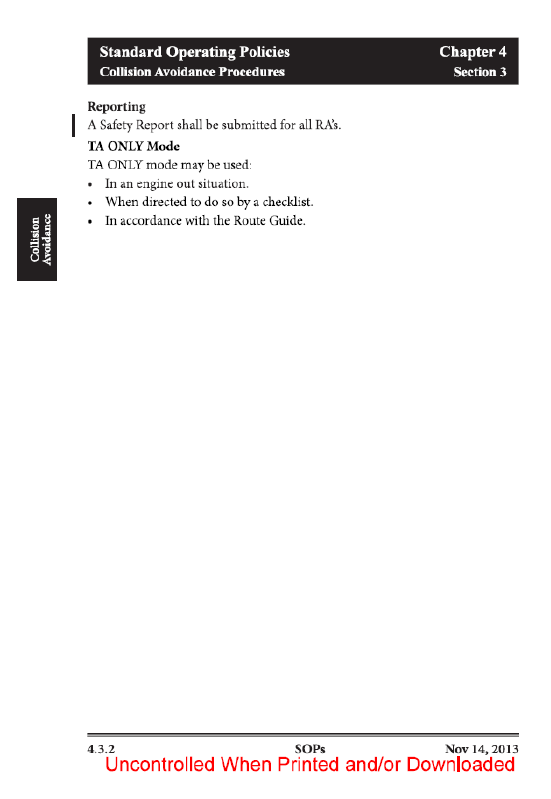
Make an entry in the Technical Log that the CVR circuit-breaker has been pulled. A Safety Report must be submitted.

- The failure to preserve the CVR recordings also meant that the operator and the flight crew lost an opportunity to reflect on and learn from this incident.
- This issue has been a problem for other airline operators and investigation agencies for some time. International safety organisations have made steps towards increasing the CVR recording period. The United States National Transportation Safety Board (NTSB) adopted its safety recommendation report, Extended Duration Cockpit Voice Recorders (ASR-18-04) in 2018. In the same year it made two safety recommendations to the Federal Aviation Administration (FAA) (NTSB Safety Recommendation A-18-030 and A-18-031) to increase the recording duration of CVR records to at least 25 hours for all new aircraft that required CVRs and to retrofit existing aircraft CVRs to the same recording duration by 2024.
- Subsequent to 2018, the FAA technical standard order for CVRs (TSO-C123c) has been aligned with a European Organisation for Civil Aviation Equipment (EUROCAE) document, ED-112A, Minimum Operational Performance Specification for Crash Protected Airborne Recorder Systems. ICAO has also revised its requirements for large passenger aircraft: ICAO Annex 6 – Operation of Aircraft – Part 1 requires that new aircraft certified for a take-off mass greater than 27,000 kilograms and first registered after January 2022 be equipped with CVRs that retain at least the last 25 hours of their operation. New CVRs are available today (2021) with the extended-duration recording period of 25 hours.
- The Commission is concerned that operators are not recognising the importance of CVR records and the value they can provide to post-incident and -accident investigations and learning. In 2009 the Commission made a recommendation to the New Zealand Civil Aviation Authority (CAA) about a late notification of a runway excursion at New Plymouth by a Metroliner operated by Life Flight NZ. The delay allowed the aircraft to resume operations after the incident and the CVR records to be overwritten (TAIC, 2009). In 2017 a Nelson-based ATR72 operated by Mount Cook Airline landed at Palmerston North with an undercarriage problem. The aeroplane was shut down on the runway and the CVR isolated by a Commission investigator after the incident. Ground crew subsequently repowered the CVR when they started up the aeroplane to taxi it off the runway for repair. The CVR recording of the incident was overwritten with ground crew conversations (TAIC, 2017).
Appendix 1. Wellington International Airport (NZWN), New Zealand Aeronautical Information Publication (NZAIP)


Appendix 2. Timeline
Appendix 3. Air Nelson Standard Operating Procedures Extract – Flight Recorders and TCAS

Appendix 4. Air New Zealand serious incident list
The following list of incidents that Air New Zealand consider serious was submitted to the Commission as an example extracted from their revised 2022, Q300 flight crew annual technical refresher training modules. The first bullet point describes the subject incident for this report (note that the revision status of the source document for this submitted extract was not provided at the time).