On 19 February 2015 a Robinson R44 helicopter was returning to Queenstown from a training flight when it suffered a mast bump and crashed in bush near the Lochy River. The instructor and student on board were killed. The Commission investigated the accident, the cause could not be conclusively determined, and the Commission’s final report was published in August 2016. The Commission resumed the inquiry the following month after being advised of new evidence concerning the mental health of the instructor. It concluded that it is very unlikely that any medical factor contributed to the accident and it is very likely the instructor was medically fit to fly when his most recent medical certificate was issued. The Commission also found that: there are too many ways to circumvent the civil aviation process designed to prevent pilots flying if they are not medically fit to do so; and that there is currently a low awareness amongst medical practitioners of their duty to report to the Civil Aviation Authority if they become aware that a pilot has developed a medical condition that would otherwise render them unfit to fly. It made recommendations to the Director of Civil Aviation and to the Chief Executive of the Ministry of Health.
Executive summary Tuhinga whakarāpopoto
- On 19 February 2015 a Robinson Helicopter Company R44 helicopter registered ZK-IPY (the helicopter) was returning to Queenstown from a training flight when it suffered a mast bump and crashed in bush near the Lochy River. The instructor and student on board were killed.
- The Transport Accident Investigation Commission (Commission) investigated the accident, but the cause of the mast bump and resulting in-flight break-up could not be conclusively determined. The Commission’s final report was published on 25 August 2016.
- On 31 August 2016 the Commission was advised of new evidence concerning the mental health of the instructor prior to the crash, in 2014. On 28 September 2016 the Commission resumed the inquiry to evaluate the new evidence, conduct further enquiries and identify any relevant safety issues.
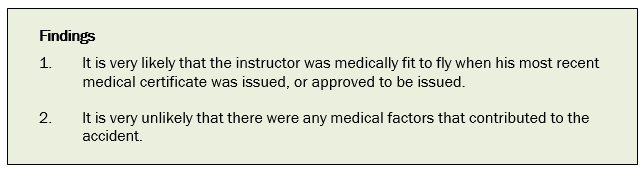
- The Commission concluded that it is very unlikely that any medical factor contributed to the accident. As a result, no changes were made to the original findings in the published report. The Commission made a further finding: that it is very likely that the instructor was medically fit to fly when his most recent medical certificate was issued.
- The Commission also found that: there are currently too many ways for a holder of an aviation document to circumvent the civil aviation process designed to prevent pilots flying if they are not medically fit to do so; and that there is currently a low awareness amongst medical practitioners of their duty to report to the Civil Aviation Authority if they become aware that a pilot has developed a medical condition that would otherwise render them unfit to fly.
- The Commission made recommendations to the Director of Civil Aviation: that he improve the mechanisms for informing medical practitioners of the requirement to report to the Civil Aviation Authority; and that he review the medical application process to ensure that it is more robust in identifying potentially serious health issues with pilots and other aviation document holders.
- The Commission also made a recommendation to the Chief Executive of the Ministry of Health that they consider adding the following functions to the national electronic health record database being developed:
- that a person’s occupation be added to the record to allow monitoring of individuals in safety-critical occupations who have potentially adverse health conditions or medications, so that the appropriate authority can be alerted to possible public safety risks
- a mechanism to draw the attention of all health practitioners to their obligation to notify the appropriate authority when a person or patient has a health condition or need for medication that could pose a threat to public safety in that individual’s occupation.
Conduct of the resumed inquiry He tikanga rapunga
- At about 1600 on Thursday 19 February 2015, the Civil Aviation Authority (CAA) notified the Transport Accident Investigation Commission (Commission) of the accident. The Commission opened an inquiry under section 13(1)b of the Transport Accident Investigation Commission Act 1990, because it believed that the circumstances of the accident had or were likely to have implications for transport safety, and because the Commission was already inquiring into two other break-ups involving Robinson Helicopter Company (Robinson) helicopters.
- On 27 April 2016 the Commission approved a draft report for circulation to interested persons for comment. Eight submissions were received and considered by the Commission. Any changes as a result of those submissions were included in the final report.
- The Commission approved the final report for publication on 27 July 2016, and the report was published on 22 August 2016.
- On 31 August 2016 the Coroner informed the Commission of medical information concerning the instructor, who was the pilot in command of the helicopter at the time it crashed. The Commission determined that the information was new and potentially significant evidence that it had not considered. On 28 September 2016 the Commission resumed its investigation into the accident.
- Between September 2016 and December 2016 the Commission exercised the powers given to it under the Transport Accident Investigation Commission Act and the Commissions of Inquiry Act 1908 to obtain records from medical organisations that had been involved with the instructor. Relevant medical staff and several new witnesses were interviewed, and some previous witnesses were re-interviewed.
- A senior psychiatrist was engaged to assist the Commission’s medical consultant and to provide specialist advice (Dr Mark Davis, MBChB, MRCPsych, FRANZCP). On 10 January 2017 the psychiatrist provided the Commission with a report on his review of the new evidence.
- On 29 March 2017 the Commission approved the draft addendum for circulation to interested persons for comment. Submissions were received from four interested persons. The Commission considered the submissions and amended the addendum as appropriate.
- On 28 June 2017 the Commission approved the addendum for release.
Factual information Pārongo pono
The initial inquiry
-
On 19 February 2015, Robinson R44 ZK-IPY (the helicopter) was returning to Queenstown from a training flight when it broke up in mid-air and crashed in bush near the Lochy River, killing the instructor and the student on board.
- The helicopter broke up in the air as a result of ‘mast bumping’, which happens when the inner part of a main rotor blade or rotor hub contacts the main rotor shaft. The Commission found that the student was about as likely as not to have been flying the helicopter when the mast bumping occurred, and that the weather was suitable for the flight. No pre-existing defects or mechanical failures on the helicopter were identified. The cause of the mast bump was not determined.
New information
- On 31 August 2016, the Coroner informed the Commission that the instructor had undergone treatment for a mental health condition some months prior to the accident.
- The Commission determined that this was new and potentially significant information about the instructor. The purpose of resuming the inquiry was to assess:
- whether any new circumstances could affect the Commission’s previous findings
- whether any new circumstances could result in new findings
- whether there were any new safety issues arising that might need to be addressed.
The instructor
Personal history
- The instructor began his aviation career in March 1998, flying helicopters with the British Royal Marines. He completed a tour of active duty in Iraq before leaving the service in September 2003. He emigrated to New Zealand and obtained a flying job in Central Otago. In July 2012 he commenced a three-year contract flying helicopters in Papua New Guinea, on a month on, month off rotation.
- In February 2014 the instructor self-referred to a psychotherapist for counselling. In late March, after returning from Papua New Guinea, he attended an appointment with his general practitioner (GP) for problems with sleeping and anxiety. The GP made an initial diagnosis of ‘depression with anxiety component’. The instructor resigned from his flying contract in Papua New Guinea at this time and took a non-flying job in New Zealand. Further appointments with his GP and other medical practitioners followed.
- In early August 2014 the instructor felt a marked improvement in his mental health and stopped taking all medications at this time. People who were close to him, including his GP, noticed an improvement.
- During August 2014 the instructor was offered two flying jobs in Queenstown. On 1 September 2014 he began flying for the operator (Over The Top Limited) for which he had worked previously.
Regulatory requirements in regard to pilot medical certificates
Pilot medical certificate
- The instructor was required to hold a valid medical certificate in order to exercise the privileges of his pilot licence (a medical certificate is required to exercise the privileges of most categories of pilot licence and by air traffic controllers). His pilot medical certificate had lapsed, so prior to resuming flying for the operator he applied for a renewal. On 17 August 2014 he underwent an examination by a Civil Aviation Authority (CAA)-approved medical examiner. On 21 August 2014 he was re-issued with a class 1 medical certificate with no restrictions, which was valid until 21 February 2015. On 4 February 2015 he applied for a renewal of the medical certificate and was examined and assessed as ‘fit’ by a CAA medical examiner. The replacement certificate was in the process of being issued with no restrictions at the time of the accident on 19 February 2015.
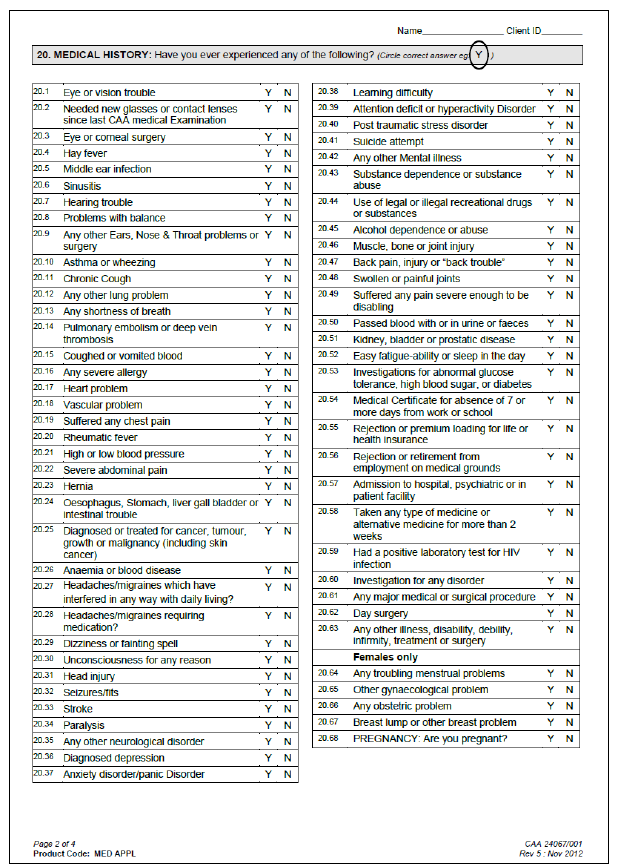
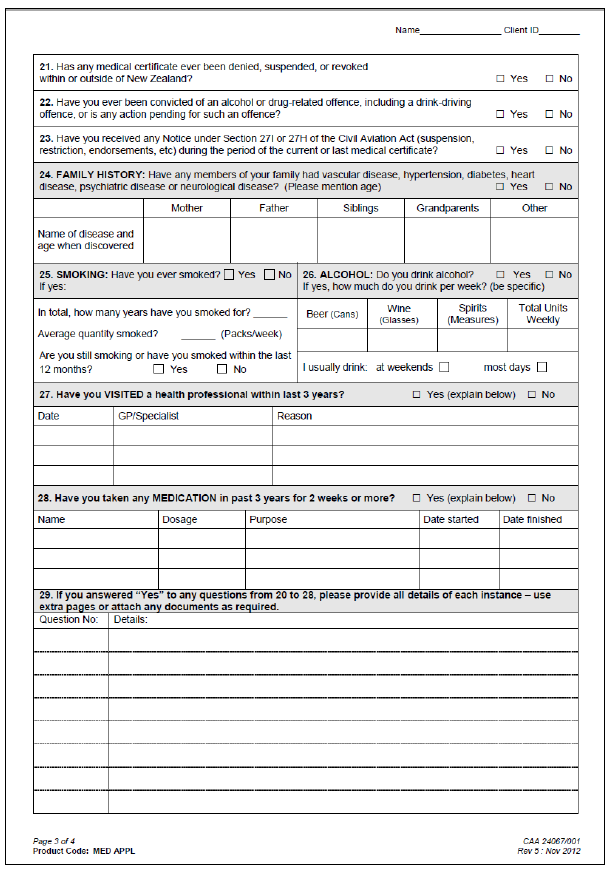
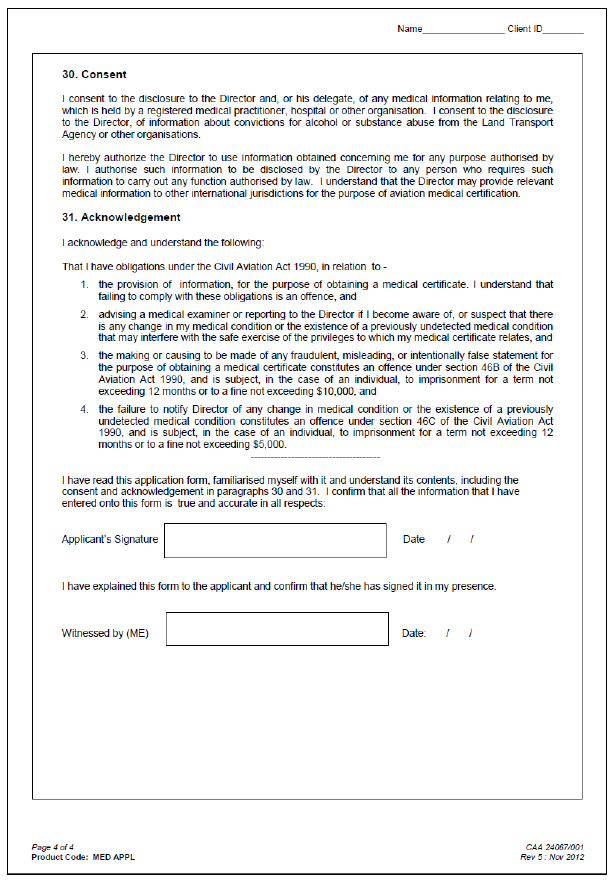
- Prior to a medical examination an applicant must complete a CAA ‘Application for Medical Certificate’ form. This form is reviewed by the CAA medical examiner during the examination. The form includes a section on medical history. The applicant is required to answer questions relating to specified illnesses and injuries. They are also required to list recent visits to health professionals and any medication taken. There are specific questions on some psychological and mental health conditions (see Appendix).
- On the two most recent applications for a medical certificate, dated 17 August 2014 and 4 February 2015, the instructor reported problems with sleeping. He did not declare any of the medication he had taken or make any reference to any psychological or mental health conditions.
Civil Aviation Act
-
A medical certificate may be invalidated if the holder’s medical condition changes, for example because of injury or illness. Section 27C(1) of the Civil Aviation Act 1990 states:
… if a licence holder is aware of, or has reasonable grounds to suspect, any change in his or her medical condition or the existence of any previously undetected medical condition that may interfere with the safe exercise of the privileges to which his or her medical certificate relates, the licence holder -
(a) must advise the Director [of Civil Aviation] of the change as soon as practicable; and
(b) may not exercise the privileges to which the licence holder’s medical certificate relates.
-
There is a similar obligation placed on various people who become aware that the holder of a medical certificate has had a change in their medical condition, or has a previously undetected medical condition. Section 27C (2) and (3) of the Civil Aviation Act further states:
(2) if an aviation examiner or medical examiner or operator is aware of, or has reasonable grounds to suspect, any change in the medical condition of a licence holder or the existence of any previously undetected medical condition in the licence holder that may interfere with the safe exercise of the privileges to which the licence holder’s medical certificate relates, the aviation examiner or medical examiner or operator must advise both the licence holder and the Director of the change as soon as practicable.
(3) if a medical practitioner has reasonable grounds to believe that a person is a licence holder and is aware, or has reasonable grounds to suspect, that the licence holder has a medical condition that may interfere with the safe exercise of the privileges to which the licence holder’s medical certificate relates, the medical practitioner must, as soon as practicable,
(a) inform the licence holder that the Director will be advised of the condition; and
(b) advise the Director of the condition.
Analysis Tātaritanga
Introduction
- The various medical practitioners involved with the instructor’s medical care, and the various people closely associated with the instructor at professional and personal levels, agreed that the instructor’s mental demeanour had significantly improved, if not fully returned to normal. This view was shared by the Commission’s independent psychiatry expert, who having reviewed all of the available material was confident that it was feasible for the instructor to have made a full and sustained recovery before the instructor returned to flying.
- When considering these expressed views in context with the known circumstances of the accident as described in the main report, the Commission has concluded that it is very unlikely that any medical factor contributed to the accident. Accordingly, none of the original findings has been amended.
- However, the resumed inquiry identified two new safety issues:
- the CAA medical certification process does not provide sufficient assurance that an applicant has no undisclosed health condition
- many medical practitioners are unaware of their legal obligation to inform the Director of Civil Aviation that a licence holder has a medical condition that may interfere with the safe exercise of the privileges of the licence to which the holder’s medical certificate relates.
Were there any medical factors that could have contributed to the accident?
- There was no history of the instructor having had any mental health issue prior to 2014. His discharge medical records from the Royal Marines showed that he was in good health and had no ill effects from his service in Iraq. The first documented indication of a health issue was when he visited a counsellor on 28 February 2014, during a break from flying in Papua New Guinea. Four weeks later he visited his GP complaining of problems with sleeping, low mood and anxiety. The GP diagnosed ‘depression with anxiety component’ and prescribed a range of medications. The Commission’s psychiatry expert, after reviewing the medical records, said the instructor’s condition during this time might have been more accurately described as a Depressive Disorder Not Otherwise Specified.
- The sudden turnaround in the instructor’s mental health was observed by a number of people close to him, including his GP. The return to normal health was considered by the Commission’s psychiatry expert to be feasible. This was particularly so in this case where “the history indicates the probability that his disorder was associated with (if not caused by) the existence of significant psychosocial stressors”.4 The stressors were related to his past.
- The psychiatry expert also said that a rapid recovery was possible as a result of a distraction from his own difficulties associated with past stressors.
- The consulting psychiatrist reviewed the medications taken by the instructor, and confirmed that it was highly unlikely that the instructor would have experienced any discontinuation-related symptoms or long-term effects. The consulting psychiatrist commented that the “(likely) diagnosis of Depressive Disorder Not Otherwise Specified had fully remitted by September 2014 and remained in remission up until the time of his death” – some five months later.
- Those witnesses who were aware of the instructor’s mental health issues were confident that his return to normal health was sustained. The instructor’s employer and fellow work colleagues were in agreement that the instructor had not changed in any way from when he had worked there two years previously. He had quickly reintegrated into the company and was a valued and trusted member of the team.
- The instructor’s GP had met the instructor several times socially after he returned to flying and had no concerns about the instructor’s mental health in that period.
- The medical examiner had known the instructor since November 2003, when he performed the instructor’s first pilot medical examination in New Zealand. He had subsequently performed all the instructor’s medical examinations, 12 in total, the last examination being on 4 February 2014, 15 days before the accident. The medical report had a tick box for ‘Psychiatric examination’. The medical examiner had ticked ‘Yes’ on each occasion, confirming ‘normal, without unusual features’. The medical examiner, like others interviewed, had no concerns about the instructor’s fitness to fly (medical examinations are discussed further in the following section.)
- The Commission’s psychiatry expert advised that based on the evidence provided on the instructor’s history and the accident sequence, he considered it very unlikely that the state of the instructor’s mental health had any influence on the accident.
The process for issuing CAA medical certificates
- The current application process for a CAA medical certificate relies on the honesty of the applicant to disclose their medical history fully when completing the application. The medical examiner carries out a physical examination of the applicant and may question the answers in the application form. If there is nothing to trigger further action, the application will normally continue uninterrupted and a certificate will be issued.
- The instructor completed two medical examinations between recovering from his mental health issues and the accident. The first examination was about five days after he was assessed as having returned to full health. The instructor did not fully disclose the extent of the treatment he had received in addressing his mental health issues.
- The instructor recorded only two of his visits to his GP, and said that both visits were regarding problems sleeping. There were at least five other GP visits and numerous consultations with various health professionals that the instructor did not disclose. This included a consultation with a consultant psychiatrist to whom he was referred through the mental health service, which was 10 days before his aviation medical examination. He had also been prescribed and had taken a range of medications that were not noted on either application for an aviation medical certificate.
- Civil aviation procedures did not require a medical examiner to contact an applicant’s GP prior to the issue of a medical certificate. They would normally only do so if they had a specific health concern that they had decided to assess further. In this case the medical examiner determined that the instructor was fit to fly and had no concerns about his physical and mental health.
- Had the instructor disclosed the full extent of his treatment, this may not have precluded him obtaining his medical certificate. However, it would likely have generated further enquiries from the medical examiner and the CAA medical section, that would likely have resulted in the instructor being required to undergo a more formal assessment before being issued with a medical certificate.
- The full and honest disclosure of an applicant’s medical history has the potential to incur additional costs to the applicant and time to obtain a medical certificate. There can also be the perception on the applicant’s part that they may lose their licence. There could therefore be a natural reluctance for applicants to give full disclosure. There is also the potential for this to dissuade medical certificate holders from seeking help in the first place, which could be more of a safety issue.
- Under the current system there is an opportunity for applicants to minimise the risk of losing a medical certificate by using different GPs for specific purposes. A clean record can be maintained with the GP declared in the application form, while another GP is used for the treatment of problems the applicant prefers to keep confidential. This was not the case for the instructor. However, it further highlights how the current CAA system for maintaining appropriate aviation medical standards can be circumvented.
- The purpose of medical practitioners having to report to the CAA any change in the medical condition of, or the existence of any previously undetected medical condition in a licence holder was to prevent pilots circumventing the system in this way. This is discussed in the following section.
Duty for medical practitioners to report
- The instructor’s GP was not aware of the need to inform the CAA about the instructor’s mental health and treatment. The GP knew that the instructor had not flown during the period of his illness and expressed no concerns about his returning to flying. He did not consider it an issue at the time.
- The CAA has undertaken a range of initiatives to inform medical practitioners of their obligations under the Civil Aviation Act to inform the CAA of potential safety risks involving their patients. However, many of the medical practitioners spoken to during the inquiry were not aware of their obligations under the Act5, which suggests that further work is required to ensure that all medical practitioners are aware of their obligations.
- The requirement for medical practitioners to report to the CAA is an important check in the system to prevent its being circumvented.
-
The CAA could not be sure of the number of cases where medical practitioners, pilots and air traffic controllers had failed to disclose relevant health issues fully. Since 2004 the CAA had undertaken some 14 prosecutions under section 48B of the Civil Aviation Act.6 These mainly related to either false declarations or failing to disclose information.
- This inquiry has highlighted weaknesses in the medical certification process for civil aviation document holders. The issue could be relevant to other transport modes and other industries where participants are required to hold medical certificates of some sort.
- Commission staff met with the Chief Medical Adviser and other staff of the Ministry of Health to discuss ways to reduce the potential for serious illnesses to be concealed by people in safety-sensitive occupations such as transportation. Arising from these discussions it was agreed that the Commission’s medical consultant would write a chapter for the Cole’s Medical practice in New Zealand 2017 edition; write an article for the Medical Protection Society on the balance of public safety and patient privacy; and work with the New Zealand Nurses Organisation to raise the level of awareness to notify concerns amongst the nursing profession.
- The Ministry of Health is currently developing a national electronic health records database. One method of improving medical examiners’ ability to assess applicants’ fitness for duty would be for them to have access to such a database and be able to query an applicant’s recent medical, mental and prescription history.
- The Commission has made a recommendation to the Ministry of Health to explore enhancing the national database to address the safety issues identified above.
International initiatives to address mental health issues in aviation
- Following the Germanwings Flight 9525 accident in France in 2015, both the European Aviation Safety Agency-led Germanwings taskforce on the accident and the Bureau d’Enquêtes et d’Analyses pour la sécurité de l’aviation civile issued recommendations to address issues with the system for administering aviation medical certificates in Europe. A number of initiatives have been proposed that are expected to improve the level of safety by introducing new requirements:
- to strengthen class 1 medical examinations for applicants for and holders of certificates by including drugs and alcohol screening and comprehensive mental health assessments as well as improved follow-up where there is a history of psychiatric conditions for aero-medical centres and aero-medical examiners to report to the competent authority all incomplete medical assessments, thus preventing fraud attempts to increase the quality of the aero-medical examinations by improving the training, oversight and competency assessment of aero-medical examiners for the holders of medical certificates to return them to the licensing authority in case of suspension and revocation of their medical certificates.
- for aero-medical centres and aero-medical examiners to report to the competent authority all incomplete medical assessments, thus preventing fraud attempts
- to increase the quality of the aero-medical examinations by improving the training, oversight and competency assessment of aero-medical examiners
- for the holders of medical certificates to return them to the licensing authority in case of suspension and revocation of their medical certificates.
-
Since the Germanwings accident the International Civil Aviation Organization has initiated a ‘health promotion amendment process’ aimed at addressing the issue of mental health in aviation. The process aims to change current ‘recommendations’ to a ‘standard’ that States must comply with. The proposed standard is:
1.2.4.2 States shall apply, as part of their State safety programme, basic safety management principles to the medical assessment process of licence holders, that as a minimum include:
a) routine analysis of in-flight incapacitation events and medical findings during medical assessments to identify areas of increased medical risk, and
b) continuous re-evaluation of the medical assessment process to concentrate on identified areas of increased medical risk.
1.2.4.3 The licensing authority shall implement appropriate aviation-related health promotion for licence holders subject to a medical assessment to reduce future medical risks to flight safety.
- The recommendations made to the Director of the New Zealand Civil Aviation Authority resulting from this inquiry will go some way to meeting the proposed International Civil Aviation Organization standard.
Safety issues and remedial action Ngā take haumanu me ngā mahi whakatika
No new safety actions were identified.
Recommendations Ngā tūtohutanga
General
- The Commission may issue, or give notice of, recommendations to any person or organisation that it considers the most appropriate to address the identified safety issues, depending on whether these safety issues are applicable to a single operator only or to the wider transport sector. In this case, recommendations have been issued to the Director of Civil Aviation and the Ministry of Health.
- In the interests of transport safety, it is important that these recommendations are implemented without delay.
Recommendations to the Civil Aviation Authority
-
The medical practitioners associated with the care of the instructor, and many of the others spoken to during the course of the investigation, were unaware of their obligations under the Civil Aviation Act to inform the CAA about a licence holder who has a known or suspected medical condition that may affect their ability to conduct their duties safely. Despite the efforts of the CAA, this lack of awareness of the Civil Aviation Act appears to be wider than just among those involved with this case.
On 28 June 2017 the Commission recommended to the Director of Civil Aviation that he improve the mechanisms for informing medical practitioners of the requirement to report to the CAA any health issues with a CAA licence holder that may interfere with that person’s ability to exercise the privileges of their licence safely. (019/17)
-
On 6 July 2017 the Deputy Director Aviation Infrastructure and Personnel, CAA replied:
Notwithstanding past and ongoing effort to educate medical practitioners about their duty to report to the CAA any health issues with a CAA licence holder that may interfere with that person's ability to exercise the privileges of their licence safety it is acknowledged this activity needs to be ongoing and the results of the Commission's investigation highlight this need. Accordingly this recommendation is accepted and the work will continue on an ongoing basis. As this educational work will need to be enduring in its nature and will be undertaken on an ongoing basis it is not practicable to specify a final implementation date. In conducting this ongoing work will we however review the manner in which we have sought to educate medical practitioners in the past and look to identify additional pathways that may be complimentary to those previously used. This review will be completed by 1 December 2017.
-
Section 27C(1) of the Civil Aviation Act requires medical practitioners to inform the Director if they believe a person is a licence holder and is aware, or has reasonable grounds to suspect, that the licence holder has a medical condition that may interfere with the safe exercise of the privileges to which the licence holder’s medical certificate relates.
The Civil Aviation Act defines a medical practitioner as a health practitioner who is registered as a practitioner of the profession of medicine. This does not recognise that other health professionals (as defined in the Health Practitioners Competence Assurance Act 2003) may be providing care to a licence holder. Other health professionals, such as psychologists, could know, or become aware of, a CAA licence holder having a medical condition that may interfere with the safe exercise of the privileges of their licence.
On 28 June 2017 the Commission recommended the Director of Civil Aviation consider measures to ensure that other appropriate health practitioners, not included under the current definition in the Civil Aviation Authority Act, notify the Director when they are aware, or have reasonable grounds to suspect, that the holder of a CAA licence has a medical condition that may interfere with the privileges to which their medical certificate relates. (020/17)
On 6 July 2017 the Deputy Director Aviation Infrastructure and Personnel, CAA replied:
We recognise the basis for this recommendation and the outcomes the Commission is seeking to achieve. We are supportive of these. However changes to the Civil Aviation Act 1990 (the Act) would be required to support any effective measures aimed at implementing the recommendation. The Act is administered by the Ministry of Transport. As such, any recommendation for a change to the content of the Act should be made to the Secretary for Transport.
-
The medical examiner did not, and saw no reason to, contact the instructor’s GP as part of the medical assessment process. Had he done so, it is likely that he would have learned of the instructor’s recent illness and initiated a more formalised review of the instructor’s fitness to fly. A procedural requirement for medical examiners to consult GPs would help to ensure that they are fully informed about applicants’ health.
On 28 June 2017 the Commission recommended to the Director of Civil Aviation that he review the medical application process:
- to ensure that it promotes a positive reporting culture for applicants
- that is more robust in identifying potentially serious health issues that may interfere with the safe exercise of the privileges to which applicants’ medical certificates relate
-
to ensure that the system supports medical examiners exercising their discretion to consult medical practitioners when assessing applications for medical certificates. (021/17)
On 6 July 2017 the Deputy Director Aviation Infrastructure and Personnel, CAA replied:
By way of context to the CAA's response, it should be noted that consistent with developments overseas, the CAA has recently consulted with stakeholders regarding the appropriate medical certification standard for the holders of a private pilot licence. The international trend is for a reduction in the standard of any aviation medical certificate or even the removal of the requirement for such a certificate altogether. This reflects a view that the regulatory burden that has been imposed in the past is unreasonable given the very small number of accidents with a medical cause factor. It is important to note, however, that if such a change were to occur in New Zealand it would be very unlikely to apply to the medical certification of pilots conducting hire or reward activity. Therefore, the preceding context does not reduce the validity of the Commission's recommendations as they might apply to the holders of the aviation documents required for the performance of hire or reward operations.
The CAA accepts the first element of this recommendation and will do what it can to promote a "positive reporting culture" for medical certificate applicants to the degree it can do so while still acting decisively to protect the public interest when it has reasonable cause for concern about matters of potential aeromedical significance. The CAA will review current processes in line with this recommendation by 1 December 2017.
The CAA accepts the second element of this recommendation as it applies to the holders of aviation documents utilised for professional purposes. The CAA will review current processes in line with this recommendation by 1 December 2017.
The CAA considers that the third element of the recommendation is unworkable in that it would currently be unlawful in terms of the Civil Aviation Act for the Director to require an applicant, as a precondition to the issue of a medical certificate, to provide information from their GP or other medical practitioner, or to authorise the CAA to access that information, in the absence of reasonable cause in a specific case for requesting that information. In addition, the CAA considers that the provisions of S27C (3) of the Civil Aviation Act which requires medical practitioners to inform the Director if they have reasonable grounds to believe that a licence holder has a medical condition that may interfere with the safe exercise of the privileges of the licence they hold does not provide sufficient authority for the GP to share all medical information regarding a licence holder patient with a Medical Examiner. Any effective system in support of medical examiners in the manner anticipated by this element of the recommendation would require changes to the Civil Aviation Act.
Given the above and the fact that the Ministry of Transport administers the Civil Aviation Act, the CAA recommends that the Commission consider making a recommendation to the Secretary for Transport for amendment of the Civil Aviation Act requiring GPs to provide, on request from a Medical Examiner, medical information regarding a patient who holds, or is seeking, aviation medical certification.
Recommendation to the Ministry of Health
-
There is the potential for applicants for medical certificates to attempt to circumvent the medical assessment process by inaccurately representing their state of health through the misreporting of their treatment, including undisclosed medications and possible multiple GPs and other health professionals. This risk is shared by other transport modes that require a person to hold a medical certificate or make a declaration on their health status. A national health database would provide one means of addressing this risk.
On 28 June 2017 the Commission recommended to the Chief Executive of the Ministry of Health that he consider adding the following functions to the national electronic health record database under development:
- that a person’s occupation be added to the record to allow monitoring of individuals who hold transport-related documents that require periodic medical checks, and who have potentially adverse health conditions or medications, so that the appropriate authority can be alerted to possible public safety risks
-
a mechanism to draw the attention of all health practitioners to their obligation to notify the appropriate transport authority when a person or patient has a health condition or need for medication that could pose a threat to public safety in that individual’s occupation. (022/17)
On 3 July 2017 the Chief Medical Officer for the Ministry of Health replied:
The National Electronic Health Record Business Case project is a significant project that is working though a Treasury Better Business Case (BBC) process. This process is for agencies that have significant proposals that will have a whole of life cost of more than $25 million.
The BBC process has a number of stages and at this point we are close to completing stage 2 of 4. At the completion of stage 4 we expect that we will begin to implement the solution for the National Electronic Health Record, timing for the duration of the implementation phase is yet to be determined. With our current timeline, we expect this to begin no earlier than late 2018 pending approval from Cabinet and successfully delivering the business case process and large scale procurements required.
With these timings in mind, we recognise that there is a requirement to hold the occupation for an individual and to be able to undertake reporting and processes related to the occupation should potentially adverse health and/or medications be identified. At this stage we cannot commit that the functionality that has been suggested will be implemented and will not be in a position to do so until the Business Case process is completed. However, while we cannot yet confirm the details of this type of functionality, we can and will take this into account during our deliberations and include in our business case documentation the advantages of having this type of functionality tied into the Electronic Health Record once established.
Data summary Whakarāpopoto raraunga
Details
latitude: 45° 11.15´ south
longitude: 168° 35.7´ east
Appendix. CAA Application for a Medical Certificate form



Related Recommendations
The medical examiner did not, and saw no reason to, contact the instructor's GP as part of the medical assessment process. Had he done so, it is likely that he would have learned of the instructor's recent illness and initiated a more formalised review of the instructor's fitness to fly. A procedural requirement for medical examiners to consult GPs would help to ensure that they are fully informed about applicants' health. On 28 June 2017 the Commission recommended to the Director of Civil Aviation that he review the medical application process:
Section 27C(1) of the Civil Aviation Act requires medical practitioners to inform the Director if they believe a person is a licence holder and is aware, or has reasonable grounds to suspect, that the licence holder has a medical condition that may interfere with the safe exercise of the privileges to which the licence holder's medical certificate relates.
There is the potential for applicants for medical certificates to attempt to circumvent the medical assessment process by inaccurately representing their state of health through the misreporting of their treatment, including undisclosed medications and possible multiple GPs and other health professionals. This risk is shared by other transport modes that require a person to hold a medical certificate or make a declaration on their health status. A national health database would provide one means of addressing this risk.
The medical practitioners associated with the care of the instructor, and many of the others spoken to during the course of the investigation, were unaware of their obligations under the Civil Aviation Act to inform the CAA about a licence holder who has a known or suspected medical condition that may affect their ability to conduct their duties safely. Despite the efforts of the CAA, this lack of awareness of the Civil Aviation Act appears to be wider than just among those involved with this case.