At Wellington station, the driver of an empty train thought a Green signal was meant for his train, and he drove past the Red signal that actually applied. The driver stopped his train just short of a cross-over point. Another train with 79 passengers on board passed in front; there was no collision, nobody injured. TAIC calls on KiwiRail and Greater Wellington Regional Council to find short term and long term solutions to reduce risks for trains running through the limited available space at Wellington Station.
Executive summary Tuhinga whakarāpopoto


- Shortly after midnight on Saturday 28 May 2016, an empty passenger train was being moved from Platform 7 at Wellington Railway Station (Wellington Station) to the West Storage Yard for overnight storage. At about the same time a passenger train with 79 passengers on board departed from Platform 5 bound for Upper Hutt. Their respective routes would cross within a short distance from the platforms. It was dark and raining.
- The signal box controller had set a clear (Green) route for the Upper Hutt train and had set a Red Stop signal to hold the empty train just short of the cross-over point until the Upper Hutt train had cleared that section of track.
- However, there was another signal showing Green, adjacent to the Red signal meant for the empty train. The driver confused the two signals, and thinking the Green signal was meant for his train, he continued past the Red signal towards the cross-over point.
- The driver realised his mistake just as his driving cab passed between the Red and Green signals and immediately stopped his train just 12 metres short of the cross-over point. The Upper Hutt train passed through the cross-over 13 seconds later. Both trains were restricted to a maximum speed of 20 kilometres per hour. There was no collision and nobody was injured.
- Noting that train drivers failing to stop their trains at Red signals is a known and foreseeable risk, the Commission found that there should have been more checks or defences built into the system to prevent this near collision when the driver confused the two signals.
- The Commission also found that due to the geographically constrained and congested nature of the Wellington Station area, there are fewer fail-safe back-up systems than would normally be associated with a modern track and signalling system. Consequently, there is an elevated risk of trains colliding in the area that will need to be managed now and in future.
- Safety issues identified during the inquiry included:
- the heightened risk of trains colliding within the approaches to Wellington Station because limited space makes the track layout congested
- a number of reasonable measures had not been taken to further reduce the risk of trains colliding in the approaches to Wellington Station. These include the provision of providing better recognition of signals, standard procedures for signalling trains through the area, and better communication between train drivers and persons controlling the trains
- The Commission refers to a previous recommendation to address issues with communication, and makes two new recommendations to address immediate and long-term solutions for managing the risk in the Wellington Station area.
- Key safety lessons arising from this incident are that:
- all safety-critical systems should have checks and defences designed into them that mitigate against human error resulting in incidents or accidents
- there should be sufficient clear and concise communication between persons responsible for controlling trains and train drivers so that all parties are aware of the situation and alert to any threats to safe train operations.
Factual information Pārongo pono
Background
- The train storage yard and the train maintenance facilities are close to Wellington Station. Consequently, the track layout with the required cross-over points between the main lines on the approaches to the station are congested due to the limited area available. The close proximity of the train storage yard and train maintenance facility contribute to a high number of train ‘relay’ movements passing through this congested area.
- The majority of relay movements around Wellington Station are empty train movements into and out of the train storage yard to facilitate the demands of peak and off-peak times. However, other types of relays include moving trains from one platform to another, taking a train into or out of a maintenance facility, or taking the train through the automatic train wash system.
- This incident involved an empty train that was being moved from Platform 7 into the train storage yard for the night (route depicted in green on Figure 2 below).

- Around the same time as the relay movement, an Upper Hutt service (depicted in blue on Figure 2 above) was scheduled to leave Platform 5 at 0005 for the Up Main, passing ahead of the relay train. Also a Waikanae service (depicted in yellow on Figure 2 above) was scheduled to depart Platform 8 at 0014 for the Middle Main, by which time the relay should have been completed.
- The trains were all being controlled by a signalbox controller (the signaller) from the Wellington Signalbox, locally know as ‘A Box’ (depicted in red on Figure 2 above).
Narrative
- A driver who had just completed his shift was asked to drive a relay train to the train storage yard. This type of request was not unusual and the driver could say no without repercussion. Just after midnight on 28 May, the driver and a TXO boarded the relay train. The TXO was present to set the manual points into the storage yard. Once in the driving cab the TXO took the left-hand seat but played no part in the relay train movement.
- It was dark at the time and light rain was falling. The driver was using the windscreen wipers on the train, which he reported were working well.
- The signaller had pre-set the signals for all three trains departing Wellington. For the Upper Hutt service from Platform 5 all signals were set to ‘Green – Proceed’ to the Up Main. The Relay was signalled to leave Platform 7 with a ‘Yellow – Caution-to-Stop’ signal while the next signal (100) was set to ‘All Red – Stop’. The Waikanae service was held on Platform 8 by an ‘All Red – Stop’ signal, but the next signal (99) was pre-set to ‘Green – Proceed’ with its route indicator displaying ‘M’ for the Middle Main (see Figure 3).

- The relay departed from Platform 7 authorised by the signal displaying a ‘Yellow over Red – Caution-to-Stop’ indication. This meant the next signal at that time was set at ‘All Red – Stop’.
- Within seconds of the relay departing the platform, the passenger service destined for Upper Hutt departed Platform 5 with 79 passengers on board.
- At 0007, the relay approached signal 100 on the left-hand side of the track, which was still displaying an ‘All Red – Stop’ indication. However, signal 99 on the right-hand side of the track was displaying a ‘Green – Proceed’ indication. Although it had a route indicator displaying an ‘M’ for the Middle Main, the relay driver mistook the signal on his right to be for his relay and did not stop his train, passing signal 100 at ‘All Red – Stop’ (see Figure 4). Passing a signal displaying this indication is classed as a SPAD A (SPAD means passing a STOP signal without authorisation. A ‘SPAD A’ is passing a perfectly displayed STOP signal without authorisation) (signal passed at danger category A).

- The relay driver realised his mistake as he drew level with the ‘Stop’ signal and applied the train brakes, bringing the relay movement to a full stop 30 metres (m) beyond the signal.
- Simultaneously, the signaller noticed that the relay train had passed the signal at ‘Stop’ and waved vigorously out of the window in an attempt to get the relay movement to stop.
- The Upper Hutt service crossed through the set of points directly in front of the relay train 13 seconds after it had stopped. (see Figure 5)
- The distance between the relay train and the passing Upper Hutt service was 12 m.
- The incident was reported to Train Control and the driver was relieved of the relay train and taken for drug and alcohol testing.

Personnel information
- Both the relay and Upper Hutt service drivers, plus the signaller and TXO, were all certified for their respective roles at the time of the incident.
- The relay driver had been certified to drive Matangi units 12 months prior to the incident.
- The relay driver was not familiar with the Wellington driver adage used by some that is ‘left leaving – right arriving’. This means that when leaving Wellington Station the signals for the route will be on the left-hand side of the track, and when arriving into Wellington the signals are on the right-hand side of the track. However, when leaving platform 7 both signals 99 and 100 appear from the left hand side of the driver until approximately 30 m away, when it becomes clear the train will pass between the two signals and signal 100 is on the left hand side of the train.
- The signaller had a total of 41 years’ experience in Wellington rail, completing the last 11 years as a signaller in Wellington Signalbox, after four years as a signaller in Taita Signalbox.
- Following the incident, the relay driver underwent a KiwiRail post-incident drug and alcohol test, which returned a negative (clear) result.
Track layout
- The signals between Wellington Station through to Ngāūranga are manually controlled from the Wellington Signalbox known locally as A Box.
- Part of the track layout just north of Wellington Station is congested due to a lack of available land (see Figure 6), There are multiple sets of points and possible direction or track changes available over a short distance.

- The track layout and its associated signalling system was originally built in 1937. A number of improvements to the track and signalling infrastructure have been made over time, including:
- the upgrading of individual signals from the older searchlight type to modern LEDs (light-emitting diodes) (see Figure 7)

- the placement of route indicators (see Figure 8) to Directing Signals in the area to identity the route which has been set, indicated by illuminated characters

- the addition of non-reflective white arrows to the uprights of signals 99 and 100 in 2005, to assist drivers to identify which signal is controlling which track
- the introduction of a third bi-directional main line into and out of Wellington in July 2010 (see Figure 9) to improve flexibility into and out of Wellington Station.

Analysis Tātaritanga
Introduction
- The following analysis discusses the circumstances that resulted in the relay train passing signal 100 when it was at Red Stop and setting up a potential collision with the departing Upper Hutt service.
- The analysis also discusses the following safety issues, identified during the inquiry:
- there is a heightened risk of trains colliding within the approaches to Wellington Station because limited space makes the track layout congested
- there are a number of reasonable measures that had not been taken to further reduce the risk of trains colliding on the approaches to Wellington Station, such as: providing better recognition of signals; standard procedures for signalling trains through the area; and better communication between train drivers and persons controlling the trains
- the standard of non-technical skills (NTS), formerly known as Crew Resource Management, between the driver, the TXO and the signaller were ineffective.
What happened
- There had been no radio communication between the signaller and the relay driver before the relay train departed Platform 7. He was unaware of what other train movements were happening at the time. He just knew what the destination for his train was and departed the platform in accordance with the signal. The signal was at that time showing Yellow over Red, which meant that the next signal ahead (signal 100) was displaying Red.
- The next signal ahead was displaying Red because the signaller had set a route for the Upper Hutt train, which would cross ahead of the relay train. The cross-over point was approximately 43 m ahead of signal 100 which was showing Red.
- In line with signal 100, on the opposite side of the track, was signal 99. The signaller had pre-set signal 99 to Green in anticipation of routing the Waikanae train that was still sitting at Platform 8 taking passengers on board.
- Instead of stopping his train at the Red signal 100 on his left, the driver of the relay train mistook the Green signal 99 on his right as being for his train and continued past it. Both signals had a placard with a white arrow on a black background pointing towards the track to which they applied (see Figure 4). However, the arrows are not illuminated or reflective and are difficult to see in the dark and the rain.
- Additionally, the signal required to get from the platform to the storage yard would be a ‘Red over Red light with a Low Speed Yellow light’, so the driver should not have taken a ‘Green Proceed’ indication on either signal (see Figure 10).

- The driver quickly realised his error and stopped his train 12 m short of the cross-over points, thereby narrowly averting a collision with the Upper Hutt train, which passed through the cross-over 13 seconds later.
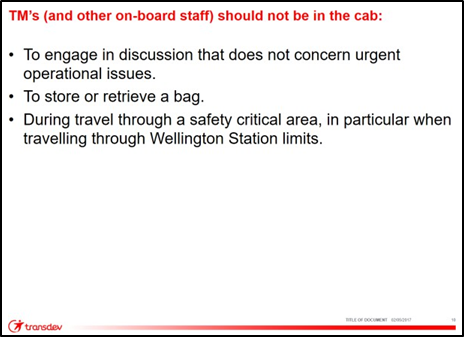
- No conversation is reported to have taken place between the relay driver and the TXO once in the cab of the relay train, so the TXO’s presence in the cab did not directly contribute to the incident. While in the cab, the TXO could have helped prevent the incident had he been calling the signals.
- The relay train driver had completed similar relay movements before and was familiar with the signals that were applicable to the possible routes. Evidence of this was his immediate recognition of his error as he passed the Red signal.
- In human factor terms the driver’s mistake is considered a lapse, possibly attributable to him being past the end of his shift late at night, with a less heightened sense of awareness because he was performing the additional task of storing an empty train for the night.
- The incident highlights the importance of having checks or defences in a system to counteract the known risk of human error. This is discussed in more detail in the following sections.
Suitability of the track layout facilitating a modern timetable
Safety issue – There is a heightened risk of trains colliding within the approaches to Wellington Station because limited space makes the track layout congested.
- The track layout and associated control system between Wellington Station platforms, and the lines into and out of Wellington and those to the surrounding storage yards or maintenance depots, have remained relatively unchanged since 1937 (see Appendix 2).
- The control of the various signals and points in this area is achieved by operating the lever mechanisms inside the Wellington Signalbox. Mechanical interlocks prevent the signaller from being able to set conflicting train movements.
- A number of signals and points around New Zealand are controlled via Computer Based Interlocking from the National Train Control Centre within Wellington Station. This system links signals and points by using software interlocking to prevent possible conflicting train movements. Computer Based Interlocking allows complex logic to be implemented, whereas this is considerably more difficult for lever and relay based interlocking.
- The Wellington Signalbox controlled area is based on 1930s’ vintage signalling principles and the associated interlocking is appropriate for a lever based system of this vintage, and remains fit for purpose, although it does not meet modern design standards8. The fundamental principles are the same as those deployed today with the exception that more modern computer based interlocking equipment allows more complex logic to be developed. The existing layout means there are no safety overlaps9 designed into this area and few fail-safe back-up systems in place in the event of a SPAD. The current system is highly reliant on drivers always stopping at a Red light.
- However, changing control of the area from the Wellington Signalbox to a National Train Control Centre would not have prevented this incident. The issue is with the congested layout of the track and signalling system.
- Any increases in commuter train services into and out of Wellington through this tight track layout increases the pressure on this bottleneck area, and in turn increases the underlying risk of relying on train drivers to stop at Red lights.
- Between the 2001/02 and 2015/16 financial years there has been a 26% increase in patronage on the Wellington commuter network (see Figure 11). To meet this demand there has to be a corresponding increase in the length of trains or an increased service frequency, which has therefore increased the pressure on this congested area.
- Using longer trains to accommodate an increase in patronage does not increase the likelihood of collisions, but the potential consequence is elevated. Alternatively, a more frequent service means the likelihood of collisions is increased, but the potential consequence is not.

- Comparing the relatively modern 2010 Britomart Auckland design to the 1930s’-designed Wellington Signalbox controlled area shows some similarities and differences between the two. Both are terminating stations and have the highest patronage in their respective areas.
- Operationally, Britomart Auckland has five platforms fed from two tracks compared to Wellington’s four tracks feeding nine platforms. Additionally, Britomart has maintenance depots located some distance away, there are no requirements for relays, the signals and points are controlled by the computerised Train Control system, safety overlaps are built in, and the European Train Control System (ETCS) (the ETCS alerts drivers to the status of signals ahead, moderates approach speeds automatically for specific locations, and automatically applies train brakes in a SPAD (it does not prevent SPADs but minimises the possible distance of a SPAD)) is installed, which can moderate train speeds approaching signals and automatically apply train brakes in the event of a SPAD.
- By contrast, in Wellington the passenger train and freight maintenance depots are both located within the Wellington Signalbox controlled area. Relays are required from platform-to-platform, and into and out of the storage yards or maintenance depots, with all movements controlled by the electro-mechanical system in the signalbox. To install an ETCS type system in Wellington a substantial remodel of the current layout to facilitate the required safety overlaps would be required. See Appendix 3 for a tabular comparison between Auckland Britomart and the Wellington Signalbox controlled areas.
- Currently, Greater Wellington Regional Council, in partnership with KiwiRail and Transdev, has developed and maintains a Wellington Network Management Plan. This is a three-yearly document used for budgeting and operational delivery within a 10-year planning period. The current planned signalling work programme addresses reliability issues and life-expired equipment.
- Decongesting and modernising the track and signal infrastructure at Wellington Station will require significant resources, and is unlikely to occur in the near future. However, with the increasing rail patronage and a corresponding capacity-increase demand, the Commission is recommending that KiwiRail and Greater Wellington Regional Council develop a long-term strategy for the metropolitan rail system, with a view to addressing the issues described above. Meanwhile, there is a need to further mitigate the risks that the current system poses, and this issue is discussed in the following sections.
Risk management
Safety issue – There are a number of reasonable measures that had not been taken to further reduce the risk of trains colliding within the approaches to Wellington Station, such as: providing better recognition of signals; standard procedures for signalling trains through the area; and better communication between train drivers and persons controlling the trains.
Signalling procedures
- One way to reduce the risk of trains colliding in the Wellington Station area is to develop signalling procedures that could reduce the number of potential conflicts or points of possible confusion for drivers.
- For example, the advantage in pre-setting signal 99 to Green for the Waikanae bound train, so that only one lever movement was required to release the Waikanae service for the whole movement out of the Wellington Station area, was offset by the increased risk of the relay train driver confusing it as his signal. Signal 99 was the signal that the relay train driver mistook as applying to his train.
- Another example is the relay train being signalled to depart the platform, knowing that it would likely only travel 150 m before needing to stop at signal 100 to allow the passage of the Upper Hutt train through the cross-over. In this scenario, probably the safest solution would have been to keep the relay train at its platform until the Upper Hutt train had cleared the section, thereby eliminating the potential for conflict.
- It had become accepted practice for signallers to advance trains the short distance from the platforms up to signals held at red. This helps clear trains from the platforms more quickly and therefore contributes to keeping services on schedule at peak service times. This incident occurred shortly after midnight, during a quiet period with fewer trains operating. While there may be marginal time gains in some cases, such gains are likely to be offset by there being few technical interventions for preventing collisions should a driver fail to stop at a Red signal.
- It had also become accepted practice for signallers to pre-set part of the route ahead for a service and hold the train at the platform on a Red signal to help spread the signaller’s workload.
- KiwiRail had no written guidelines, instructions or procedures on how early a signaller can pre-set part of the route prior to a planned departure.
- Without procedures or guidelines, signallers can achieve the same movement multiple different ways. There is therefore a lack of consistency about how signallers should signal and route a given movement.
Communication
- Good positive communication is the key to safe operational transport systems, and train operation is no different from other modes of transport. As mentioned earlier, the relay train driver boarded his train and moved off with no knowledge of what other movements might be affecting the movement of his train or what the route to his destination would be.
- The holding of a relay at the platform with a Red signal until the driver is on board and ready to depart would ensure the driver would need to call the signaller to request a light to depart. This would give the signaller the opportunity to confirm with the driver his train’s destination, the route it will take and any priority constraints. In this case, if it was deemed necessary to move the relay train off the platform and up to signal 100, typical information could read ‘cleared to depart Platform 7 for the yard in accordance with signals – likely hold at signal 100 for passage of the Upper Hutt Service departing Platform 5’. Such communication would put the driver on alert that there was a conflicting movement in parallel and crossing his train.
-
KiwiRail’s ‘Local Instructions – Operating Procedures Tranz Metro Wellington’ (Rev 9 dated 2/9/15) document states in section ‘5.4 Platform/Platform Relays’:
Before taking a relay movement from the platform, the Locomotive Engineer must call A Box for the intended movement.
It is unclear why there is a requirement for a driver to interact with the signaller only for platform-to-platform relays and not for all relay train or unusual train movements.
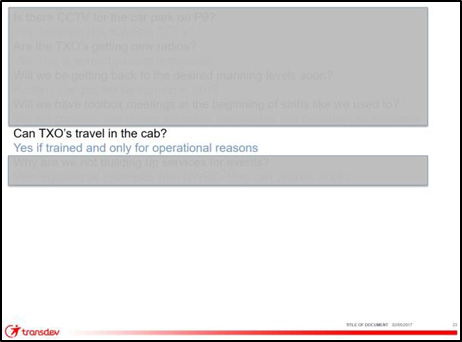
- The TXO was sitting in the driving cab of the relay train for operational reasons. He was allowed to be there provided he was directly involved in matters related to the running of the train. The TXO was trained and experienced in the various routes and signals within the Wellington Station area. There was a lost opportunity for him to work with the driver by calling the relevant signals along the route. It is feasible that had he been doing so, he would have prompted the driver to focus on the correct signal, thereby averting the incident.
- Finally, when the signaller realised there had been a SPAD, his spontaneous reaction was to wave out of the window of the Wellington Signalbox to try and attract the attention of the relay train driver in the dark and rain. A more effective way to have communicated the problem would have been to use the available radio and call ‘stop, stop, stop’, thereby stopping both trains.
Signal definition
- The potential for a driver to confuse signals 99 and 100 was partially addressed in 2005 by the addition of non-reflective arrows on the signal poles, pointing to the respective track the signal is controlling (see Figure 12). The arrows are effective during daylight hours, but they are not illuminated or reflective and are difficult to see at night.

- In Figure 12, signal 100 controls the track depicted by the green arrow, which is the track the relay train was travelling on. Signal 99 controls the track to the right depicted by the yellow arrow, which was the track the Waikanae bound train was scheduled to travel on.
- Illuminating the arrows may have assisted the relay train driver in recognising which of the two signals applied to his train. The Commission has recommended that the Chief Executive of KiwiRail conduct a review of current arrangements and take any opportunities they can to reduce the risk of unsafe train operations in the area.
- In an automatic signalling area like Wellington Station, if a train passes a Red signal the surrounding signals governing potential conflicting movements automatically change to Red as a safety feature. This happens because the rogue train has occupied an unauthorised section of track beyond the Red signal, which then activates the associated track circuits to change all other signals to Red to prevent a potential collision.
- In this section of Wellington Station the complexity of possible movements and the congested nature of the area mean that the insulated joint where the track circuit detection happens is not directly adjacent to signal 100. The relay train proceeded 30 m past signal 100 and stopped 1 m short of the insulated joint. Consequently, the signals for the Upper Hutt bound train remained Green even though the relay train had passed the Red signal by 30 m.
- To allow simultaneous parallel train movements through adjacent sets of point on adjacent lines with the relatively simple electro-mechanical logic system in the existing Wellington Signalbox, sections of track have been linked to form zones (see Figure 13). This limits the sensitivity of the system and was the reason why the insulated joint was not located immediately adjacent to signal 100.

- This meant that the signal for the Upper Hutt service, displaying a ‘Green – Proceed’ indication, did not revert to ‘All Red – Stop’ despite the incursion of the relay movement towards the same convergence of points. It is debatable whether the Upper Hutt service would have had time to stop before colliding with the relay train if the relay had continued into the conflict area. However, had the signals for the Upper Hutt bound train reverted to Red as soon as the relay train passed the Red signal 100, the driver of the Upper Hutt bound train would have had more opportunity to slow his train before both trains reached the convergence points.
- A number of key signals in the Wellington Station area are fitted with signal trips (see Figure 14). However, there are no automatic signal trips fitted to signals 99, 100 or 101, which would automatically engage the train brakes in the event of a SPAD. The reason given for signal trips not being fitted to these signals is that the signals are too close to the conflict zone for a train to stop before it occupies the points area. However, in this case the driver was able to stop his train just short of the conflict zone and avoid a potential collision. There may therefore be some safety benefit from having such devices installed in some cases.

- KiwiRail has said that the current mitigation actions against train collisions and minimising damage to passengers and rolling stock in the event of a collision in this area are:
- for the driver to always stop at an ‘All Red – Stop’ signal
- a 20 kilometre-per-hour speed restriction in the area to ensure any collision is at a relatively low speed
-
the crashworthiness of the various train vehicle designs to minimise impact damage and vehicle incursion into the passenger compartment in the event of a train-to-train impact.
Only one of the three measures would actually prevent a collision, and that measure relies solely on human performance. The other two measures do not prevent collisions, but minimise the consequences instead.
- There have been 10 recorded relay movement SPADs within the Wellington Signalbox controlled area between January 2006 and May 2016, so this area could be considered a relatively high-SPAD and high-risk area. This incident has shown that more work is required by KiwiRail to reduce the risk of train collisions within the Wellington Station area. The Commission is recommending that the Chief Executive of KiwiRail liaise with Greater Wellington Regional Council to develop a long-term strategy for the metropolitan rail system, with a view to identifying and addressing the current safety issues with the track and signalling infrastructure in the Wellington Station area.
Appendix 1. Signal set-up for intended movements

Appendix 2. Wellington Station 1937 and 2016

Appendix 3. Comparison of Auckland and Wellington rail networks

Appendix 4. Signal Sighting Committee review notes for signal 99

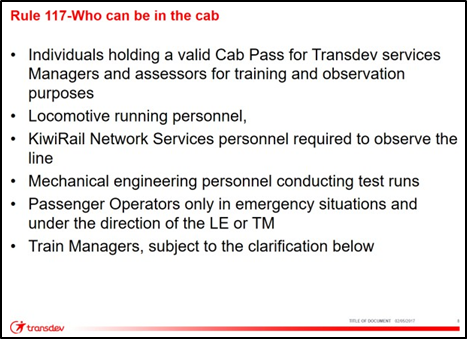
Appendix 5. Transdev staff briefing on Rule 117