The Monte Stello is a passenger and freight roll-on-roll-off ferry that was operating on the Cook Strait ferry service on short-term charter to Interislander, a business division of KiwiRail Limited. At about 0600 on 4 May 2011, the Monte Stello was making its entrance into Tory Channel via the eastern entrance. The bridge team comprised the master (acting as pilot), the third mate (acting as co-pilot), the helmsman, and the lookout.
Executive summary Tuhinga whakarāpopoto


- The Monte Stello is a passenger and freight roll-on-roll-off ferry that was operating on the Cook Strait ferry service on short-term charter to Interislander, a business division of KiwiRail Limited.
- At about 0600 on 4 May 2011, the Monte Stello was making its entrance into Tory Channel via the eastern entrance. The bridge team comprised the master (acting as pilot), the third mate (acting as co-pilot), the helmsman, and the lookout.
- While making the left-hand turn into Tory Channel, the rudder was inadvertently placed in the wrong direction, causing the ship to deviate from the planned track. The error was soon realised and corrective action taken, but not soon enough to prevent the ship glancing off a rock on the northern side of the channel.
- The rock caused indenting of the hull plating but did not penetrate the hull. One of the vessel’s two propellers sustained damage when it also struck the rock. The ship was able to complete the voyage to Picton unaided. No-one was injured in the accident.
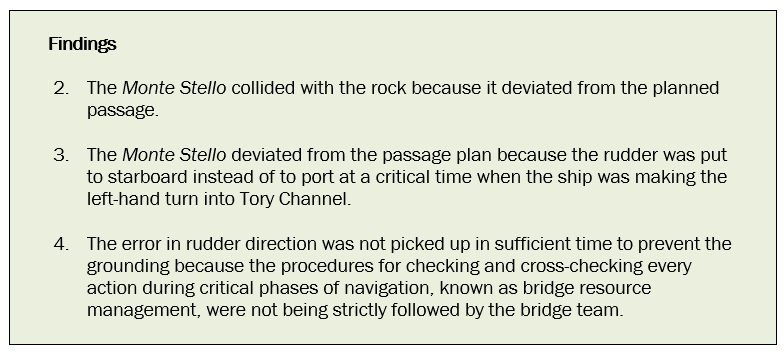
- The Commission found that the error in rudder direction was not picked up in sufficient time to prevent the grounding because the procedures for checking and cross-checking every action during critical phases of navigation, known as bridge resource management, were not being strictly followed by the bridge team.
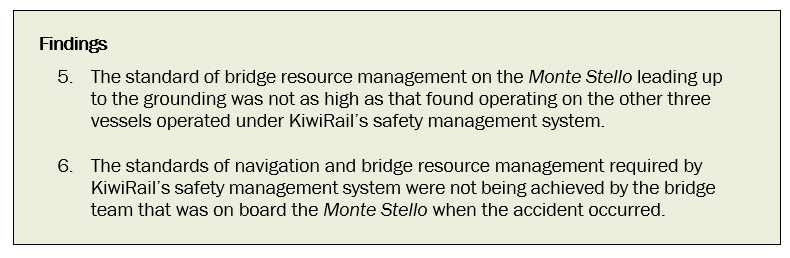
- The Commission also found that the standards of navigation and bridge resource management required by KiwiRail’s safety management system were not being achieved by the bridge team that was on board the Monte Stello when the accident occurred.
- The Commission made one recommendation to KiwiRail to address this safety issue.
- A key lesson arising from the inquiry was that bridge resource management is not something that can be trained for and then left to chance. It must be a standard operating procedure fully understood and followed by all crews, all of the time. It only takes one bridge team failure to result in a serious accident.
Factual information Pārongo pono
Narrative
- The Monte Stello is a roll-on-roll-off ferry that was operating between Wellington and Picton. The ferry was on a short-term bareboat charter to Interislander, a business unit of KiwiRail Limited, while one of its permanent vessels was undergoing a major modification.
- On 3 May 2011 the Monte Stello was in Wellington preparing for its departure to Picton early the following morning.
- The master joined the vessel at about 1400 on 3 May 2011. The third mate, helmsman and lookout joined the vessel at 0200 on 4 May and began loading operations along with the rest of the crew. The rostered helmsman had called in sick and so a standby crew member was called in to replace him.
- When loading operations were complete, the Monte Stello left its berth at 0349 on 4 May.
- The helmsman steered the vessel out of Wellington Harbour under the control of the master. There were five people on the bridge at the time: the master, the third mate, the helmsman, the second mate, and the lookout. Once the vessel was clear of Wellington Harbour the master set the auto-pilot and handed over the control to the second mate. The master then left the bridge. The trip across Cook Strait was unremarkable. At about 0500 the third mate took over the watch from the second mate.
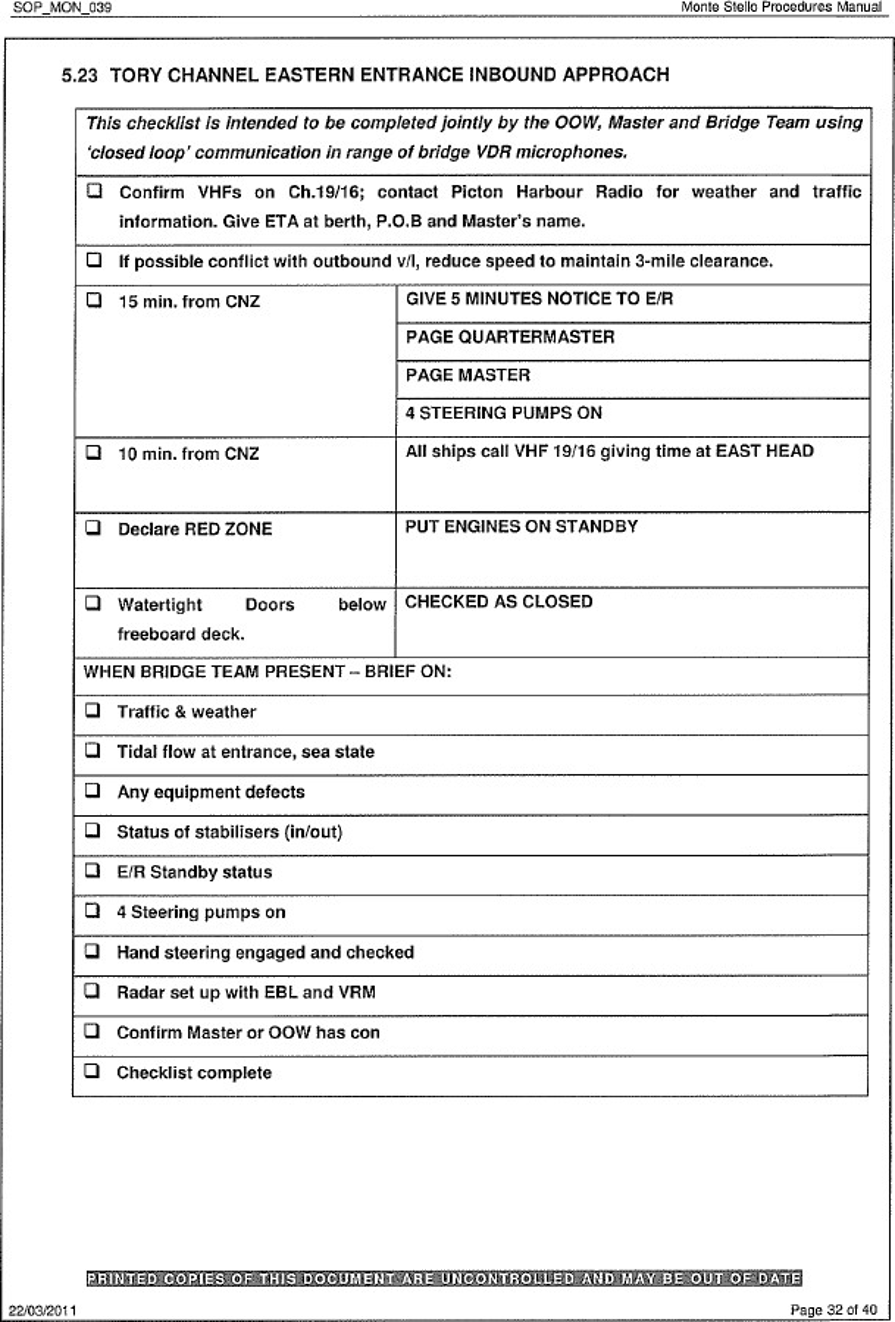
- It was pre-dawn and hence dark when the vessel was approaching the entrance to Tory Channel, and visibility was restricted by light rain and/or mist. The third mate called the master, who arrived on the bridge shortly before 0540. The third mate then ran through the checklist Tory Channel Eastern Entrance Inbound Approach. As part of that checklist he briefed the bridge team on the Monte Stello’s status, environmental conditions, and other ship movements within the Marlborough Sounds. The master then took over the control of the vessel at about 0540, approximately 12 minutes before the Monte Stello entered the Controlled Navigation Zone (the Controlled Navigation Zone is defined in bylaws and shown on the chart. It is intended to ensure that only one vessel of 350 gross tons or more navigates within the confines of the zone at any one time) at the entrance to Tory Channel (see Figure 2). The “Change of watch checklist” was also completed at the same time.
- The Monte Stello entered the Tory Channel Controlled Navigation Zone at about 0552.
- Once the master had control of the vessel he confirmed it was aligned with the leading lights (leading lights are a pair of light beacons. The beacons consist of two lights that are separated in distance and elevation, so that when they are aligned, with one above the other, they provide a leading line for safe navigation) into Tory Channel. He then turned off the auto-pilot and the helmsman took over helming duties using the ship’s wheel, acting on the master’s orders. The master then began to prepare for the controlled-radius-turn (a controlled-radius-turn is where the rate of turn of the vessel is controlled by a constant radius; that is to say, the path taken by the vessel is an arc) to port once the Monte Stello had passed West Head.
- As the Monte Stello came abreast of West Head light at about 0554, the master gave a helm order of “port 10” (a helm order of “port 10” means that the rudder should be put to 10 degrees to port; this will cause the vessel to turn to port). The helmsman repeated the order and as he put the helm 10 degrees to port the master acknowledged this correct confirmation. The master then asked the third mate to go to the port bridge wing to look out for the light on Scraggy Point. As the third mate walked across the bridge he looked up at the rudder indicator to confirm it had indeed gone to port 10 degrees.
- The master later said he then gave a helm order of “port 15”, which the third mate later confirmed that had he heard. However, the third mate did not recall the helmsman responding. The helmsman thought the master gave a helm order of “starboard 15”, and placed the helm over to starboard 15 degrees. The lookout said later during his interview that he heard “starboard 15”. The third mate was by then on the bridge wing outside the wheelhouse looking for the Scraggy Point light. He was not therefore monitoring the rudder indicator.
-
The master soon realised that the ship was not responding as he expected and so he checked the ECDIS (ECDIS is an acronym for Electronic Chart Display and Information System), which showed the Monte Stello was to starboard of the intended track. He gave a helm order of “starboard 20”; he realised he had misspoken and immediately corrected himself by giving the order “midship”, which means to put the rudder to the centre. The lookout also challenged his “starboard 20” order.
- The master then ordered “hard a-port”. He moved to the engine control and stopped the port engine and reduced the starboard engine to “4” (four-tenths of normal forward power). He then put the port engine to astern and the Monte Stello began rapidly turning to port.
- At about 0555 the starboard quarter (the starboard, rear part of the ship) of the Monte Stello collided with a rock, which was felt by all personnel on the bridge.
- The master put the vessel engine controls to slow ahead,and activated the remote controls to close all the watertight doors. He then called the standby mate to inspect below for water ingress. The master also conversed with the engine room crew on the telephone.
- The crew did not find any evidence of water ingress. There appeared to be no undue vibration in the vessel and the rudder appeared to be operating effectively. The master proceeded slowly, and gradually increased vessel speed up to 16 knots.
- The Monte Stello continued down Tory Channel without issue. When it reached Diffenbach.
- Point the master ordered “port 10”; however, the helmsman put the rudder to starboard. The master corrected him, after which the helmsman put the rudder to port and the Monte Stello continued on to berth
- The Monte Stello was berthed in Picton at 0724. Once berthed, a preliminary dive survey found damage to the starboard propeller and to the starboard hull plating below the bilge keel in the midships area. This assessment was subsequently confirmed with another, more detailed, inspection carried out once the ship had returned to Wellington.

Crew profile
- The master began his seafaring career in Great Britain in 1960. He gained a master’s certification in 1974. He was granted a New Zealand certificate of competency as Master of a Foreign-going Ship in 2002. He began working at KiwiRail as first mate in 2003, and was promoted to master in 2006. He began sailing as master on the Monte Stello on 12 April 2011.
- The third mate began his seafaring career in Sri Lanka in 1996, where he served as an ordinary seaman. He began working at KiwiRail in 2001. In 2006 the Australian Maritime Safety Authority granted him a certificate of competency as Watchkeeper (Deck), which was endorsed by Maritime New Zealand in November 2010.
- The helmsman gained an Able Bodied Seaman certificate in 2000 in Kiribati. He started at KiwiRail in 2008 as an able seaman.
- The lookout began his seafaring career studying at Tuvalu Maritime Training Institute and joined his first ship in 1993. He began working at KiwiRail in 2003. He was granted a New Zealand Certificate of Competency as Able Bodied Seaman in 2009.
Environmental conditions
- At the entrance to Tory Channel the wind was 12 knots from the northeast. There was light rain and/or mist. It was pre-dawn and hence it was dark, but there was no cloud. Sea state was slight with negligible swell. The tidal stream was flooding into Tory Channel.
- New Zealand Nautical Almanac 2011-12 predicted the high water tide at Picton was 0742 on 4 May. The Monte Stello entered the Tory Channel Controlled Navigation Zone at about 0552 that morning, which was a little less than two hours before high water at Picton. The New Zealand Nautical Almanac 2011-12 tidal stream diagram for a flood tide at Tory Channel entrance for that time is given in Figure 3. Some of the tidal stream vectors have been superimposed over the chart excerpt in Figure 2.

Safety management systems
- The International Maritime Organization (IMO) publishes standards for shipping. The IMO implements those standards via a number of instruments such as the International Convention for the Safety of Life at Sea, 1974 (SOLAS Convention).
-
Chapter IX of the SOLAS Convention is the International Safety Management and Pollution Prevention Code (ISM Code). The purpose of the ISM Code was to provide an international standard for the safe management and operation of ships and for pollution prevention.
- Under New Zealand regulations, each vessel which met the criteria for the ISM Code was required to hold two certificates issued by the administrator (Maritime New Zealand). The first was to certify that the safety management system of the company that operated the vessel complied with the ISM Code. This certificate is the Document of Compliance. The second is to certify that the safety management system as applied on board the vessel itself complied with the ISM Code. This certificate is named the Safety Management Certificate.
- The Monte Stello was owned by Monte Stello Limited and operated by KiwiRail under a bareboat charter. Under this arrangement KiwiRail paid a daily hire rate to the owners and in return took full possession of the vessel with respect to maintenance and operation. The charter agreement was signed on 17 March 2011. Thus KiwiRail Limited was responsible for the Monte Stello’s safety management system.
- Maritime New Zealand had audited and issued a Document of Compliance to certify the safety management system of KiwiRail Limited on 18 February 2011. Maritime New Zealand had also audited and issued an Interim Safety Management Certificate for the Monte Stello on 28 March 2011. An Interim Safety Management Certificate is granted to vessels that are new to the operator, because there is insufficient record of operation to grant a full Safety Management Certificate. Both certificates were valid at the time of the grounding.
- This inquiry focused on the aspects of the KiwiRail and Monte Stello’s safety management system relating to navigation and bridge resource management. These aspects are discussed in the following analysis section.
Analysis Tātaritanga
Introduction
- The grounding of a roll-on-roll-off passenger and freight vessel is a serious accident with potentially high consequences. If the Monte Stello had collided with the rock a few metres further into the turn then it could have resulted in the hull being penetrated.
- The Monte Stello collided with the rock because it deviated from the planned passage. There was no evidence of a failure of any engineering control or propulsion systems, or of its navigation systems. There was, however, evidence that the deviation from the planned passage was due to a breakdown in bridge team performance.
- The following analysis discusses the Monte Stello and KiwiRail’s safety management systems and how, together, they were supposed to ensure procedures were in place to minimise the opportunity of accidents such as this happening. Section 4.2 describes the concept of bridge resource management and how it was intended to work. Section 4.3 describes what happened on the bridge of the Monte Stello that caused the ship to collide with the rock.

Bridge resource management
- The safe navigation of a vessel is dependent on the performance of the bridge team. However, human error is ubiquitous and inevitable, a fact noted by Professor James Reason (Reason, J. (1990). Human Error. New York: Cambridge University Press). Professor Reason said, “Error management has two components: limiting the incidence of dangerous errors and – since this will never be wholly effective – creating systems that are better able to tolerate the occurrence of errors and contain their damaging effects (Reason, J. (1997). Managing the Risks of Organizational Accidents. Aldershot: Ashgate).” That is to say, human error will occur and so a primary driver in the vessel’s safety management system is to prevent and correct any errors that are made.
- The Monte Stello’s safety management system incorporated the practices of bridge resource management (BRM). BRM is the name given to an industry-recognised methodology and behaviour covering all aspects of bridge operations. The key safety aspect of BRM is that it uses all available resources, including people, procedures and equipment, to provide safeguards against accidents of the “one-person-error” (a one-person-error is an error made by one person) type.
- Three procedures manuals relevant to this incident were KiwiRail’s Fleet Operating Procedures, its Fleet Passage Plan, and the Procedures Manual for Monte Stello.
Fleet Operation Procedures
- The Fleet Operating Procedures manual described the principles and procedures that should be applied by all crew across the KiwiRail Limited fleet. Section 2 was titled “Bridge Operating Procedures” and contains various subsections describing, for example, the “Principles of Watchkeeping” and what the officer-of-the-watch must do. A review of this document did not identify any issues that contributed to the grounding.
Fleet Passage Plan
- The Fleet Passage Plan contained detailed passage plans for the passages between Wellington and Picton via Tory Channel. The passage plans described waypoint positions; courses; distances; radio call requirements; chart excerpts showing the passage plan; comments highlighting any dangers or restrictions; and various other pertinent information. A review of this document did not identify any issues that contributed to the grounding.
Procedures Manual for Monte Stello
- The Procedures Manual for Monte Stello was effectively a catalogue of checklists specific to the Monte Stello that the crew must use for critical procedures. For example, it included a checklist named Tory Channel Eastern Entrance Inbound Approach (see the appendix), which prompted the bridge team to specific actions they must take on the approach to Tory Channel. A review of this document did not identify any issues that contributed to the grounding.
Shared mental model
- An underlying principle of eradicating error within teams is the concept of a shared mental model. A shared mental model is a concept whereby the members of a team share the same understanding of the operation to be performed and the teamwork involved. Thus if a team member deviates from what is expected, then other team members will notice, challenge and correct the error.
- The concept of a shared mental model across the bridge team is critical to bridge resource management, and is encapsulated within the Monte Stello’s safety management system. An example of this is bridge team briefings. The Tory Channel Eastern Entrance Inbound Approach checklist states: “This checklist is intended to be completed jointly by the [officer of the watch], master and bridge team… .” The checklist states that the entire bridge team must be briefed at the same time on a number of points including (but not limited to) “traffic and weather, tidal flow at entrance, sea state, hand steering engaged and checked, and confirm master or officer-of-the-watch has [control of the vessel]”.
Closed loop communication
- Another example of ensuring a shared mental model is with respect to communication. The
- Fleet Operating Procedures manual says: “Closed loop [communications] shall always be used when communicating with or within the bridge. For example – between the pilot and helmsman when altering to a new course…:

Red Zone
- The Monte Stello’s safety management system provided procedures for high risk operations, where the tolerance for error is low, and the consequence of failure is high. The entrance to Tory Channel involved strong currents, a tight turn to port (left), and limited room for the vessel to manoeuvre. The safety management system recognised this as high risk and classified the entrance to Tory Channel as a “Red Zone”. The passage plan stated the “Red Zone begins 10 minutes prior to entering Tory Channel Controlled Navigation Zone” and extended all the way to the berth at Picton. One of the prompts on the Tory Channel Eastern Entrance Inbound Approach checklist was to “declare Red Zone”.
- The declaration of a Red Zone was intended to trigger a heightened level of crew vigilance and safety for operations. The areas covered by Red Zones were defined within the Fleet Passage Plan, and the Fleet Operating Procedures manual described the required bridge procedures within Red Zones. For example, there was an increased manning level where the master was required to be on the bridge in addition to the officer-of-the-watch, the helmsman, and a lookout. Also, a pilot/co-pilot system would always be in place while the vessel was operating within a Red Zone. The pilot/co-pilot system was described in the Fleet Operating Procedures manual.
Pilot/Co-pilot system
- The pilot was the officer who had the control of the vessel. The pilot initiated all manoeuvres, ensured the co-pilot was well informed about planned actions, and was responsible for the successful execution of the passage plan. In this case, the master was the pilot.
- The co-pilot was an officer responsible for “following up all manoeuvres and navigation made by the pilot”, and also “[review] all actions taken by the pilot and keep himself aware of all planned actions in order to be able to take over their duties at any time”. The co-pilot was also responsible for other duties including (but not limited to) communication external to the bridge team and monitoring the ship’s position relative to the plan. In this case, the third mate was the co-pilot.
The Monte Stello’s approach to Tory Channel
- The third mate was the officer-of-the-watch as the Monte Stello approached the entrance to Tory Channel. He called the master to the bridge as planned. When the master arrived on the bridge, the other three crew members were already there. At about 0540 the third mate and master completed the bridge control handover checklist and the Tory Channel Eastern Inbound Approach checklist in the presence of the other bridge team members. The bridge team at that time was the master (as pilot), third mate (as co-pilot), helmsman, and lookout.
- Once the master had control of the vessel, he began monitoring its track against the leading lights, which provided a lead for the vessel through the entrance and into Tory Channel. He turned the auto-pilot off and the helmsman began steering by hand to the master’s orders.
- The master planned for the Monte Stello to pass through the heads and then begin a controlled-radius-turn to port in accordance with the passage plan. Although the two required checklists were used, there was no significant discussion or briefing on the imminent entry to Tory Channel. He did not discuss the plan with the other bridge team members, as he thought that entering Tory Channel was a routine manoeuvre which he expected the other bridge team members would be familiar with. The master did not think it necessary for the helmsman to know details of the plan, as his role was simply to execute whatever helm order the master gave him. Similarly the helmsman felt he did not need to know, as he was focused solely on following the master’s helm orders.
- However, the accident voyage was the first time the bridge team had worked together to transit Tory Channel. Prior to the accident voyage, the helmsman had neither acted as helmsman on the Monte Stello, nor acted as helmsman on any other vessel through the entrance to Tory Channel. Neither the lookout nor the helmsman had sailed with the master before. This unfamiliarity should not necessarily have been an issue if good BRM practices were being followed. However, neither the master nor the helmsman had engaged with the principles of good BRM: one questioning the other’s need to know, and the other questioning why he needed to know.
Wrong-way helm
- When the Monte Stello was abreast of West Head, the master (acting as pilot) initiated the controlled-radius-turn to port by speaking the helm order “port 10”. The helmsman repeated the order, which the master confirmed. The process they followed was a textbook example of closed loop communication as described in KiwiRail’s Fleet Operating Procedures manual. The third mate (who was co-pilot) monitored the rudder indicator to ensure it went to port 10, and in doing so fulfilled his duty to follow up on the master’s intentions. Through this process there could be no misunderstanding or practical mistake between what the master planned to happen and what did happen. The Monte Stello began to turn to port.
- Due to the design of the bridge, the master did not have a clear view out the side of the bridge and so he sent the third mate out to the port bridge wing to watch for the light on Scraggy Point. From that position the co-pilot was not able to monitor the master’s actions and outcomes, and so from that time the pilot/co-pilot system ceased to have effect. An option open to the master was to ask the lookout to look for the Scraggy Point light. The practical outcome was that henceforth no-one monitored the master’s orders, nor the rudder indicator, to ensure they were correct. This included the master. Depending on the circumstances, it is good practice for the pilot (the master in this case) to glance at the rudder indicator for each order given to ensure it is moving to the expected position.
- The Monte Stello was still to starboard of the planned track and so the master intended to increase the rate-of-turn by increasing the rudder angle. The master said he ordered “port 15”, which the third mate said he heard as he walked across the bridge to the port bridge wing, but both the helmsman and lookout later said the master had ordered “starboard 15”. The helmsman turned the rudder to starboard. He did not repeat the order nor did the master follow up to confirm his order was understood. Closed loop communication was not used and hence the opportunity to correct the error was lost. Because the third mate had gone to the bridge wing, no-one was monitoring the rudder indicator, and so another opportunity to correct the error was lost.
- The helmsman later said that he thought the ship was still approaching the channel entrance and that the master was aligning the vessel with the leading lights. Therefore, he did not think an order for starboard rudder was inappropriate. Usual protocol for deliberately changing the helm order from port to starboard would be to first order the rudder to amidships. A fully aware helmsman would ideally confirm such a perceived order to place the helm directly from a port setting to a starboard setting. Aside from what the helmsman thought, had the bridge team been more engaged as a team, sharing the same understanding of where the ship was and what was planned next, it is more likely the helmsman and/or lookout would have recognised that for the master to give a starboard helm order in that situation would be unusual.
- The Monte Stello deviated further from the planned turn to port due to the wrong-way helm (the condition whereby the rudder is put in the opposite direction from what was expected, for example where the officer of the watch ordered the rudder to port, but the rudder was put to starboard). At that point the master did not realise the rudder had gone the wrong way, and he thought the problem was that the angle of rudder to port was still insufficient. He intended to increase that angle further to port. However, he misspoke and said “starboard 20”. He immediately realised his mistake and corrected himself by saying “midships”, and then “hard a-port”.
Summary
- The safety management system provided four procedures that should have helped prevent the helm being put the wrong way:
- the pre-manoeuvre briefing for the bridge team
- the declaration of “Red Zone” to heighten the crew’s awareness and vigilance
- the pilot/co-pilot system
- the closed loop communication.
- The pre-manoeuvre briefing (completion of the Tory Channel Eastern Inbound Approach checklist) did not include any discussion about the actual planned passage, nor reminders about responsibilities (for example pilot/co-pilot), nor was “Red Zone” declared. The first two points were not included in the checklist. However, they are an integral part of effective BRM practice. The briefing did not result in a shared mental model across the bridge team.
- The declaration of “Red Zone” was intended to provide a heightened level of vigilance. However, it appears to have had little effect on the actions of the bridge team other than the increased manning level.
- The pilot/co-pilot system was rendered ineffective when the co-pilot was ordered to a location where he was unable to monitor the pilot’s actions and outcomes and to some extent there might have been an overreliance on it, as evidenced by the master not routinely checking that what he had asked for was actually happening.
- Bridge team members later said that closed loop communication was not always used, especially in routine manoeuvres. This was one explanation for why it was used for one helm order and not the next.
- The safety management system provided appropriate defences against the wrong-way helm error yet the Monte Stello still collided with the rock. The reasons why the safety management system failed to ensure the safety of the vessel are discussed in the next section.
Safety management system
- BRM is founded on the principle of teamwork, where all team members contribute to its success. It is the responsibility of all bridge team members to implement the practices and behaviours of BRM. For an individual to implement the practices and behaviours they must first understand them, and so it follows that all bridge team members should be trained in those practices and behaviours.
- Of the four bridge team members on board the Monte Stello, only the master and third mate had received formal BRM training. Some of their actions and discussions following the accident indicated they had not wholly embraced the concept. The other two had picked up some concepts via exposure to it as a part of their roles on the bridge. For example, they understood what “closed loop communication” meant. Thus the effective implementation of the safety management system was almost wholly reliant on the officers’ explanation and enforcement of the practices and behaviours of BRM, which clearly did not happen in this case. This issue was compounded by the fact that this bridge team had not sailed together before, and the helmsman was not a regular bridge team member.
-
The master has ultimate responsibility for ensuring high standards of navigation and BRM are being achieved by his or her bridge team. Therefore, for BRM to be fully effective, the master must lead by example and drive the bridge team to conform to the practice.
- Safety management systems for individual ships are linked to the safety management system for the operating company. The BRM aspects of the safety management system as applied on board the other three vessels operated by KiwiRail were audited internally by KiwiRail as part of its safety management system, and externally by Maritime New Zealand as part of its ongoing process of continual improvement for Cook Strait ferries.
- KiwiRail audited the BRM procedures of the three vessels in its fleet in December 2008. The auditors travelled with the ships and observed the bridge team performance. KiwiRail found that bridge team briefing sessions across all three vessels were carried out in a meaningful and positive manner. On one vessel it found that “robust BRM procedures were observed to be in use as routine procedure”, and on another it found that it was timely to initiate another round of BRM courses due to significant change of staff.
- In January 2010 Maritime New Zealand auditors completed one round trip with each of the three vessels to assess the operation of the bridge team; the auditors then produced a Bridge Resource Management Assessment report. The report found that generally the masters and senior officers “were confident of their powers of discretion and empowerment”. In particular, bridge lookouts were “well briefed in their role and responsibilities”, and “best practice closed loop bridge communication was consistent at all times”. However, the audit report also raised a question about how the skill and experience of the master and senior officers were passed on to junior officers. In the report the auditors “wished” that bridge resource management training be considered by KiwiRail for all deck officers as a further process improvement.
- Both internal and external audits found that generally BRM practices were operating effectively. However, they also both raised questions about the level of BRM training given to the bridge teams, including for existing junior officers and for new crew.
- The safety management system as applied on board the Monte Stello had not yet been audited while in operation. However, it is clear that, at least on the accident voyage with this particular crew, BRM was not implemented effectively.
- Arguably the standard of navigation and BRM on the Monte Stello posed the biggest risk to KiwiRail. The ship had not been fully embedded into the KiwiRail safety management system and was only on a short-term charter. Additionally, the make-up of the crew was ad hoc, meaning bridge teams would not have the benefit of familiarity in working with each other as they did on the permanent ships in the fleet.
- This accident is a salient reminder that bridge resource management is not something that can be trained for once only on a fleet-wide basis and then left to chance. It must be a standard operating procedure fully understood and followed by all crews, and the safety management system needs to ensure that it remains that way as crews come and go from the fleet. It is equally important for all ships in the fleet, regardless of whether they are there for the short or long term. The Commission has recommended that the chief executive of KiwiRail future-proof the bridge resource management policy and procedures outlined in its safety management system to ensure they remain relevant and effective for all crews on all ships in the fleet, all of the time.
Appendix 1. Tory Channel Eastern Entrance Inbound Approach