The fire on the fishing trawler Dong Won took hold because the fire alarm did not sound, the crew’s initial firefighting was inefficient; and the ship was exempt from and did not comply with current structural fire protection standards. On any such vessel, the crew may not be as safe as they would be on a newer vessel constructed to newer standards. TAIC recommendations address the key issues.
Executive summary Tuhinga whakarāpopoto


- On 9 April 2018, the New Zealand-registered fishing trawler Dong Won 701 was discharging its catch of fish in the port of Timaru when fire broke out in the accommodation space. Initial attempts by crew to extinguish the fire were unsuccessful, and by the time Fire and Emergency New Zealand attended the vessel, the fire had engulfed much of the accommodation.
- The firefighting response continued for some eight days until the fire was fully extinguished. The vessel was later declared a total constructive loss. Three crew members and one Fire and Emergency New Zealand firefighter had to be treated at hospital for smoke inhalation.
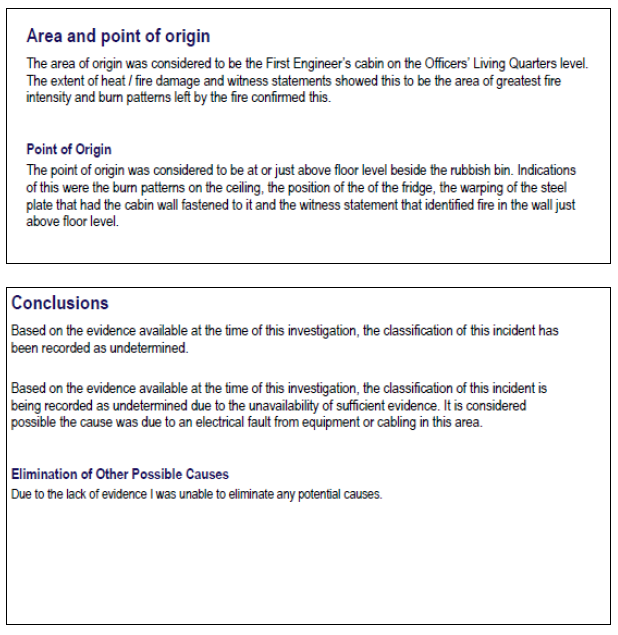
- The Transport Accident Investigation Commission (Commission) found that the fire started in a cabin on the officers’ deck, but due to its intensity and duration and the consequent damage to the accommodation structure, it has not been possible to establish how it started.
- The Commission found that delays in sounding the alarm, the inefficient mustering of available crew and a failure to follow good industry practice for fighting the fire allowed it to spread rapidly through the accommodation.
- The Commission also found that although the Dong Won 701 complied with the relevant Maritime Rules, the vessel’s structural fire integrity did not meet contemporary standards, and this was a factor in the speed and intensity with which the fire spread.
- Safety issues identified included that inconsistencies in the application of Maritime Rules Part 40D: Design, Construction and Equipment – Fishing Ships may have resulted in up to 12 fishing vessels operating under the New Zealand Flag not complying fully with the relevant safety standards. A further 50 fishing vessels have been afforded grandparent rights that will allow them to operate indefinitely without meeting contemporary safety standards under the current Maritime Rules.
- The Commission has made one recommendation to the operator, DW New Zealand Limited, and two recommendations to the Director of Maritime New Zealand.
- Key lessons arising from this inquiry included:
- safety-critical systems such as fire-detection and alarm systems must be routinely tested to ensure they remain functional at all times in order to give early warning of a fire
- on discovering a fire it is important for the safety of all on board that the ship’s general alarm is used to alert crew to the danger as soon as possible
- it is important to slow or prevent a fire spreading by, as soon as possible, closing all openings that can allow air to feed or be drawn into the location of the fire.
Factual summary Pārongo pono
Background
- The Dong Won 701 was a New Zealand-registered, 82-metre-long fishing trawler. The vessel was owned and operated by Dong Won New Zealand Limited, a subsidiary of the Dong Won Fisheries Company, based in South Korea.
Narrative
- The Dong Won 701 sailed from Dunedin on 7 March 2018 and spent 33 days at sea before returning to Timaru at about 0640 on 9 April 2018 to discharge the catch.
- Cargo discharge continued until about 1700 that day. That evening 35 crew members went ashore, leaving the master and eight crew members on board.
- One of the crew members who had gone ashore at 1945 was the first engineer. The first engineer’s cabin was located on the port side of the officers’ deck (see Figures 1 and 2).
- At about 2045 an engine room rating in an adjacent cabin noticed smoke entering the cabin through the ventilation duct. The engine room rating decided to investigate and noticed smoke coming from the first engineer’s cabin.


- The engine room rating opened the first engineer’s cabin door and was overwhelmed by thick black smoke, so closed the door again. The engine room rating then began knocking on other cabin doors shouting “Fire!” to alert the rest of the crew.
- The ship had an automatic fire-detection and alarm system on board but it had not activated.
- A deck officer who was coming down the stairs at the time took a portable fire extinguisher to the first engineer’s cabin and together with the engine room rating attempted to fight the fire. However, hampered by smoke they retreated down the passageway through an exit door to an open deck at the back of the accommodation space. They left both the first engineer’s cabin door and the exit door to the outside deck open. They thought this would help clear smoke from the cabin and passageway.

- Another crew member on the crew deck below the officers’ deck heard the engine room rating shouting “Fire!”. That crew member also began shouting “Fire!” and knocking on cabin doors to alert any crew members on that deck.
- The master, who was asleep in his cabin at the time, was informed of the fire by a phone call from the bridge. The master went to the bridge to organise a firefighting response.
- The crew attempted to rig a ship’s fire hose to fight the fire, but could not pressurise the fire hose because they were unable to get the emergency fire pump to deliver water.
- At about 2130 a number of the crew members ashore learned of the fire and returned to the vessel. At about that time the vessel’s generators shut down, causing a blackout.
- The chief engineer and first engineer entered the engine room to restart the generators. Their intention was to restore power to run the refrigeration compressors and collect the ammonia refrigerant flowing through the freezer compartments located under the accommodation space that was on fire. The engineers succeeded in restoring power long enough to divert the ammonia into a secure tank away from the fire.
- At about 2125 a member of the public notified FENZ of the fire. FENZ arrived on the scene at about 2132. By this time the fire was well established and the vessel’s accommodation superstructure was engulfed in flames.

- FENZ firefighters took control of the scene and evacuated the master and all crew from the vessel.
- FENZ used multiple low-pressure fire hoses and an aerial monitor positioned on the wharf to boundary cool the side of the vessel.
- The operations manager for PrimePort Timaru arrived on the scene at about 2215 and instructed the port tug, Te Maru, to assist with the firefighting effort. The tug positioned on the port side of the vessel at about 2230 and started boundary cooling.

- PrimePort Timaru engaged an independent maritime expert with specialist knowledge in maritime firefighting to assist FENZ with the technical aspects of fighting a fire on board a ship. The maritime expert was on the scene at about midnight the same evening the fire started.
- The firefighting effort continued for two days, focused on boundary cooling and limiting the amount of water entering the ship (uncontained water in a ship can adversely affect the ship’s stability, and in the worst case can cause it to capsize).
- On 12 April, with the fire still not extinguished, FENZ decided to inject high-expansion foam into the vessel. The FENZ team cut holes on the upper forecastle deck and injected foam into the lower decks. They also sealed off the accommodation portholes to reduce the supply of oxygen to the fire.
- It took several days to seal the portholes and inject the high-expansion foam into the vessel.
- On 17 April 2018 the fire was fully extinguished.
- Three crew members and one FENZ firefighter had to be treated at hospital for smoke inhalation as a result of the fire or the firefighting effort.
- Although the fire was fully extinguished, the ship was later declared a total constructive loss.
Scene examination
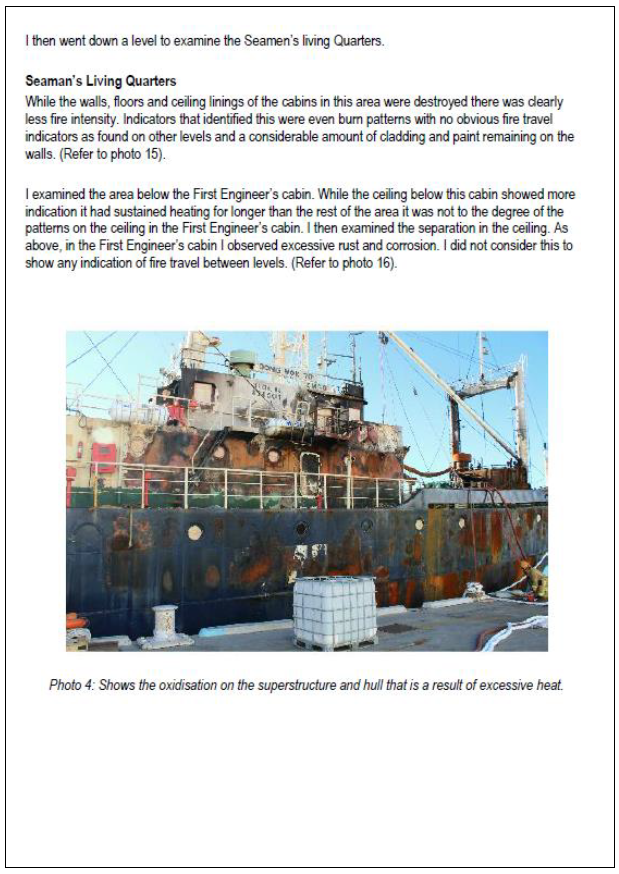
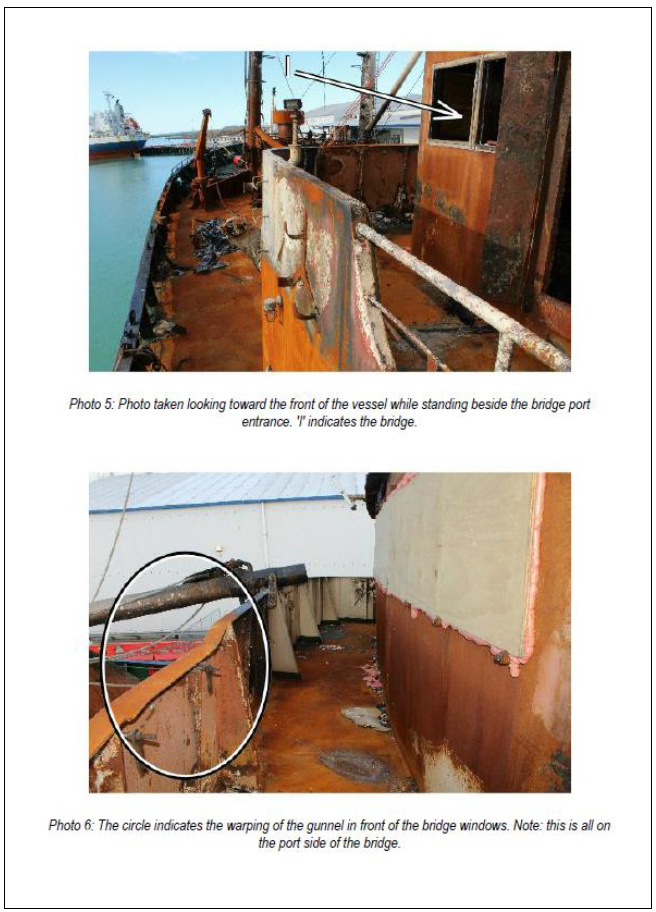
- The following is an overview of the damage caused by the fire. A FENZ fire investigation report in Appendix 1 provides a more detailed description of the damage. The vessel suffered fire and heat damage to areas forward of the main winches on the upper deck, as shown in Figure 6.

- The accommodation superstructure and area forward of the superstructure suffered severe heat damage and buckled in several areas. The rear of the superstructure was less affected: the protective paint was still relatively intact and there was no buckling of the upper deck.
- A ventilation damper located above the bridge was found in the open position.

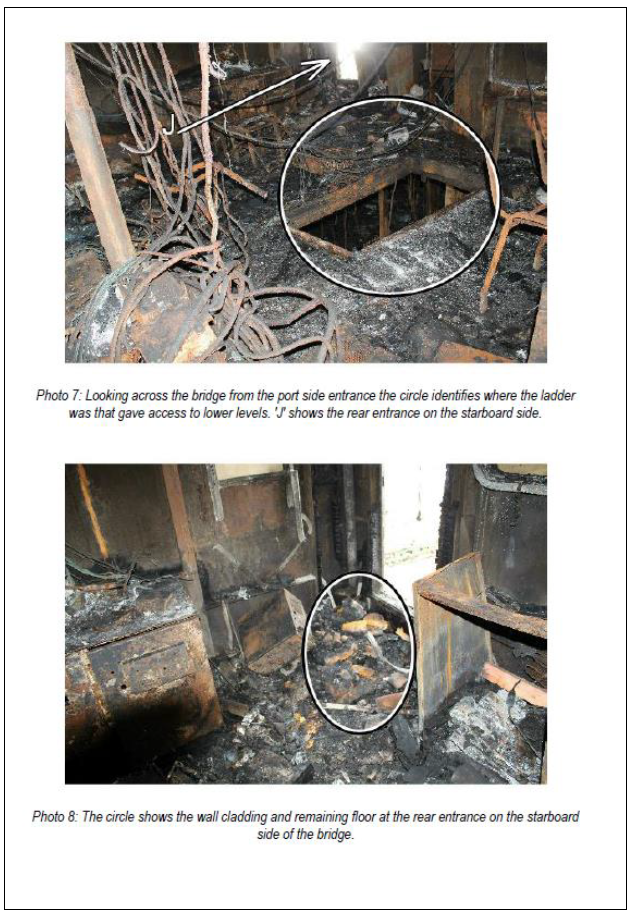
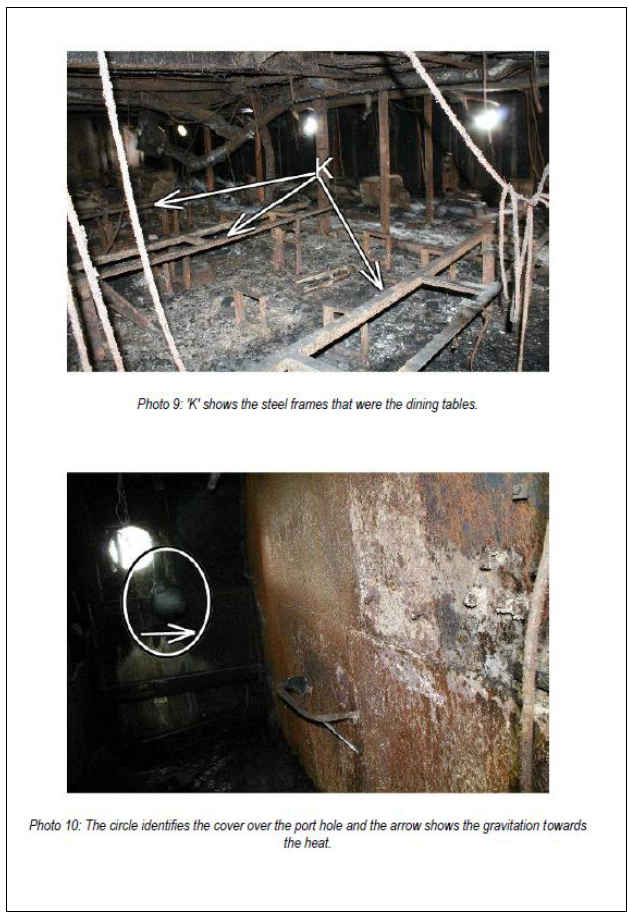
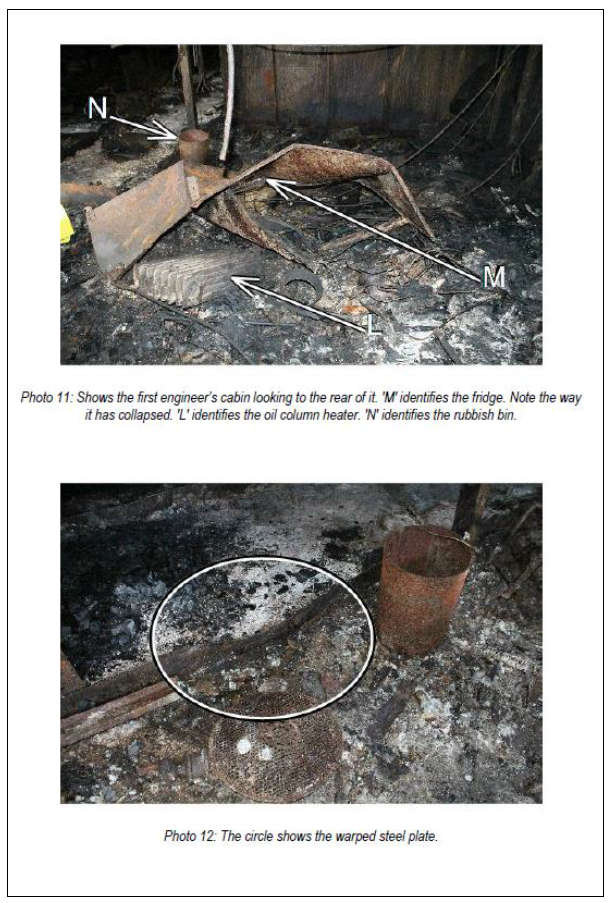
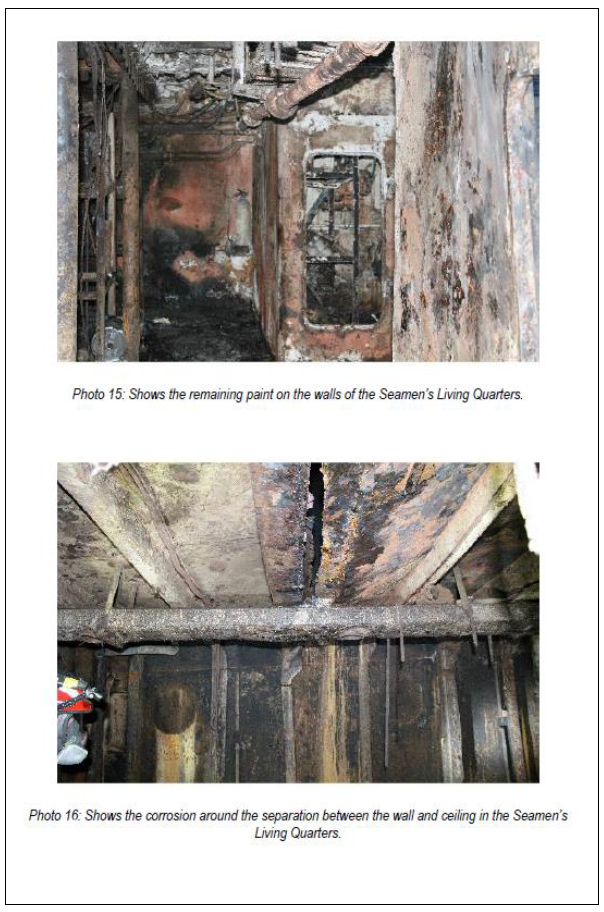
- All cabins located on the port and starboard sides of the officers’ deck were destroyed by the fire (see Figure 8 and Figure 9). The first engineer’s cabin suffered the most fire damage. The severity of the damage reduced with the distance away from the first engineer’s cabin.


Analysis Tātaritanga
Introduction
- Fire on board any ship is a serious event. Ships are necessarily designed with a number of high-fire-hazard machinery and electrical installations in close proximity to accommodation and cargo spaces, each with its own fire risk. These fire risks are managed through:
- fire-resistant design and construction
- fire-detection and warning systems
- firefighting appliances and systems
- firefighting procedures.
- In this case the fire occurred while the ship was in port, where shore-based firefighting resources were available (Refer Transport Accident Investigation Commission Report MO-2017-205). However, because ships spend the majority of their time at sea, remote from shore assistance, ship firefighting systems are designed around self-sufficiency when it comes to managing the risks and consequences of fire.
- The following analysis considers each of these aspects in relation to the fire on board the Dong Won 701, and discusses two safety issues:
- some aspects of the crew response to the fire did not meet industry good practice
- safety issues identified included that inconsistencies in the application of Maritime Rules Part 40D: Design, Construction and Equipment – Fishing Ships may have resulted in up to 12 fishing vessels operating under the New Zealand Flag not complying fully with the relevant safety standards. A further 50 fishing vessels have been afforded grandparent rights (a provision in which an old rule continues to apply to an existing vessel while a new rule applies to all future vessels. Those exempt from the new rule are said to have grandparent rights) that will allow them to operate indefinitely without meeting contemporary safety standards under the current Maritime Rules.
Cause of the fire
- Due to the intensity and duration of the fire and the consequent damage to the accommodation structure, it was not possible to determine conclusively the cause of the fire.
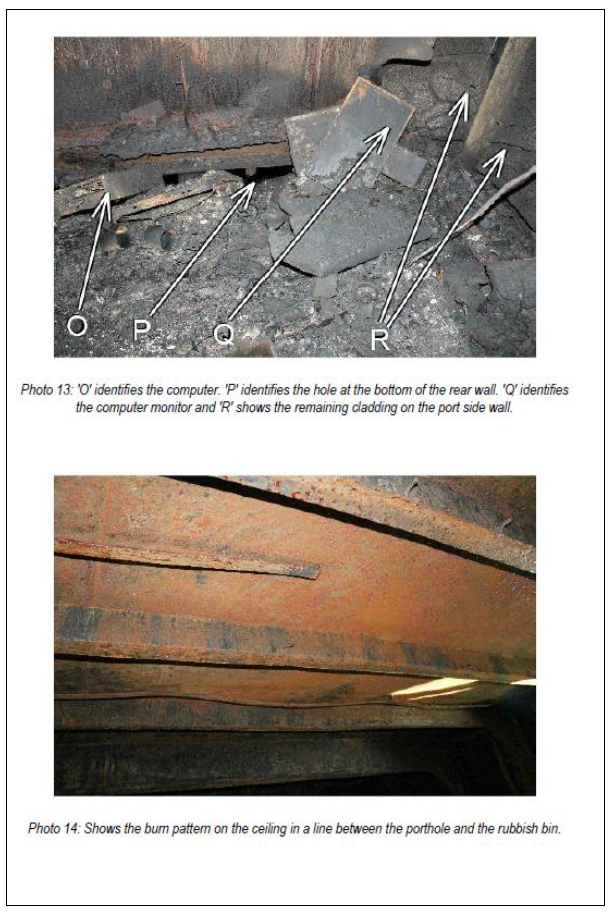
- Based on the observed burn patterns and the nature of the damage that occurred, the area of origin was determined to be the first engineer’s cabin on the officers’ deck. This hypothesis is supported by witness accounts, particularly those of the engine room rating who first discovered the fire, and the crew member on the deck below, who was able to confirm that initially there was no fire in the cabin directly below the first engineer’s cabin, or anywhere else on that deck.
- Figure 11 shows a plan of the first engineer’s cabin, reconstructed from the ship’s plans and according to interviews with crew. It shows multiple potential sources of ignition, mainly electrical sources.
- The point of origin was considered to be at or just above the floor level beside the rubbish bin, next to the first officer’s desk. The burn patterns on the ceiling and the warping of the steel plate where the cabin bulkheads were fastened supported this conclusion, as did the accounts of those who entered the cabin during the initial firefighting effort.

Fire detection and alarm
- The Dong Won 701 was fitted with an automatic fire-alarm and fire-detection system for the accommodation spaces. The system had been installed on board between 2015 and 2016.
- Each cabin was fitted with a photoelectric-type smoke detector connected to a fire alarm panel installed on the bridge. The smoke detector sent a signal to the fire alarm panel when smoke was detected. The fire alarm panel displayed the location of the fire and automatically triggered a general alarm throughout the ship.
- Smoke detectors of the type installed in the cabins could detect smoke at an early stage, even before it became obviously visible.
- The early detection of fire is critical to the safety of ship and crew. Early detection allows crew to respond immediately and extinguish the fire by direct attack before it escalates beyond control.
-
During this fire the fire-detection system did not detect the fire or sound the general alarm. Due to the damage caused by the severity and duration of the fire, it was not possible to determine why it did not function automatically.
-
Fire-detection and alarm systems are critical systems that would normally be routinely tested in accordance with manufacturers’ instructions. As the on-board maintenance records were destroyed in the fire, it was not possible to check these for compliance with such instructions.
-
The crew responsible for testing the fire alarm system explained that the fire alarms were “tested”, but they were unable to describe anything that resembled a routine regime for checking that all components of the fire alarm system were functional.
- Possible reasons for the system not activating include:
- a fault with the smoke detector in the cabin
- an interruption in power supply to the system
- the system being left in manual mode.
- An interruption in power supply was unlikely, as the system had a dual power supply to it and there had been no reported power supply issues prior to the fire. A fault with a single detector was also unlikely, as other detectors should have activated the alarm as the smoke spread to other areas; this did not happen.
- The system having been left in manual test mode could not be ruled out as the crew regularly left the alarm system in manual mode to avoid nuisance alarms triggered by exhaust fumes, hot work etc. The manual mode is not designed to be used as the primary operation mode. In manual mode the audible fire alarm could only be heard on the bridge and required the officer on watch to investigate and raise a general alarm if necessary.
- Regardless of why the system did not activate automatically, there were manual push-button alarms located on every deck that would have bypassed the automation and activated the fire alarm throughout the ship. Pushing one of these buttons would have been the best method of raising the alarm for everyone on board. None of the crew pushed a manual button.
Firefighting procedures and equipment
Safety issue: Some aspects of the crew response to the fire did not follow industry good practice.
- Containing and extinguishing a fire quickly and effectively is critical for preserving life and property. Once the initial individual direct attacks on the fire prove unsuccessful, the response would normally focus on containing the fire and using all available resources to extinguish it.
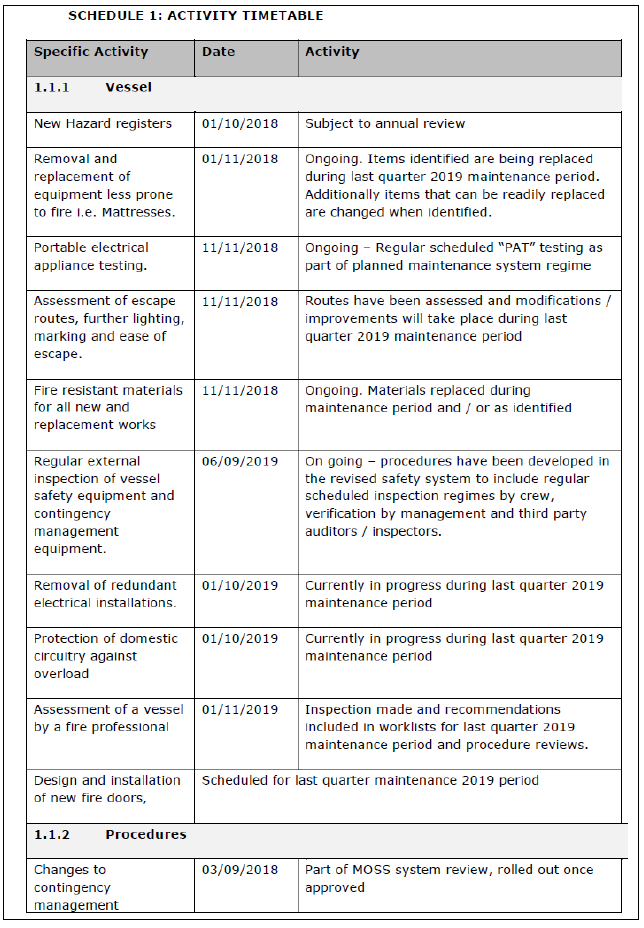
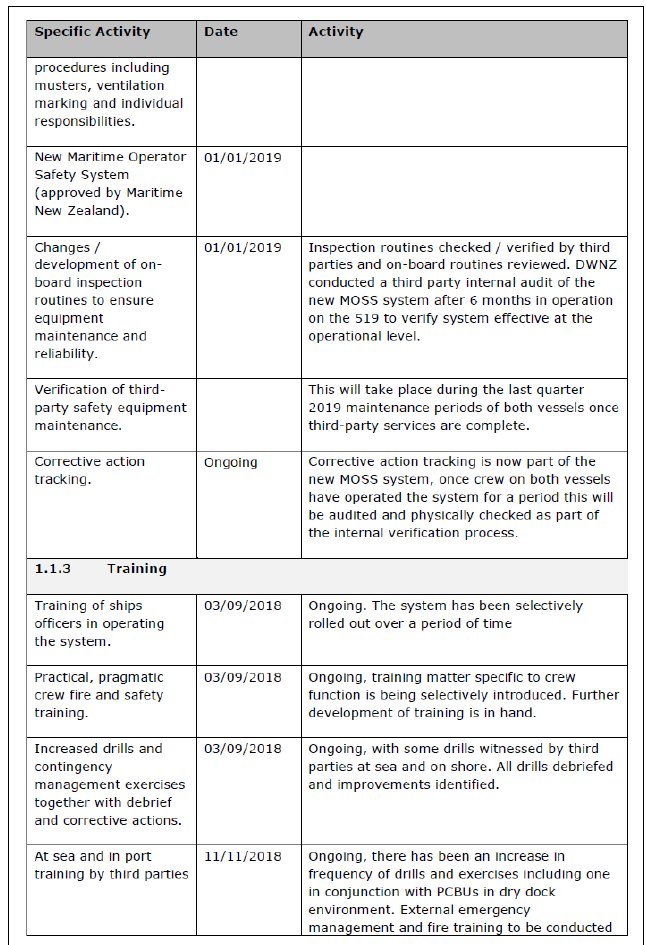
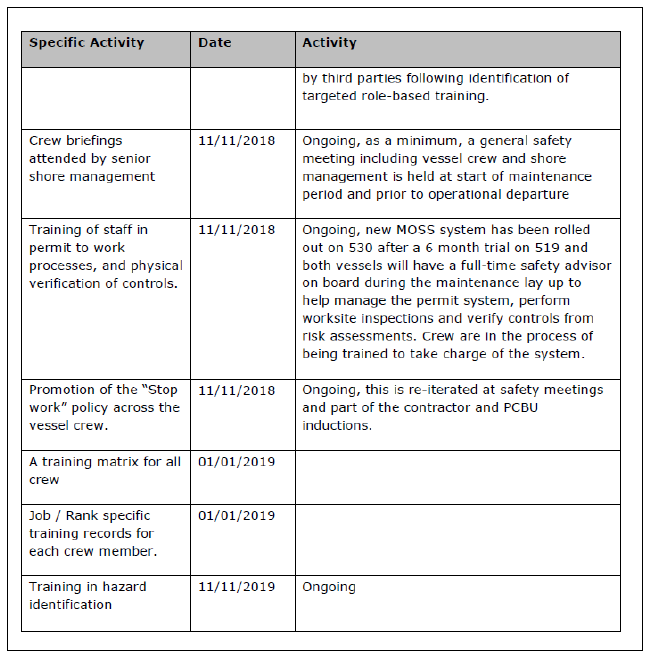
- The crew of the Dong Won 701 had all received approved shore-based firefighting training. They were all required to be current with the vessel’s firefighting procedures. This would normally have been achieved during the crew induction on board and fire and emergency drills, which according to the operator’s (DW New Zealand Limited’s) maritime transport operator plan were scheduled to happen four times each year.
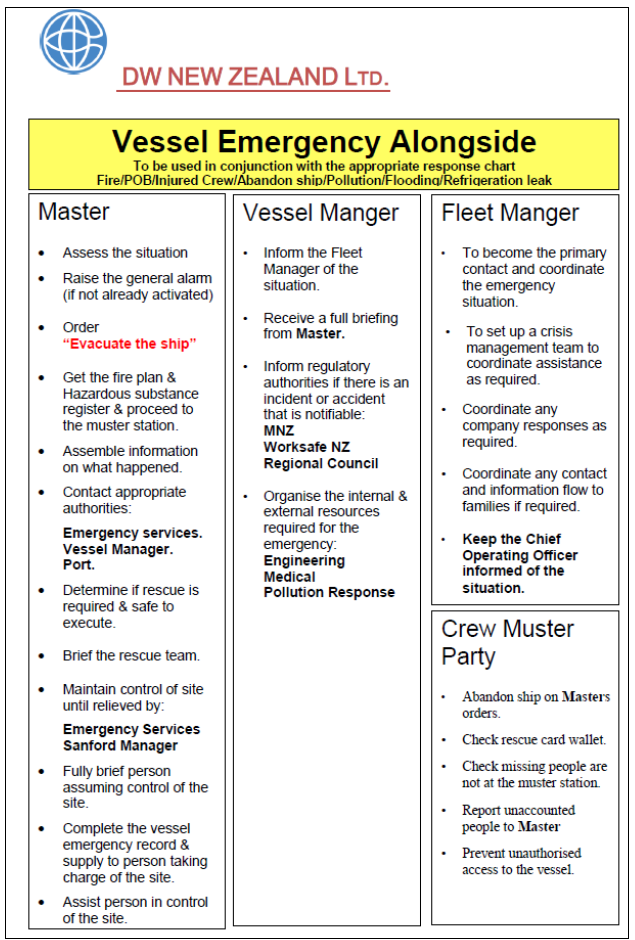
- DWNZ had different checklists for responding to a fire when out at sea and when alongside. When out at sea, the Dong Won 701’s Emergency Checklist for Fire/Explosion required the crew to take a number of actions on discovering a fire. The checklist was broadly compliant with industry good practice. However, there was no mention of holding a crew muster to account for everyone on board. DWNZ’s Vessel Emergency Alongside checklist required the crew to evacuate the vessel and muster at an unspecified muster station. However, the crew did not evacuate the vessel until ordered to do so by FENZ, and the master was unable to confirm that all his crew were safely off the vessel. Emergencies that occur in port are problematic in that regard, because not all crew will necessarily be on board. In this case only nine of the 44 crew members were on board to initially contain and fight the fire. Several important procedures were not followed, of which some were likely attributable to so few crew being available to respond.
- An important aspect of containing a fire is to deprive it of oxygen. The standard procedure for achieving this is to close all doors and openings to the space where the fire is located. After the retreat from the initial attempts to make a direct attack on the fire, the cabin door was left open – so too was the door leading from the passageway to the open deck. Also, the ventilation flaps supplying fresh air to the accommodation were left open.
- With a free flow of oxygen to the fire, it quickly spread from the first engineer’s cabin to engulf the accommodation spaces within a matter of minutes.
- The master’s designated position in an emergency was on the bridge. However, by the time he was alerted to the fire the bridge was rapidly becoming engulfed in fire. Consequently the master was unable to use the communication equipment to summon help.
- The master went to the open deck aft of the bridge, where a number of crew had mustered and attempted to organise a full muster and form teams to fight the fire. However, several crew members took their own courses of action, with some proceeding to the engine room to manage the ammonia risk and others re-entering the accommodation space to continue attacking the fire on an individual basis.
- This uncoordinated response to the fire continued until FENZ arrived and took command of the scene, having been called by a member of the public.
- Some crew members attempted to initiate firefighting by preparing fire hoses on the port and starboard sides of the upper deck. However, they were unable to work the portable emergency fire pump to pressurise the fire hoses.
- In summary, the delay in all crew being alerted to the fire was a missed opportunity to extinguish it using portable firefighting equipment before it escalated out of control. Then, because the immediate and surrounding areas were not shut down, the fire was able to spread rapidly throughout the accommodation space before an effective firefighting effort could be mustered.
Fire-resistant design and construction
Safety issue: Inconsistencies in the application of Rule 40D may have resulted in up to 12 fishing vessels operating under the New Zealand Flag not complying fully with the relevant safety standards. A further 50 fishing vessels have been afforded grandparent rights that will allow them to operate indefinitely without meeting contemporary safety standards under the current Maritime Rules.
- Fishing ships entered into the Fishing Vessel Register under the Fisheries Act 1996 (the Fisheries Act) are required to meet applicable design, construction and equipment rules in Rule 40D. Rule 40D prescribes the minimum requirements for the design, construction and equipment of New Zealand fishing ships, which include standards for structural fire protection. Rule 40D came into force in 2000.
- The application of some parts of Rule 40D depends on the date when a ship was constructed or ‘converted to’ a fishing ship. Rule 40D states that fishing ships constructed before 27 May 2004 (pre-2004 ships) are not required to meet some standards of design, construction and equipment contained in Rule 40D. Fishing ships constructed after 27 May 2004 (post-2004 ships) are required to meet all of Rule 40D.
- Under the Fisheries Act, either a New Zealand-registered fishing ship or a foreign-registered fishing ship issued with an exemption under section 103A(1) of the Fisheries Act can apply to be registered in the Fishing Vessel Register. In around 2016 changes to the Fisheries Act meant that all foreign-registered fishing ships had to be registered as New Zealand fishing ships to remain on the Fishing Vessel Register.
- Around that period the owners of many foreign-registered fishing ships began registering them as New Zealand fishing ships. For each ship this meant determining whether it was a pre-2004 ship or a post-2004 ship for the purposes of Rule 40D, and there was some inconsistency among surveyors in how this was done.
- In 2017 Maritime New Zealand discussed its interpretation of pre- and post-2004 vessels with surveyors. Maritime New Zealand’s view was that vessels constructed outside New Zealand that had been first entered into the Fishing Vessel Register in New Zealand after 27 May 2004 were considered post-2004 vessels, and therefore were required to meet all the applicable standards of Rule 40D.
- The Dong Won 701 had been constructed in Japan in 1971 and registered in South Korea (in 2016 the Dong Won 701 changed its registry to New Zealand). In 2000 the Dong Wong 701 had been entered into the Fishing Vessel Register as an exempt ship, and entered into the New Zealand safe ship management system. As it had been both constructed and entered in the New Zealand system prior to 2004, it was considered to be a pre-2004 ship, and as such was ‘grandparented’ and deemed compliant with Rule 40D.
- ‘Grandparent rights’ is a common regulatory tool used internationally in recognition of the difficulty in applying modern shipbuilding safety standards to old shipbuilding techniques, where often the cost of meeting new standards outweighs the benefits.
- An adverse effect of applying grandparent rights to older standards is that the crews are not afforded the same level of safety as, and therefore are more at risk than those on newer vessels constructed to newer standards.
- For example, the corridor bulkheads in the accommodation spaces of a new ship must be constructed of non-combustible material. The standard stairwells on newer ships are required to have B-class (bulkheads so constructed as to be capable of preventing the passage of flame to the end of the first one half-hour of the standard fire test) self-closing doors at one end to slow the spread of fire between decks.
- The internal corridor bulkheads and cabin doors on the Dong Won 701 were of hardboard or similar wood-product construction and suffered complete combustion in the fire. The stairwells on the Don won 701 had no doors fitted between decks. Consequently the fire spread rapidly to the decks above.
- It is highly likely that a similar fire on board the Dong Won 701 while at sea, with more crew and no ability to step ashore, would have had more severe consequences. This made it all the more important that fire-detection systems were working and that the fire response was fast and effective with all firefighting equipment working properly.
- Given the health and safety implications for crew working on older grandparented fishing vessels, the Commission sought information from Maritime New Zealand about the status of the New Zealand fleet. This revealed potential inconsistencies in the application of Rule 40D. This was because it was not clear from the rule that ships entering the system after 2004 should have been made to comply fully with Rule 40D, until Maritime New Zealand issued its guidance to surveyors in 2017. Consequently, prior to 2017, operators and surveyors were applying Rule 40D inconsistently.
- As of June 2018 there were 63 active commercial fishing vessels, over 24 metres in length, registered in New Zealand. Of the 63 fishing vessels, 60 had been constructed or registered outside New Zealand.
- Of these, 50 had been first entered into the Fishing Ship Register prior to 27 May 2004 and were therefore surveyed as pre-2004 ships, in accordance with Rule 40D.
- The remaining 13 commercial fishing vessels had been entered into the Fishing Ship Register after 27 May 2004. Twelve of these vessels had been constructed at various dates before 2004 and as such, according to the Maritime New Zealand guidance issued in 2017, should have been surveyed as post-2004 vessels and fully complied with the standards in Rule 40D.
- Maritime New Zealand was unable to establish from records whether these remaining 12 fishing vessels were correctly surveyed as post-2004 vessels.
- It is likely that some of these fishing vessels are not fully meeting the applicable design, construction and equipment standards prescribed in Rule 40D, depending on their year of construction and the applicable foreign rules according to which they were built. In some respects they are no different from the other 50 vessels that were afforded grandparent rights prior to 2004. As with the 12 post-2004 fishing vessels, the safety standards will vary depending on their year of construction and the applicable foreign rules according to which they were built.
- All grandparented fishing vessels can remain in the system indefinitely, because there was no time limit placed on the grandparent rights.
- A useful variation to the grandparent rights in future would be to put a cap on the year of construction applicable to the rule to prevent very old vessels entering the system and/or limit the number of years a vessel is allowed to operate before it is either upgraded to meet modern standards or withdrawn from the system. Otherwise, there is a risk that over time the average age of fishing vessels in the New Zealand Fishing Vessel Register will increase and, potentially, safety standards will fall further behind contemporary standards.
- The Commission has made recommendations to the director of Maritime New Zealand to address this issue.
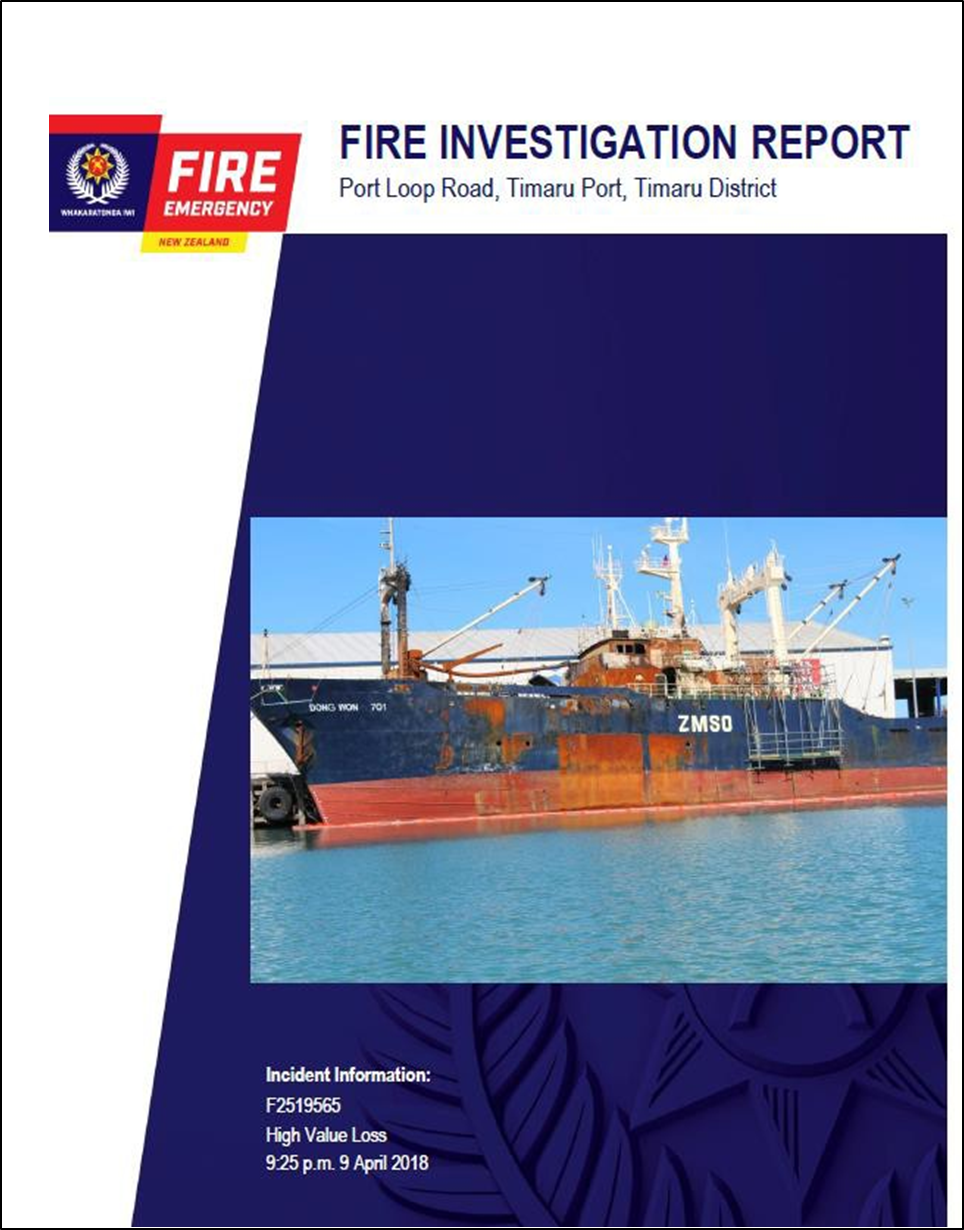
Appendix 1. Fire investigation report in part
Appendix 3. The Dong Won 701’s Vessel Emergency Alongside procedure
Appendix 4. List of actions taken by DWNZ