TAIC report: people in control of transport infrastructure need to think again about how well their structures can cope with climate change significant rainfall events. Flood water washed out rail track ballast. Freight train ran over the track. Locomotive and 17 of its 37 wagons derailed. KiwiRail has addressed safety issues with severe weather warning, flood monitoring
Executive summary Tuhinga whakarāpopoto


What happened
- At about 2300 on Monday 13 December 2021, a KiwiRail freight train was travelling north between Marton and Hunterville on the North Island Main Trunk line.
- As the train rounded a left-hand curve, the train driver saw that the field to their right was flooded with water and that the floodwater was crossing the railway track in front of the train.
- The train driver immediately reduced power to the train as it approached the water and then, suspecting that the train had derailed, applied the train’s brakes.
- Once the train had stopped, the train driver remained in the locomotive cab to await assistance, as they had seen that the overhead electrical wire was damaged.
- When assistance arrived, it was discovered that 17 of the train’s 37 wagons and the locomotive had derailed.
Why it happened
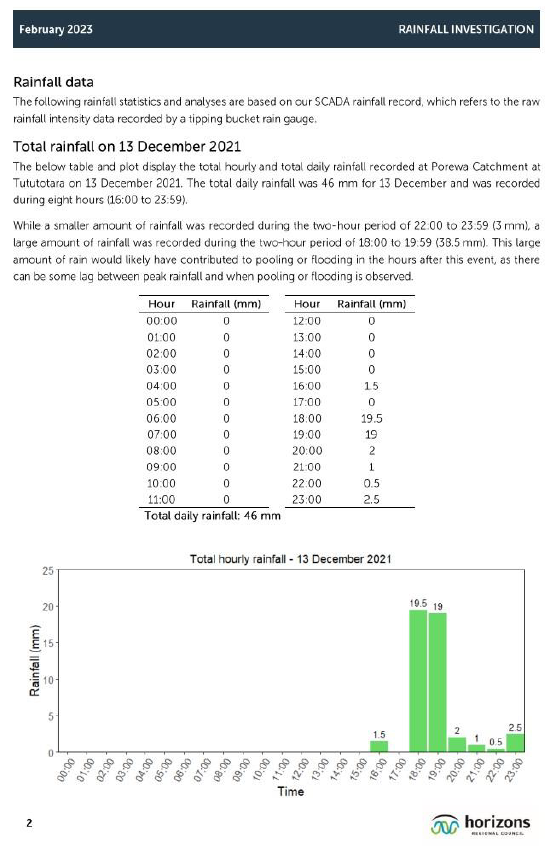
- In the days preceding the accident, unseasonal significant rainfall had occurred throughout the country. The Porewa catchment area, which was the closest to the accident site, recorded significant rainfall of 38.5 millimetres in a two-hour period before the accident.
- This rainfall had led to flooding in the area the train was traversing.
- The area in which the flooding occurred was not within monitoring or capture distance of the nearest weather stations.
- Floodwater inundated an area of farmland that had no recent history of flood events.
- The floodwater removed the ballast formation that was supporting the railway track. The unsupported track moved as the train passed over it, causing the train to derail.
What we can learn
- The transport industry needs to prepare for and be able to adapt and respond to the increase in frequency of unseasonal and severe weather events.
Who may benefit
- All rail access providers and rail operations personnel may benefit from the findings in this report.
- Anyone involved in planning for the impacts of weather events on transport networks may also benefit from the findings.
Factual information Pārongo pono
Narrative
- On 12 December 2021 the North Island of New Zealand was experiencing an unseasonal significant rainfall event.
- Rainfall continued in varying amounts throughout the five-day period of 12 to 16 December.
- Significant rainfall collected in Porewa Stream, about 5 kilometres south of Hunterville in an area of farmland near the North Island Main Trunk (NIMT) line (the main railway line for freight and passengers between Wellington and Auckland). This caused the stream to rise and eventually overflow into the farmland.
- At 2050 (times used in this report are expressed in the 24-hour format based on New Zealand Daylight Time) on Monday 13 December a train driver (the driver) commenced their shift at Palmerston North rail depot.
- The driver carried out various duties in preparation for the arrival of Train 220 en route from Wellington.
- At 2147, after the arrival of Train 220 at Palmerston North, the driver assumed responsibility for Train 220 from the incoming train crew.
- At 2151 Train 220 departed Palmerston North platform and travelled north on the NIMT.
- A roll-by inspection of Train 220 had been conducted while the train was crossing. another train at Greatford, approximately 20 kilometres south of the derailment site. No irregularities had been found in Train 220 during this inspection.
- At about 2259 Train 220 was travelling at 63 kilometres per hour when the driver noticed flooding in a paddock to the right of the track. As the track straightened out the driver noticed floodwater flowing across the track in front of the train (see Figures 3 and 4).


- On sighting the floodwater, the driver reduced power to the locomotive by moving the throttle from notch (power control for locomotives in New Zealand is typically separated into eight notches, where notch one is minimum power and notch eight is maximum power. The train driver selects power notches by operating a handle in the locomotive cab) seven to notch four in a five-second period.
- As the train entered the flooded track area the driver heard a loud noise, and at 2300:06 applied the train’s emergency brake.
- At 2300:26 the train stopped at the 197.7-kilometre mark on the NIMT (the NIMT is measured by each kilometre starting at Wellington Railway Station (0 kilometres). This increases in a northerly direction to Britomart Transport Centre in Auckland (682 kilometres)), approximately 5 kilometres south of Hunterville.
- The activation of the emergency brake set off an alarm at train control (the national train control centre is situated in Wellington Railway Station. It is responsible for track authorisations and the safe movement of rail traffic), which initiated radio communication between train control and the driver.
- Once the train had stopped, the driver saw that the overhead electrical traction wire had been disturbed, meaning that there was a potential risk of electric shock should they exit the locomotive. The driver advised train control that they would remain in the locomotive cab to await recovery.
- From inside the cab the driver was able to observe that at least one wagon had derailed, but was not able to see the full extent of the derailment.
- Assistance arrived about one hour after the derailment. On confirmation that traction power had been isolated, the driver exited the cab and the train was examined.
- A site examination by Transport Accident Investigation Commission (Commission) investigators determined that floodwater had caused washouts in three separate locations, resulting in the train derailing.
Personnel information
- The driver had six years’ train-driving experience and had been employed by KiwiRail in rail operations roles for 10 years. They were fully certified for the role. The driver underwent drug and alcohol testing after the incident. The tests indicated negative (clear) results.
Train/Vehicle information
- The train was 588 metres long and weighed 1001 tonnes. It was powered by a DL class locomotive hauling 37 wagons.
- The maximum line speed for the area in which the train was travelling was 80 kilometres per hour. At the time of the incident the train was travelling at 63 kilometres per hour.
Meteorological information
- The Rangitīkei region had been experiencing significant rainfall on the preceding day. At the time of the incident there was no severe weather warning in place for the area. It was dark and visibility was poor.
- Rainfall had collected in Porewa Stream and overflowed onto farmland on the eastern side of the railway. The floodwater had been channelled south into a small valley between hills on the eastern side of the rail formation. The floodwater from the Porewa Stream had gained momentum and the volume of water was further increased by floodwater travelling downhill from a pond situated at the top of the nearby hills (see Figure 5).
- Track-maintenance staff had earlier been called to investigate a report that vegetation was obstructing the track approximately 5 kilometres north of the derailment site. Another train had travelled through the area less than two hours before Train 220. Neither of the track occupants had observed flooding or severe weather requiring a report to train control prior to the accident.

Recorded data
- The locomotive was fitted with a data recorder known as Tranzlog. The Tranzlog download was obtained by the Commission and the verified data has been used in this report.
Site and wreckage information
- The train consisted of 38 vehicles (one locomotive and 37 wagons). The locomotive and first wagon passed over the site of the washout; however, the second wagon derailed, causing a further 15 wagons to derail, of which some overturned (see Figures 6 and 7).
- The rear axles of the locomotive and first wagon also derailed, but the vehicles remained upright on the track.


Organisational information
- KiwiRail Holdings Limited, trading as KiwiRail, was the operator of the train and railway.
Analysis Tātaritanga
Introduction
- The weather event that led to the derailment had been ongoing for at least 24 hours prior to the accident.
- KiwiRail had procedures in place to analyse and react to severe weather reports issued by its meteorological weather data supplier. On this occasion the risk to the safety and integrity of the railway was caused not by localised rainfall but by a build-up of floodwater in an unmonitored area that had not flooded for several decades, and no severe weather warning was issued.
- The following section analyses the circumstances surrounding the event to identify those factors that increased the likelihood of the event occurring or increased the severity of its outcome. It also examines any safety issues that have the potential to adversely affect future operations.
- The Commission found that it was virtually certain that the derailment followed the events described below.
Occurrences that led to the derailment of freight Train 220
- The floodwater gathered at a natural depression and inundated the track ballast. The ballast was forced from underneath the track by the weight and pressure of the floodwater from the eastern (hill) side to the western (stream) side (see Figure 8).

- Culverts designed to disperse water underneath and away from the track formation at the main washout were not effective due to the volume of floodwater flowing into the area.
- The removal of the ballast from underneath the track seriously weakened the structural integrity of the formation and resulted in the rail track being unable to support the weight of the rail vehicles (see Figure 9).
- As the train passed over the length of track that was now unsupported, the track moved and spread sideways under the weight. This caused the wheels of the rail vehicles to lose contact with the rail and they were forced off the railhead.
- The locomotive and first wagon both derailed at their rear axles, but remained upright and moving forward until they were brought to a stop when the driver initiated the emergency braking.
- The second wagon derailed and left the track to the right-hand (eastern) side. As it left the track the wagon came to an immediate stop, which in turned had a concertina effect on the wagons behind.
- The momentum of the following wagons meant that a series of ‘nose-to-tail’ collisions occurred. The wagons were forced off the track to both sides and several wagons overturned as a result (see Figures 6 and 7).

Meteorological information
Safety issue: There were no severe-weather-warning or flood-monitoring measures in place for the area in which the derailment occurred.
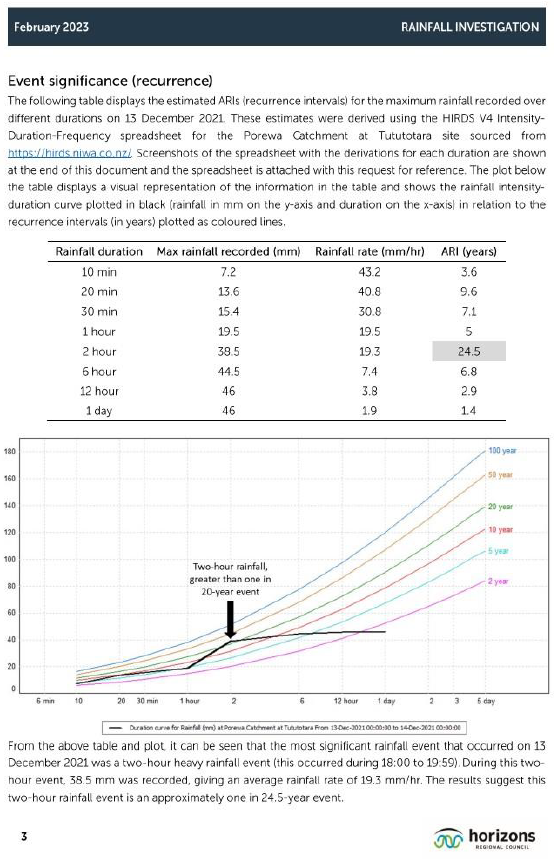
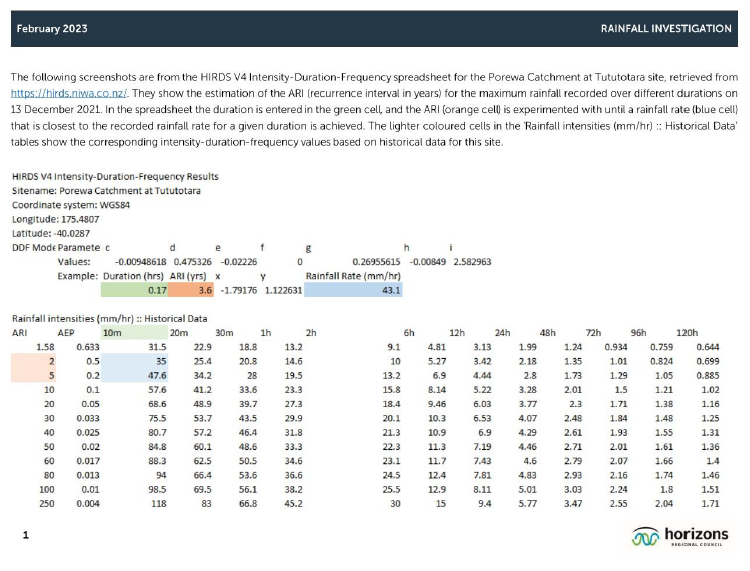
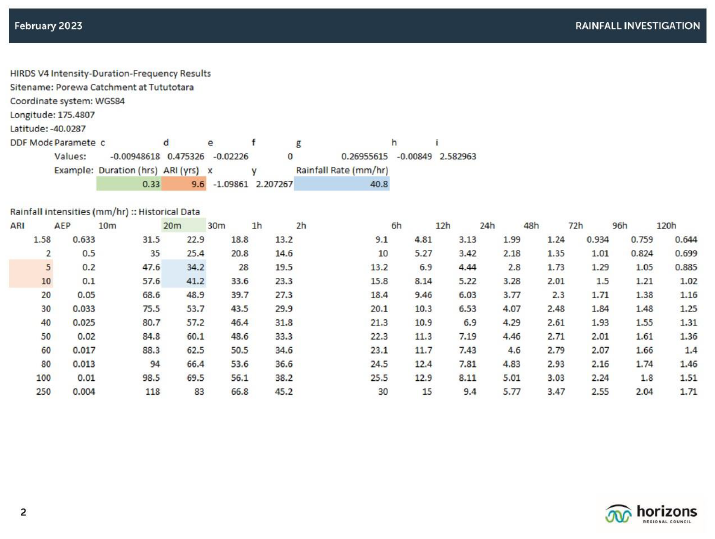
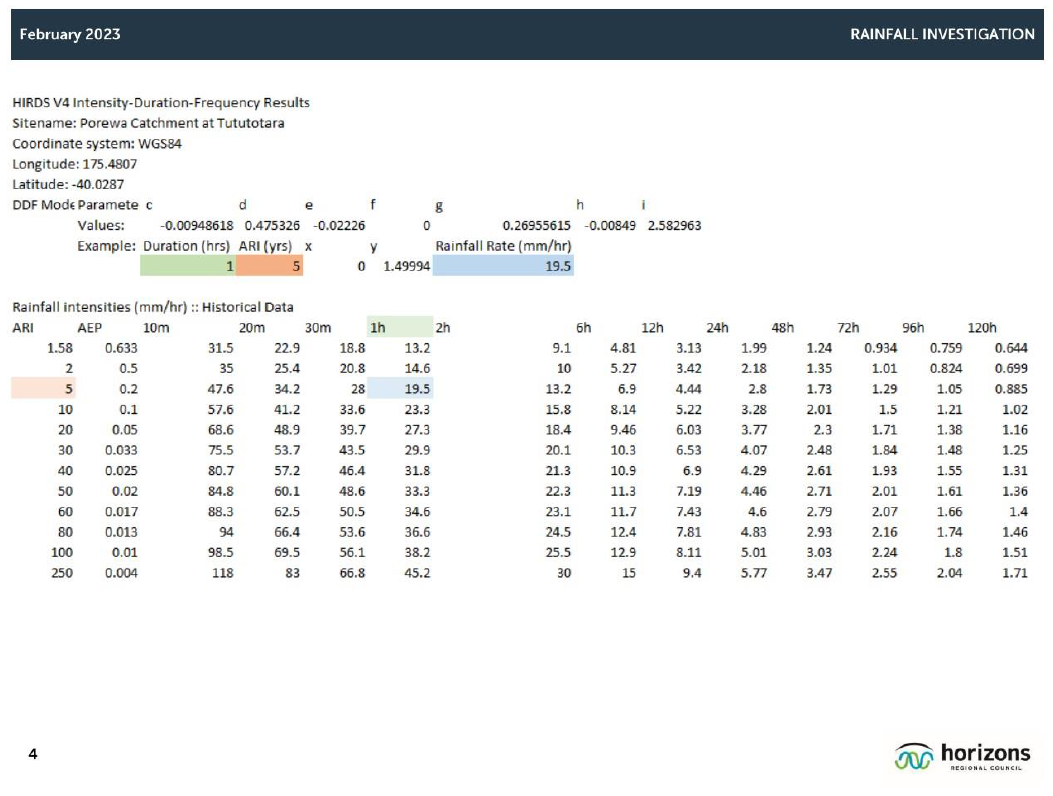
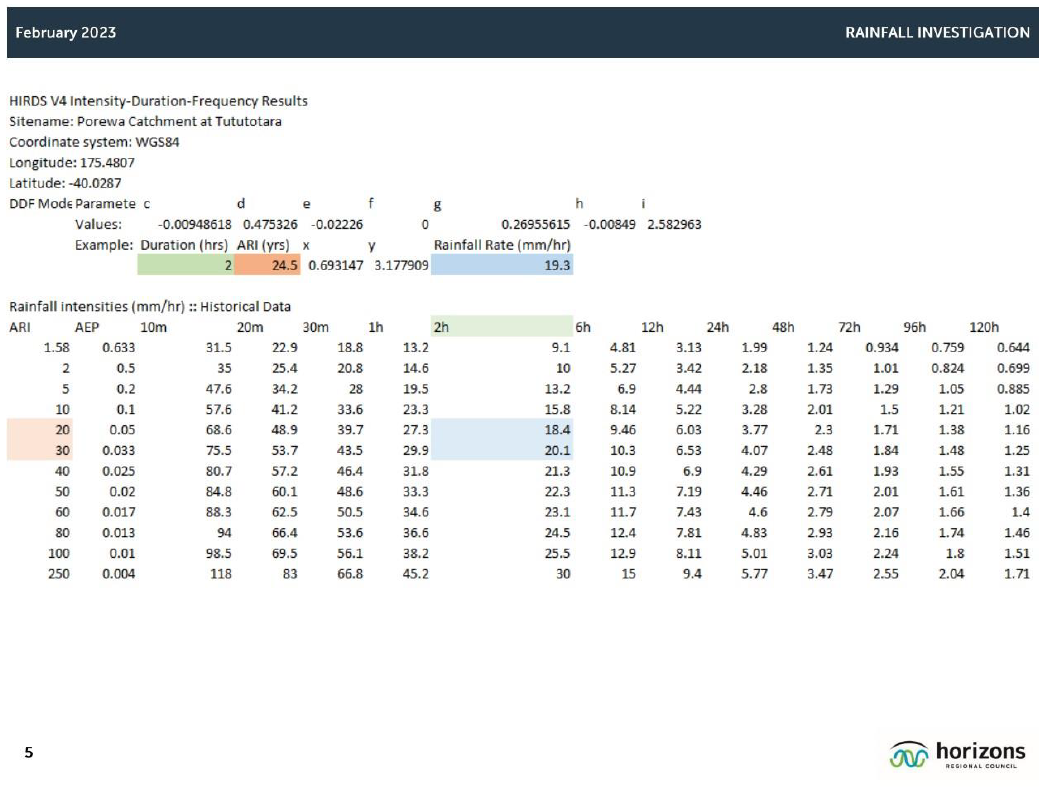
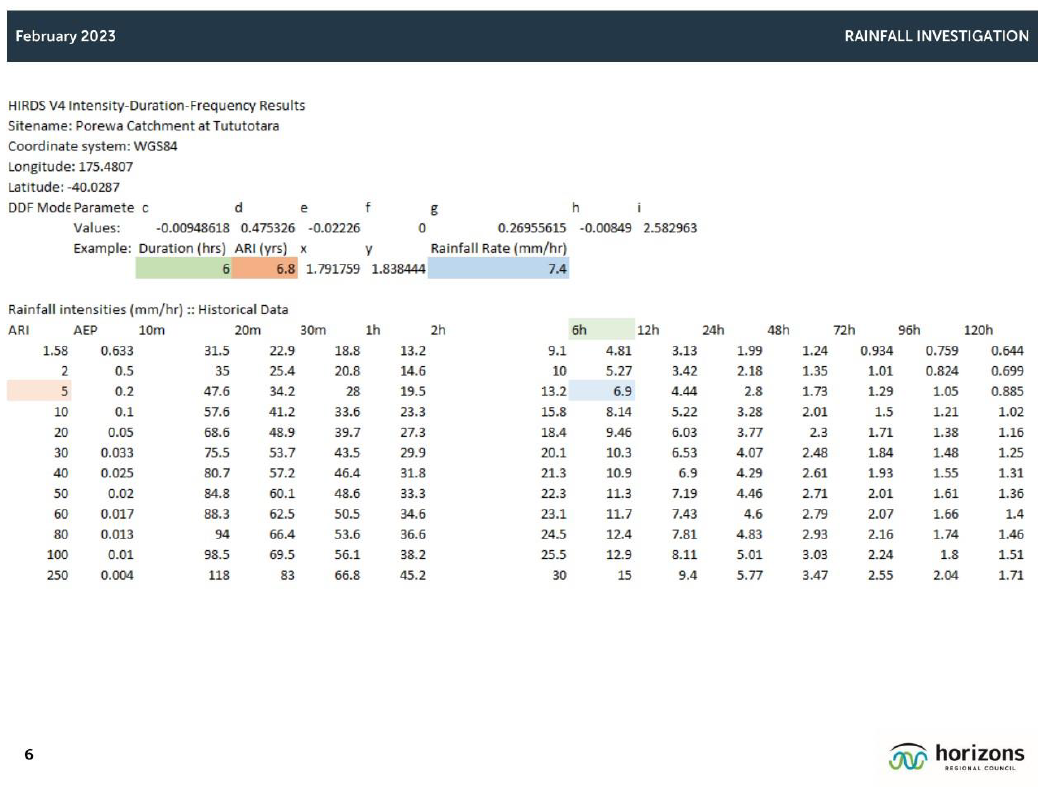
- The weather conditions at the time of the accident were abnormal for the time of year (data in paragraph 3.12 was provided to the Commission by Horizons Regional Council. See Appendix 1 for full report) (see Appendix 1). A total of 46 millimetres of rain was reported in the Porewa catchment area, 10 kilometres south of the derailment, between midnight on 13 December and midnight on 14 December. In a two-hour period between 1800 and 1959 that same day, 38.5 millimetres of rainfall were recorded, equating to an approximately one-in-24.5-year event (see Figure 10).
- In comparison, there had been a total of 45.5 millimetres of rainfall during the 12 days preceding the accident, including zero rainfall in the three days immediately prior.

- KiwiRail supplied the Commission with its Severe Weather Management protocols, which outlined the procedures and actions to be taken to mitigate the risks of severe weather events.
- KiwiRail’s ‘Severe Weather’ risk actions rely on information provided by its meteorological data supplier. The information is gathered by the supplier from its monitoring sites established at strategic locations around the country. However, it is not considered practicable to have monitored sites in every possible location in the country. The site of the accident was not monitored.
- The meteorological data supplier operates a system where rainfall totalling above 25 millimetres in a 24-hour period from the start of a rain event triggers a yellow alert, and more severe conditions are elevated to either amber alert or red alert.
- KiwiRail assesses the information supplied and takes precautions for particular geographical locations based on the forecast conditions. Depending on the severity of the conditions, the precautions range from simply alerting rail staff to adverse weather conditions in the area to conducting track inspections, implementing speed restrictions and, for more extreme conditions such as ex-tropical cyclones, stopping all activity on the railway. Drivers of rail vehicles are alerted to adverse weather warnings but are not required to take any further actions unless directed by train control.
- In this situation, and as the extent of the rainfall had not reached the 24-hour period required to trigger an alert at the time of the accident, there was no severe weather warning in place.
- Another northbound train had travelled through the area 100 minutes before Train 220 derailed, and the driver of that train had not observed, and therefore had not reported, any weather conditions of concern.
-
It is very likely that during the 100-minute period between the trains passing through the area the deluge of floodwater occurred quickly.
-
Even if a severe weather warning had been in place, it is unlikely that, beyond alerting staff, any precautionary action would have been taken by KiwiRail, due to the fact that there was little precedent for flooding in the location.
Further safety actions
- Since the accident KiwiRail has taken further safety actions by carrying out hydrology assessments and flood modelling of the area. It also intends to replace the existing culverts at the location with larger pipes and install a flood-monitoring gauge. The work is expected to be completed by mid-April 2023.
- While the Commission welcomes these actions, there is still a wider implication that parts of New Zealand’s rail network may be vulnerable to unforeseen severe weather events resulting from climate change.
- According to a 2020 United Nations Office for Disaster Risk Reduction report, the planet has experienced ‘a staggering rise in climate-related disasters’ in the past 20 years. Worldwide, between 1980 and 1999 there were 1389 reported disastrous floods. Between 2000 and 2019 the reported number increased to 3254.
- New Zealand has recognised the significance of this increase and is taking steps to build resilience into the country’s infrastructure. These steps include a climate adaption plan to enable climate-resilient transport networks, and investment in improving the reliability of rail infrastructure through the Ministry of Transport-funded Rail Network Investment Programme (RNIP).
- One of the core goals of the RNIP is for KiwiRail to ‘anticipate and adapt to emerging threats, withstand and absorb impacts of unplanned disruptive events and respond and recover quickly’.
- The Commission recognises that this work is ongoing and is intended to address the safety issue, and therefore has not made a recommendation.
Appendix 1. Rainfall report