Two workers in the rail corridor narrowly avoided being struck by a freight train on its way into the Kaimai Tunnel. They were on the track without protection and Train Control didn’t know they were there – due to a combination of ambiguous procedures, poor radio coverage and ineffective safety-critical communication.
Executive summary Tuhinga whakarāpopoto
What happened
- At about 1240 (times in this report are in New Zealand Standard Time (Universal Coordinated Time +12 hours) expressed in a 24-hour format) on Sunday 6 April 2025, two track workers completed maintenance work inside the Kaimai Tunnel (the tunnel), on the East Coast Main Trunk line (ECMT). The track workers were each driving a hi-rail vehicle (a vehicle fitted with retractable rail wheels that can travel on both road and rail) (HRV) in convoy along the track and were making their way east towards Tauranga. Soon after the HRVs exited the eastern tunnel portal (tunnel opening used for entry or exit), Train MP8, heading west towards Hamilton, rounded a bend and collided with the leading HRV.
- The lead HRV track worker jumped out of the HRV before it was struck by the train.
- There were no injuries to the track workers or the locomotive engineer (a person certified to drive mainline locomotives on the KiwiRail network) (LE). The HRV that was struck was substantially damaged. There was no damage to the locomotive.
Why it happened
- As a result of a series of miscommunications, the track workers were working inside the tunnel without any form of protection (methods established to prevent rail traffic from entering a work area. Protection may include blocking of signals, compulsory stop boards, signage and detonators), and train control (located in Wallaceville, Upper Hutt, train control is responsible for track authorisations and the safe movement of rail traffic throughout New Zealand) was not aware the track workers were in the tunnel.
- There were two separate work groups working near and in the tunnel that morning. A series of miscommunications led the track workers in the tunnel to believe that protection had been arranged by a rail protection officer (a person qualified to establish track protection for a work area) (RPO) from the second work group. However, that RPO was working in a different location and was not aware the tunnel work group was on track.
- Consequently, no protection was in place for the tunnel work group and Train MP8 was signalled by train control into the section in conflict with the track workers.
What we can learn
- All personnel undertaking safety-critical (tasks that, if not performed correctly, may result in a mishap with potentially severe consequences) roles should adhere to the principles underlying the application of non-technical skills to ensure that they share the same mental models and have a clear understanding of what is required of themselves and others to complete tasks safely.
Who may benefit
- Railway operators, rail protection officers, track maintenance personnel and anyone involved in safety-critical communications may all benefit from the findings in this report.
Factual information Pārongo pono
Background
The Kaimai Tunnel
- The Kaimai Range is a mountain range in the North Island of New Zealand. It is part of a series of ranges, with the Coromandel Range to the north and the Mamaku Ranges to the south. The Kaimai Range separates the Waikato in the west from the Bay of Plenty in the east.
- The Kaimai Tunnel (the tunnel) opened in 1978 and is the longest railway tunnel in New Zealand, at 8.98 kilometres (km). A single-line railway track cuts through the Kaimai Range as part of the East Coast Main Trunk line (ECMT). Hemopo siding is located near the tunnel’s western portal, and Whatakao siding near its eastern portal (see Figure 3). The highest point of the Kaimai Range, directly above the tunnel, rises to 814 metres (m).
-
The tunnel is concrete, lined with walkways on either side of the track (see Figure 4). There are 28 refuges (a recess built into a tunnel wall to provide an area where people or equipment cannot be struck by rail traffic. A trolley refuge is a larger recess designed to fit mobile equipment such as rail trolleys) on the northern side of the tunnel wall, spaced at intervals of roughly 400 m, and 21 trolley refuges on the southern side.
-
Phones to contact train control were placed in 11 of the 21 trolley refuges but these are no longer operational. The phones have been replaced by continuous radio coverage on both very high frequency (VHF) and ultra high frequency (UHF) within the tunnel.
Whatakao and Hemopo sidings
- Whatakao siding is located on the Bay of Plenty side of the Kaimai Range, approximately 1.5 km to the east of the eastern tunnel portal. It consists of a mainline and loop track. Entry to and exit from the siding for rail traffic is governed by fixed signals. It is directly accessible to road traffic by an entrance off a public road (see Figure 5).
- Hemopo siding is located on the Waikato side of the Kaimai Range, approximately 500 m to the west of the western tunnel portal. It consists of a mainline and loop track. The siding is not directly accessible by public road (see Figure 6).
- The distance travelling by rail between Hemopo and Whatakao is approximately 10 km, while the distance by road via State Highway 29 is approximately 80 km.
The worksites
- On the day of the accident, two separate worksites were in operation by two different work groups. Work group one (WG1) was working within the tunnel, carrying out track fastening renewals (renewing components used to secure the rail track to the rail base to prevent the track from moving).
- WG1 had obtained electronic protection (electronic protection, or ‘blocking’, is a method of protection whereby the train controller uses the train control system to prevent signals held at red (stop) being changed to proceed. Having to stop for red signals prevents rail traffic from entering a section of track that has been blocked) from train control to work between Whatakao siding and Hemopo siding. This allowed WG1 to on-track (transitioning an HRV from the road onto the railway track by lowering the rail wheels. Off-tracking is the opposite action, from the railway track onto the road) the two hi-rail vehicles (a vehicle fitted with retractable rail wheels that can travel on both road and rail. When travelling in rail mode the front road wheels are not in contact with the ground and the vehicle is unable to be steered in the manner of a road vehicle) (HRVs) at Whatakao loop, and travel into the tunnel to carry out the required work (see Figure 7).
-
Track fastening renewal work required the use of power tools to remove and replace ‘Pandrol’ clips (generic name of industry-standard rail fasteners. They are steel clips that attach rail to sleepers or concrete formation by applying tension to clamp the rail in place) (see Figure 4). WG1 used lighting from the two HRVs for illumination while the track workers were on the ground inside the tunnel.
-
Work group two (WG2) was initially working clear of the track at Whatakao and did not require electronic protection.
The track workers
- WG1 was comprised of two track workers, each operating an HRV. The senior track worker was acting as the rail protection officer (RPO) for WG1 (RPO1). This role included liaising with train control to establish track protection.
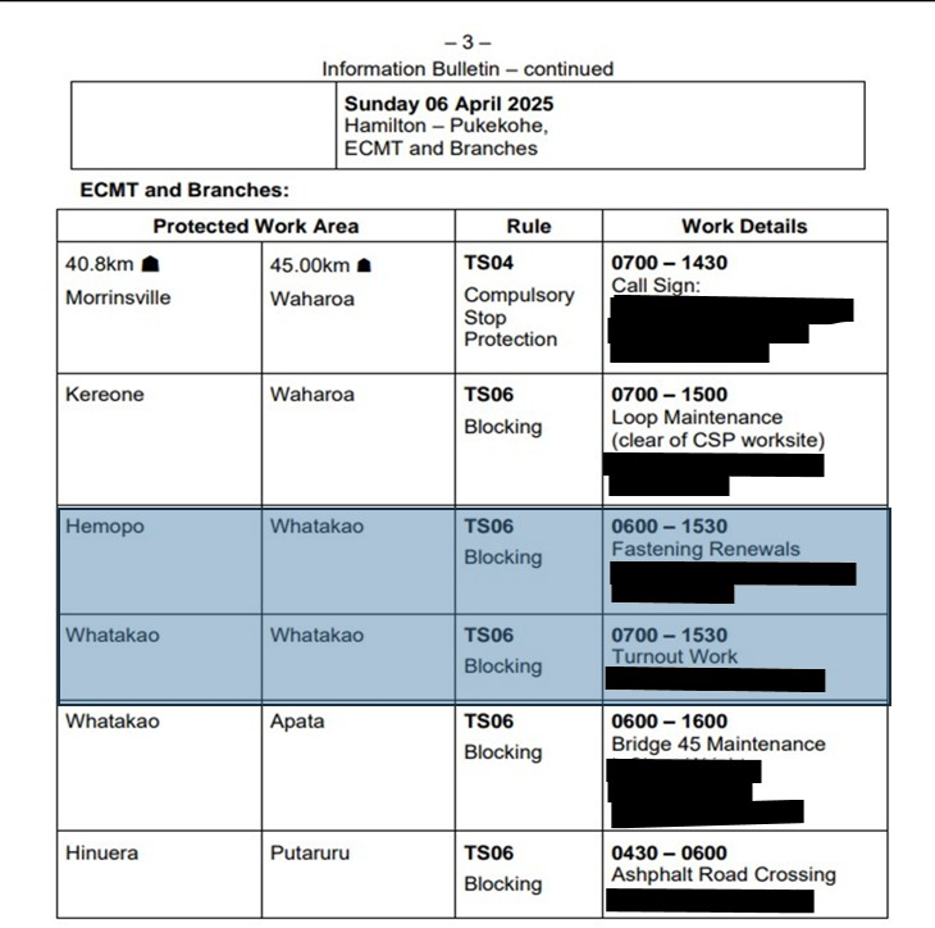
- WG2 was comprised of a senior track worker, who was acting as WG2’s RPO (RPO2), and six other track workers. Both work groups were listed separately on the daily information bulletin (DIB) (a memorandum provided to users of KiwiRail’s network that contains information about train running and track maintenance activities for that day) (see Appendix 1).
- Both RPOs were experienced track workers who held all relevant certifications for the planned work being carried out on the day. However, neither RPO was certified to protect multiple worksites.
- The track worker in WG1 (TW1) held the theory component of the Track Protection – Basic Machines (TPBM) training. TPBM was the minimum qualification required to operate an HRV on track, and TW1 was doing so under the direct supervision of RPO1.
- Both RPOs and TW1 underwent drug and alcohol testing after the incident. All staff returned negative (clear) results.
The hi-rail vehicle
- The HRV involved in the collision was a 2014 Mitsubishi Fuso truck fitted with retractable rail wheels. It was being used by WG1. It received substantial damage to its front extended bumper and to the front rail wheel configuration (see Figure 8). The HRV was certified to be operated in a tunnel environment. There was no indication or evidence to suggest that any mechanical fault contributed to the accident.
The train
- Train MP8 (the train) was powered by a single DL-class locomotive (DL 9360). It weighed 1554 tonnes (t) and was 716 m long. The train was made up of 18 heavily loaded vehicles at the front (most around 70 t each) with another 22 empty wagons behind (see Figure 9). The train was running about 70 minutes ahead of its scheduled trip from Tauranga to Hamilton.
Electronic protection
- Establishing a protected work area on the ECMT requires train control to block signals to prevent entry by rail traffic into the worksite. This is achieved by the train controller using the train control system to place a block on signals, which holds them at red (stop). Once a signal has been blocked on the train control system it cannot be placed at proceed until blocking has been removed.
- Procedures are in place to ensure that blocking is not removed until the track has been confirmed clear by the RPO or worksite supervisor. To prevent accidental removal, the train control system also prompts the train controller to manually verify that blocking may be removed. The methods to apply blocking are prescribed in KiwiRail’s Rules and Procedures RP06, ‘Using Blocking’ (KiwiRail, 2026).
Communications
- Both UHF and VHF radios were available for use by the two work groups to communicate with train control and each other. There were three separate radio channels for use in the area:
- channel 12 on the eastern side of the tunnel
- channel 2 for use inside the tunnel
- channel 13 for use on the western side of the tunnel.
-
Direct communication from one side of the tunnel to the other was not possible using either UHF or VHF because the terrain between the two locations impeded radio reception.
- In areas of limited radio reception, KiwiRail rules allow for the use of mobile phones. RPO1 and RPO2 made a series of phone calls to each other to organise a shared protected work area.
Narrative
Introduction
- On the morning of Sunday 6 April 2025, WG1 had established a protected work area with train control, and blocking was applied as necessary to carry out work within the tunnel. This blocking was removed during the course of the morning when RPO1 called train control and reported being clear of the track at Hemopo. This allowed a train through the area about two hours before the accident occurred.
Establishing protection
- At about 0700, RPO1 and TW1 were at Whatakao siding to start planned work. RPO1 and TW1 were in the cab as operators and sole occupants of each of the two HRVs. RPO1 contacted train control by radio to request to work between the loop at Whatakao and the 8R signal at Hemopo.
- At 0704, train control established blocking to protect the requested work area and, after confirming that there were ‘multiple HRVs’, authorised RPO1 to start work with a clearance time of 1100. This meant that WG1 was expected to have informed train control that they were clear of the track by 1100 at the latest.
-
Once authorisation was received, RPO1 and TW1 both on-tracked their vehicles and journeyed westward from Whatakao loop, along the ECMT and into the eastern end of the tunnel. RPO1 was travelling in the lead vehicle, with TW1 in convoy behind.
- As WG1 was entering the tunnel, RPO2 arrived at Whatakao with their work group. RPO2 had intended to carry out their planned work clear of the track. On arrival at Whatakao, RPO2 reconsidered the situation and decided that blocking would be required to move equipment around the area.
- RPO2 tried to call RPO1 by mobile phone, with the intention of arranging some form of mutual blocking for the two separate work groups, but the call went unanswered.
-
As WG2 could not use the already protected track without the knowledge of WG1, RPO2 contacted train control and requested that they relay a message for RPO1 to contact RPO2.
-
Having received no response, WG2 continued with work clear of the track at Whatakao.
Events leading up to the accident
-
Once RPO1 and TW1 arrived inside the tunnel they started work renewing Pandrol clips. As both were working outside the HRV cabs, on the ground and using power tools, the calls from RPO2 and train control were not heard or responded to.
- At about 1000, RPO1 realised they were running low on Pandrol clips and so RPO1 and TW1 both got into their HRVs and made their way out of the western end of the tunnel to off-track and collect equipment from Hemopo.
- Once outside the tunnel, RPO1 heard radio conversations between train control and an approaching train (Train MP1) that was travelling eastwards toward Tauranga. Train MP1 was running ahead of schedule and was waiting outside Hemopo for the work group’s agreed clearance time of 1100.
- At 1020, in an effort not to keep Train MP1 waiting and allow it through the protected work area, RPO1 contacted train control to report that WG1 was off and clear of track at Hemopo.
- Train control acknowledged this and then passed on the message for RPO1 to contact RPO2 at Whatakao. RPO1 responded that they would return to Whatakao once Train MP1 had cleared the area.
- At 1021, at the request of RPO1, train control removed the blocking established for WG1 between Whatakao loop and the 8R signal at Hemopo. Train control then set the relevant signals for Train MP1 to proceed eastwards toward Tauranga. Train MP1 passed through Hemopo at 1023 and through Whatakao 17 minutes later at 1040.
- During this time, a series of mobile phone calls took place between RPO1 and RPO2 to discuss protection for both work groups once Train MP1 had cleared the area (see paras 3.27–3.32). During a call, RPO1 advised RPO2 that they would not be entering the tunnel because of fumes left by Train MP1.
- While Train MP1 was clearing the Whatakao area, RPO2 contacted train control by radio to establish protection for WG2. At 1040, train control authorised RPO2 to work between the 4R and 8L signals at Whatakao, with blocking established for WG2 at those locations (see Figure 10). RPO2 was given a clearance time of 1330, which was when the next train was expected.
- RPO1 stated in interview they recalled a mobile phone discussion with RPO2 confirming that blocking was organised until 1330.
- This led to a misunderstanding between the two RPOs about who was included in the safety-critical protection arrangements. As a result, WG1 entered the tunnel and conducted work without any form of protection for the next two hours.
The accident
- At 1104, Train MP1 arrived at Tauranga one hour ahead of schedule. The same locomotive engineer (LE) was tasked to drive the return journey from Tauranga to Hamilton utilising Train MP8 (the train). The LE had a short break before departing Tauranga, and the train departed 70 minutes ahead of schedule. The journey time to Whatakao was around 30 minutes.
- On becoming aware through radio traffic that the train had departed Tauranga, RPO2 began organising WG2 to clear the track at Whatakao.
- At 1218, RPO2 advised train control that all personnel and machinery were clear of the track. On receipt of this information, train control removed the blocking and moved a set of points (movable section of rail that guides rail traffic from one track to another) at Whatakao in preparation for the passage of the train.
- At 1219, train control set signals for the train to proceed through Whatakao and Hemopo. At this time WG1 was still inside the tunnel conducting work without anyone else knowing.
- At 1241, the train passed through Whatakao and continued west towards the tunnel. At around the same time, WG1 finished the work inside the tunnel and, with TW1 operating the lead HRV, they made their way out of the eastern end of the tunnel toward Whatakao.
- RPO1, who was operating the rear HRV, instructed TW1 to stop outside the eastern tunnel entrance in order to move some equipment that had been left close to the track.
- At 1242, the train was rounding a left-hand curve when the LE sighted the HRVs on track and applied the train’s emergency brake at 1242:19. This began slowing the train down from its speed of 33.5 kilometres per hour (km/h). The LE crouched down below the driver’s console and braced for collision.
- TW1 looked up to see the train coming towards the HRV. At this time the HRV was stopped on track above a small area of open ground between two rail culverts.
- In an effort to escape the impending collision, TW1 opened the driver’s door and jumped out of the cab onto the ground below.
- RPO1, who was operating the rear HRV, put the vehicle into reverse and moved approximately 40 m back towards the tunnel.
- At 1242:29 the train was travelling at 19.3 km/h when it struck the lead HRV at the 72.288 km mark. The collision pushed the HRV back 27.7 m along the track towards the tunnel (see Figure 11). The HRV that RPO1 was operating was not impacted.
- Activation of the train’s emergency brake sent an automatic alarm to train control. Train control immediately contacted the LE, who advised of the accident and confirmed that there were no injuries.
- The train controller notified the network control manager, and the site was frozen (the retention of all evidence by ensuring nothing is moved or removed from the scene) for investigation.
Recorded data
Train data recorder
- The train’s locomotive DL 9360 was fitted with a Tranzlog data recorder (the train’s onboard ‘black box’ data recorder). The Commission obtained the Tranzlog data; the verified data was used in this report.
Tests and research
- Commission investigators conducted radio testing on both UHF and VHF channels. Testing was conducted statically between Hemopo and Whatakao.
- Testing was also conducted travelling through the tunnel using a vehicle similar to the HRV involved in the accident.
- On completion of the testing, Commission investigators concluded that radio communication was not possible between the two work groups from Hemopo to Whatakao. While direct radio coverage was possible from Hemopo through the tunnel, coverage did not extend to Whatakao.
Organisational information
- KiwiRail Holdings Limited (trading as KiwiRail) is a New Zealand state-owned enterprise. It operates trains and rail vehicles, controls rail movements on the national rail network and maintains the railway infrastructure as the access provider.
Previous occurrences
Rail inquiry RO-2023-103 Safe-working irregularity, 3.85 km mark, Johnsonville line – tunnel 5, 04 May 2023
- The report is relevant to this inquiry as the Commission found similarities relating to mobile phone use and safety-critical information transfer.
- In 2023, two track workers on the Johnsonville line had to run for safety when a train entered the tunnel they were working in. The incident occurred because of miscommunication between the track workers and train control while using mobile phones for safety-critical tasks.
- The Commission identified a safety issue that stated in part: ‘The use of incorrect procedures to establish protection and ineffective communication … indicates that non-technical skills were not being adequately utilised during a safety-critical task’ (Transport Accident Investigation Commission, 2024).
- KiwiRail took safety action to prohibit the use of mobile phones for communication when radios were available. Based on the safety action taken, the Commission did not issue a recommendation.
Analysis Tātaritanga
Introduction
- Having systems in place to protect track workers from rail traffic is a fundamental premise of rail operations worldwide. Those systems are only effective if established procedures are followed. On this occasion, a more serious accident was avoided because the track workers had completed their work and the vehicles had exited the tunnel moments before the train arrived.
- The following section analyses the circumstances surrounding the event to identify those factors that increased the likelihood of the event occurring or increased the severity of its outcome. It also examines any safety issues that could adversely affect future operations.
Train control notification
Safety issue 1: There was contradictory and ambiguous direction in KiwiRail’s procedures as to whether it was necessary for train control to be advised before the track workers entered the tunnel. This increased the risk of work being carried out within the tunnel without adequate protection being in place.
- When RPO1 initially arrived at Whatakao at around 0700, procedures were followed to establish protection to work in the tunnel through direct radio communication with train control.
- This protection remained in place until it was removed at 1021 on the request of RPO1.
- When RPO1 wanted to enter the tunnel a second time, all communication was on mobile phones between RPO1 and RPO2. Train control was therefore not a party to that communication.
- Because of the misunderstanding of protection requirements between the two RPOs, RPO1 thought that protection was in place, so they did not notify train control that they would be working within the tunnel.
- KiwiRail Standard 14-STD-005, ‘SHE Working in tunnels’ (the standard) prescribes the expected method of working in tunnels. There are also local network instructions that prescribe the methods of working in particular locations on the network. The Commission found that there were contradictions between information in the standard and KiwiRail’s local network instruction for the Kaimai Tunnel.
-
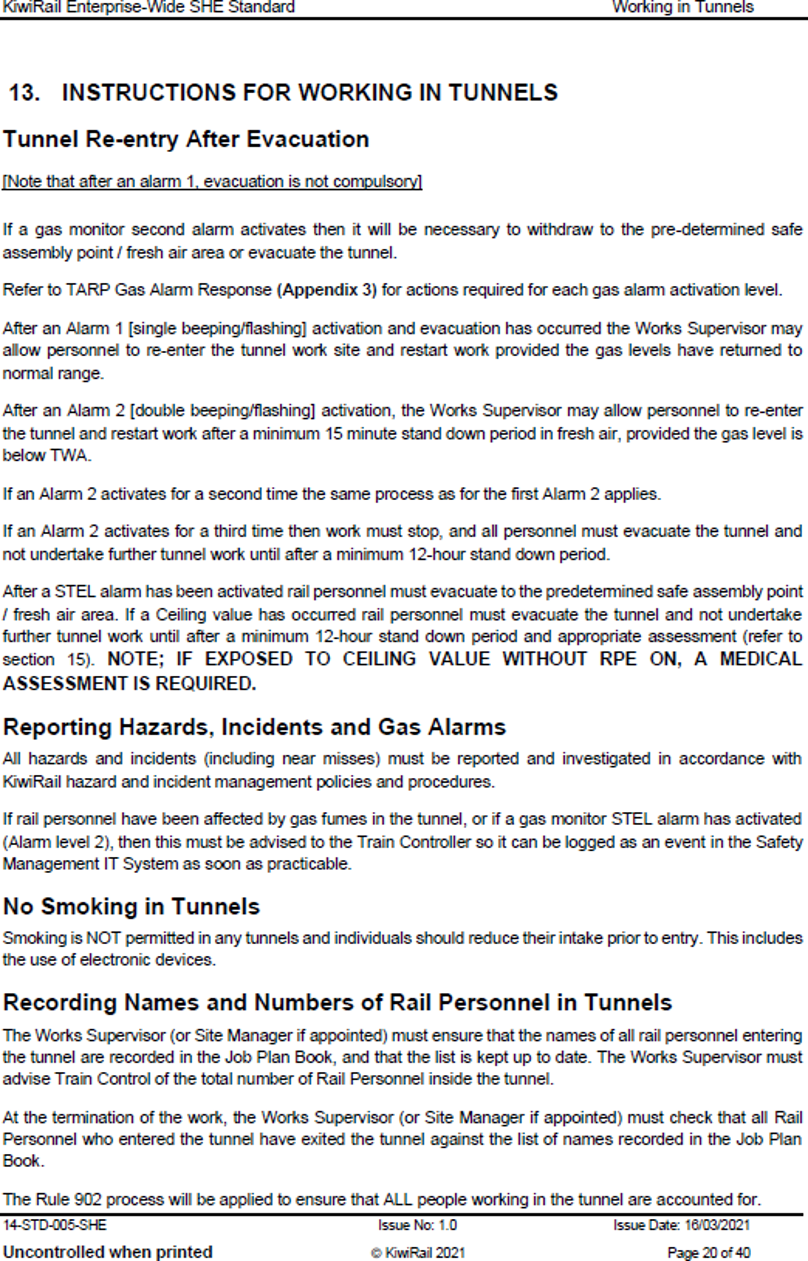
Section 13 of the standard (see Appendix 2) stated in part:
Recording Names and Numbers of Rail Personnel in Tunnels
The Works Supervisor (or Site Manager if appointed) must ensure that the names of all rail personnel entering the tunnel are recorded in the Job Plan Book, and that the list is kept up to date. The Works Supervisor must advise Train Control of the total number of Rail Personnel inside the tunnel…
-
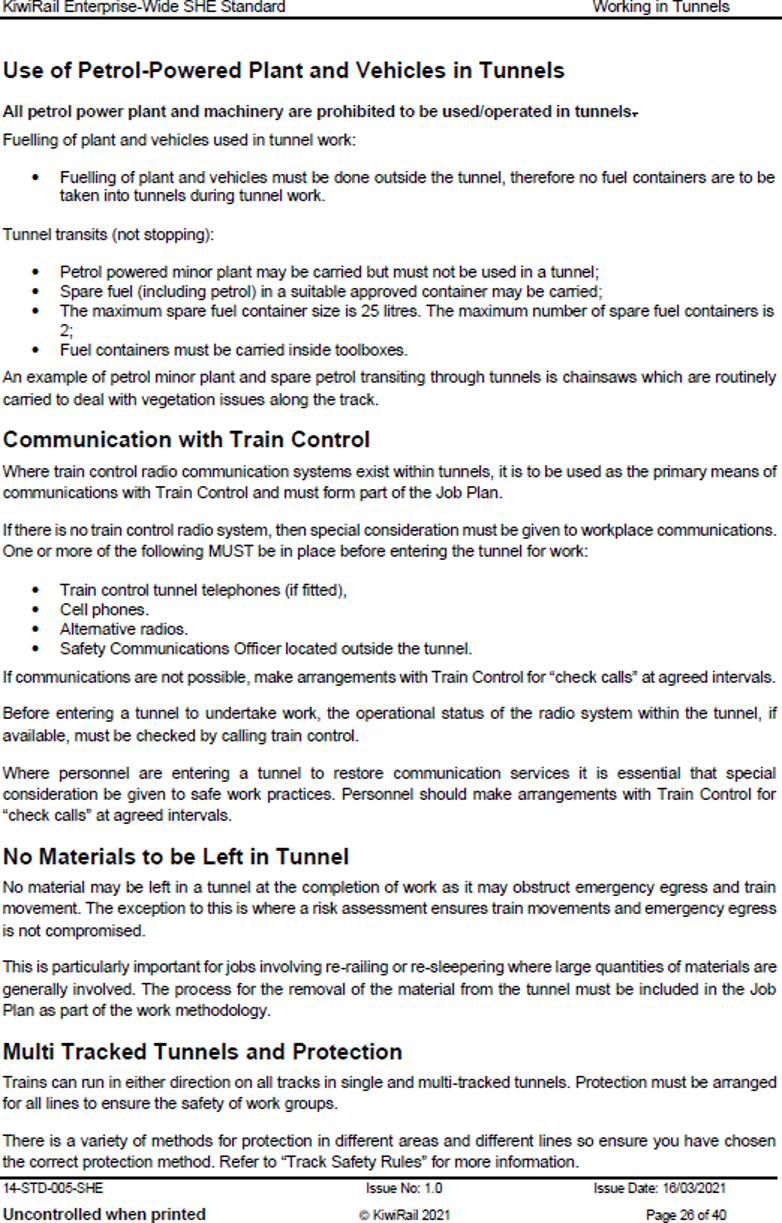
Section 14 of the standard (see Appendix 3) stated in part:
Communication with Train Control
Where train control radio communication systems exist within tunnels, it is to be used as the primary means of communications with Train Control and must form part of the Job Plan…
Before entering a tunnel to undertake work, the operational status of the radio system within the tunnel, if available, must be checked by calling train control…
-
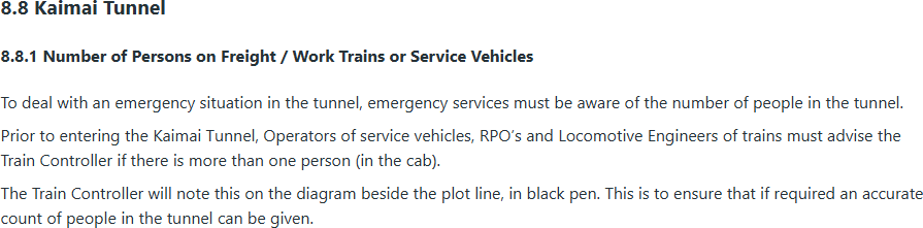
However, KiwiRail Local Network Instructions 8.8, ‘Kaimai Tunnel’ (the instructions) (see Appendix 4) stated in part:
8.8.1 Number of Persons on Freight/Work Trains or Service Vehicles
To deal with an emergency situation in the tunnel, emergency services must be aware of the number of people in the tunnel.
Prior to entering the Kaimai Tunnel, Operators of service vehicles, RPO’s and Locomotive Engineers of trains must advise the Train Controller if there is more than one person (in the cab)… [parentheses KiwiRail’s]
- While Section 13 of the standard is clear that RPO1 (as ‘Works Supervisor’) should have contacted train control before entering the tunnel, Section 8.8.1 of the instructions appears to only require such a call if there is more than one person in the cab.
- As there was only one person in each HRV cab, RPO1 adhered to the requirements of the instructions.
- Section 14 of the standard has a requirement that the operational status of the radio system within the tunnel must be checked by calling train control before entering the tunnel. It is unclear in the instructions whether this call needs to be made before each entry into the tunnel, or if it is sufficient that at least one communication with train control has been made during the working day.
-
On 20 March 2026, KiwiRail advised the Commission:
The Rules and Standards team have reviewed and believe there is no rules conflict in regard to number of persons being in rail vehicles reported to train control prior to entering the tunnel…
When more than one HRV is travelling, this is classed as multiple HRVs and must be stated as part of the information provided for the track occupation call to the Train Controller. As per TS06 – 4.1 Requesting Blocking
The Train Controller would then be aware there is more than one HRV.
The lead HRV driver would be the RPO as has taken the track occupation, and it would be his responsibility to tell the Train Controller the total number of persons travelling through the tunnel in the multiple HRVs.
- The Commission acknowledges KiwiRail’s response. However, when RPO1 obtained blocking from train control that morning they advised that there were multiple HRVs. There was no further information provided or requested regarding the exact number of HRVs, nor how many people in total were entering the tunnel.
- Notwithstanding KiwiRail’s response, the safety issue’s focus is about the wording of the instructions: ‘Prior to entering the Kaimai Tunnel, Operators of service vehicles, RPO’s and Locomotive Engineers of trains must advise the Train Controller if there is more than one person (in the cab)’ is in contradiction to the standard ‘The Works Supervisor must advise Train Control of the total number of Rail Personnel inside the tunnel.’
- If train control is not contacted, they would not be aware that anyone was in the tunnel. When RPO1 entered the tunnel for the second time that day, they did so without contacting train control because they thought protection had been arranged by RPO2.
- In the Commission’s view, the instructions (see paragraph 3.10) introduced ambiguity around whether it was necessary for an RPO to contact train control when there was only one person in the cab of each vehicle in their work group.
- If RPO1 had contacted train control before entering the tunnel for the second time, train control would have been made aware that WG1 was on track without protection. Had this occurred, it is virtually certain that action could have been taken to remove WG1 from the track and to prevent the train from entering the section.
Radio coverage
Safety issue 2: Radio coverage within the tunnel was insufficient to allow direct communication between work groups. As a result, safety-critical information was discussed and misunderstood on a closed network without an opportunity for intervention by a third party.
- Commission investigators conducted testing of the radio system. The Commission found that the tunnel radio channel could be accessed from Hemopo, but coverage did not extend to Whatakao.
- This meant the two RPOs were unable to communicate with each other using either UHF or VHF radio systems. As a result, they had to use mobile phones to coordinate their work.
- KiwiRail is aware that because of the nature of the geography in the Kaimai Range there is poor radio coverage in the area.
- KiwiRail has previously attempted to improve coverage using frequency boosting equipment, but this had the effect of interfering with commercial cellular communications.
- Had radio communication been available, any discussion on the radio between the two RPOs would have been conducted on an open radio channel. This would have provided an opportunity for train control, and any other rail workers listening, to intervene if they realised there was a misunderstanding over the protection arrangements being discussed. Had such an intervention occurred, it is very likely the accident could have been avoided.
- On 20 March 2026, KiwiRail informed the Commission of safety action taken to improve radio coverage in the Kaimai Range area (see Section 5). In the Commission’s view this safety action has addressed the safety issue.
Communication and non-technical skills
Safety issue 3: KiwiRail’s radio procedures were not implemented when using mobile phones as a primary means of communication. This led to insufficient information being exchanged and a misunderstanding of safety-critical information. As a result, a train entered a section of track that the work group incorrectly thought was protected from rail traffic.
-
Communication errors often feature as contributory or causal factors in rail incidents (Luva & Naweed, 2022), particularly while track protection is being implemented or removed (Australian Transport Safety Bureau, 2017). In this incident, RPO1 and RPO2 had different understandings about the rail protection because of miscommunication during their mobile phone conversations.
Mobile phone conversations
- Unlike calls to train control, mobile phone conversations between the RPOs were not recorded. Therefore, the accuracy of these mobile phone conversations could not be determined by Commission investigators. The events that followed are based on recollections of both RPOs as stated to Commission investigators during interviews. The RPOs had differing accounts of the outcome of these conversations and what protection was agreed to be put in place.
- RPO1 recalled that RPO2 intended to request the same blocking area previously established, which would have allowed both groups to safely work on track. RPO2 recalled that the initial agreement was for RPO1 to take out the blocking, including ‘remote locking’ (locking on to a worksite is part of KiwiRail’s track safety procedures. Remote locking is reserved for large equipment that cannot readily be moved to the lock-on location) on a digger at Whatakao.
- However, before any protection could be established, RPO1 called RPO2 to advise they would not be entering the tunnel because of fumes left by Train MP1.
- RPO2 stated in interview that they understood this to mean that RPO1 would not be going back on track. However, they were unaware that RPO1 had already on-tracked both HRVs and was waiting outside the western tunnel entrance for the fumes to clear.
- Thinking that RPO1 no longer required protection, RPO2 called train control to establish blocking for a new work area for WG2 at Whatakao. There was some discussion between RPO2 and train control around the sharing of protection limits with WG1 if required, but at that stage WG1 had reported clear of the track.
- This meant that two HRVs were on track without any form of protection, or any awareness by train control. In explanation, RPO1 stated that they thought RPO2 had already taken protection, and they had waited sufficient time for Train MP1 to clear Whatakao before going back on track to continue work inside the tunnel.
Non-technical skills
- Non-technical skills can be defined as the cognitive, social and personal resource skills that complement technical skills and contribute to safe and effective task performance. Subcategories of non-technical skills include situational awareness, communication, decision-making, leadership, teamwork, workload management and self-management.
- The effective use of non-technical skills is an important defence to capture and/or mitigate the effects of human error. This is even more important in systems that, in the absence of more robust engineering controls, are primarily reliant on individual performance and less-effective administrative controls. The RPOs had both received training in non-technical skills. However, as this incident highlights, ineffective communication can render a system that is already over-reliant on administrative controls even more vulnerable to accidents and incidents.
- The likelihood of erroneous read-back and hear-back errors is increased when those communicating have a preconceived notion of what they are expecting to hear (expectation bias) (the predisposition for individuals to perceive information according to what they are expecting to see or hear, as opposed to what is actually seen or heard. This expectancy can make it less likely that any mismatch in the information received is detected). While expectation bias cannot be eliminated, defences (such as specific phraseology and challenge-respond techniques) (methods of verifying with the other party that information being presented is correct if errors are suspected) go some way to ensuring a complete and correct understanding is shared by both parties.
Use of mobile phones
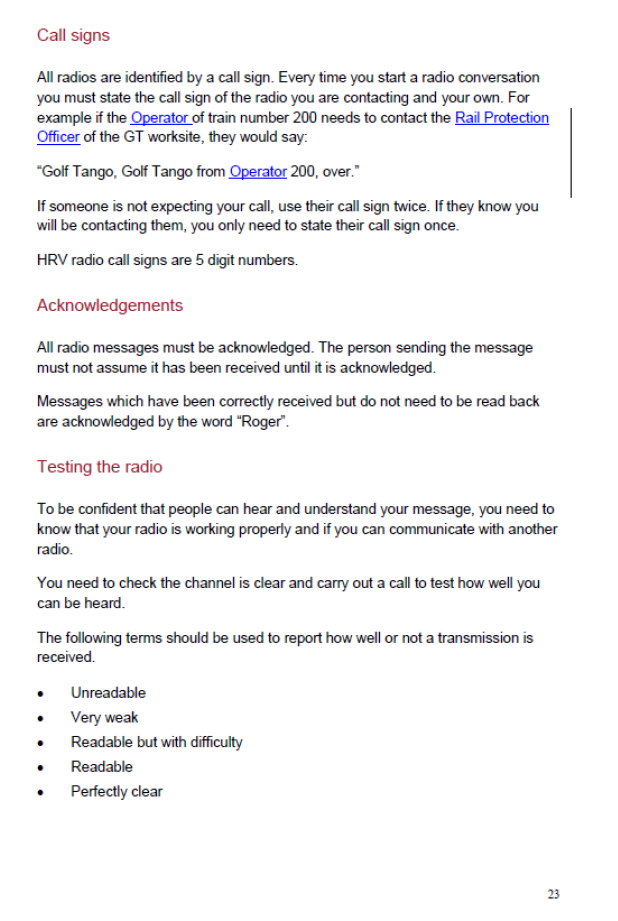
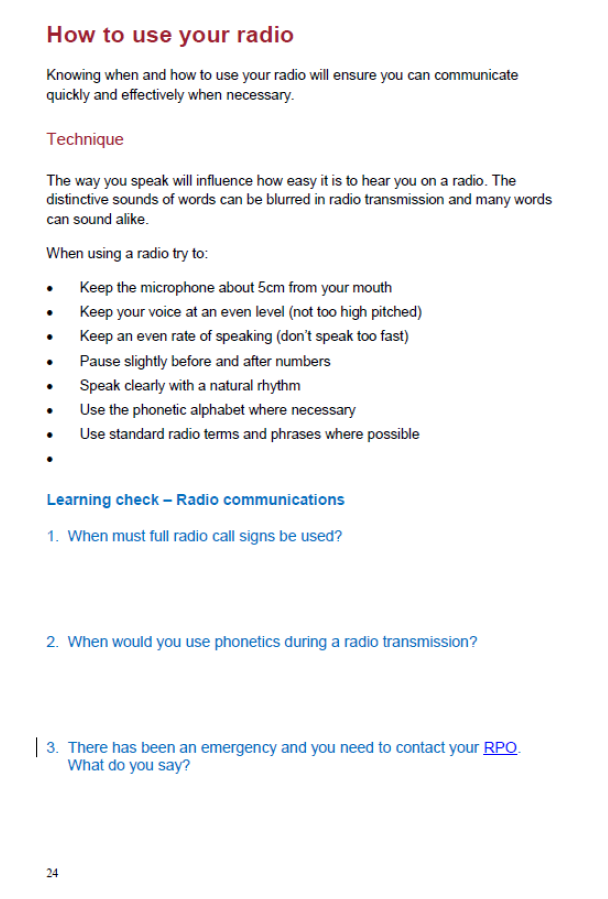
- KiwiRail has training programmes for radio communication (see Appendix 5). It is a prerequisite for track workers to have successfully completed this training certification.
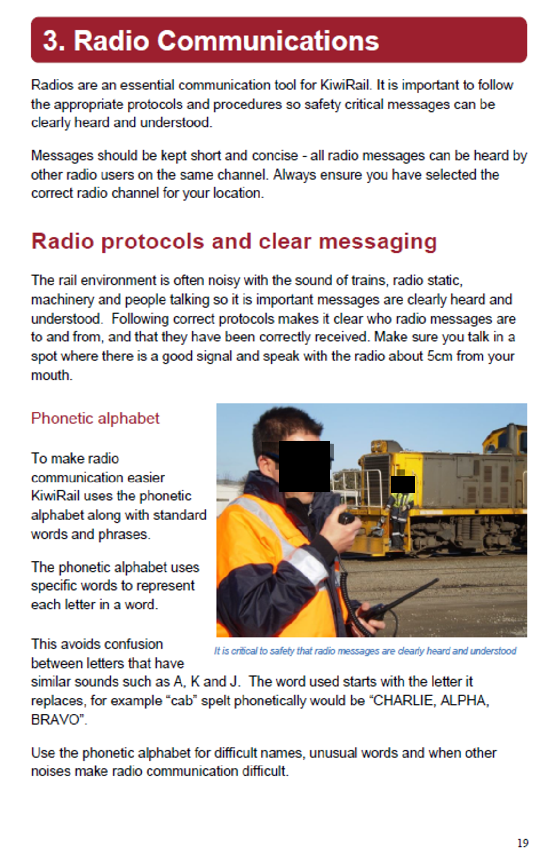
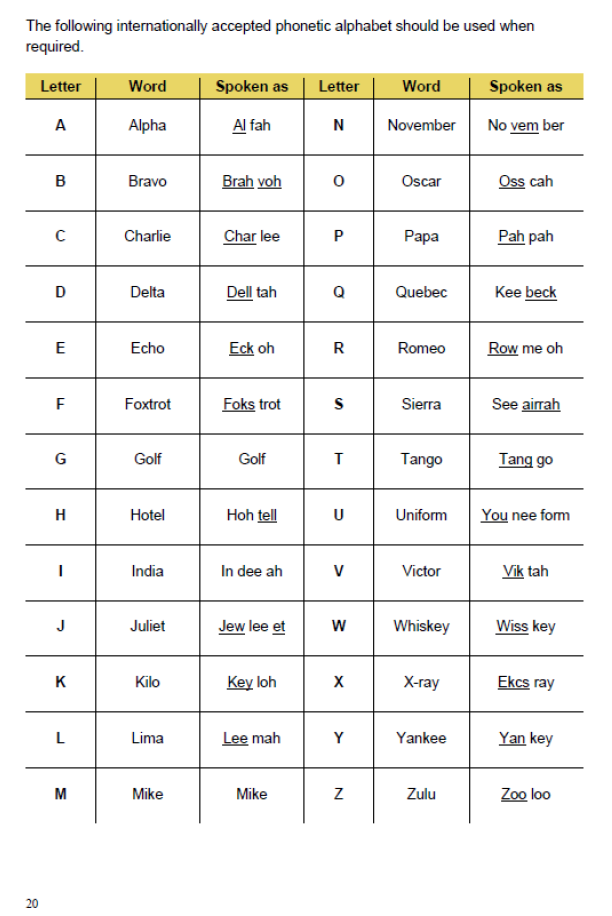
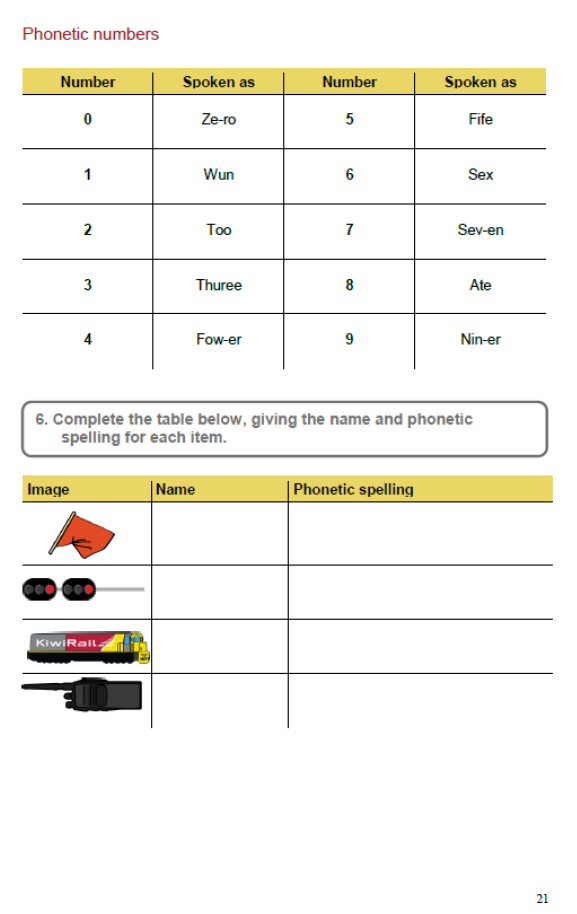
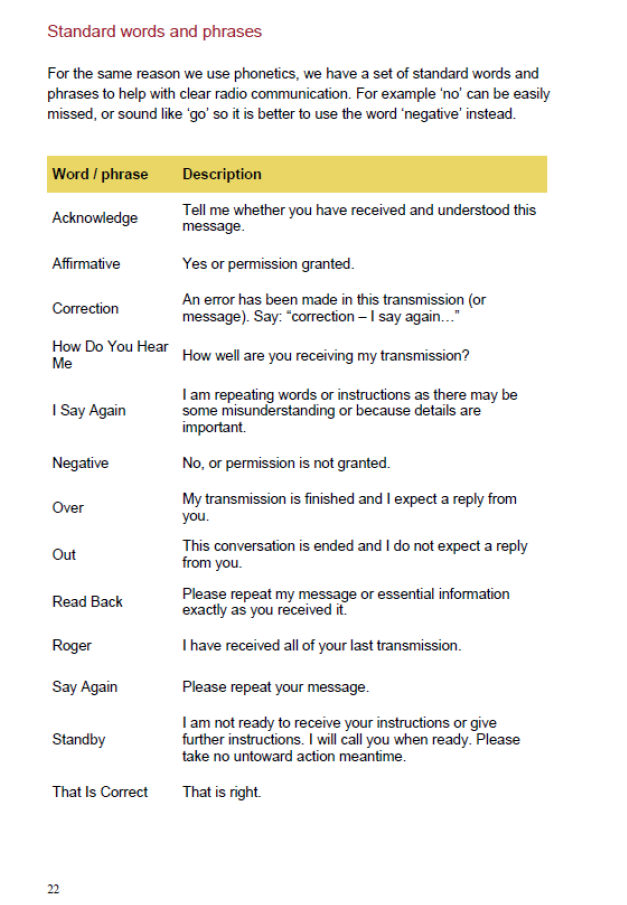
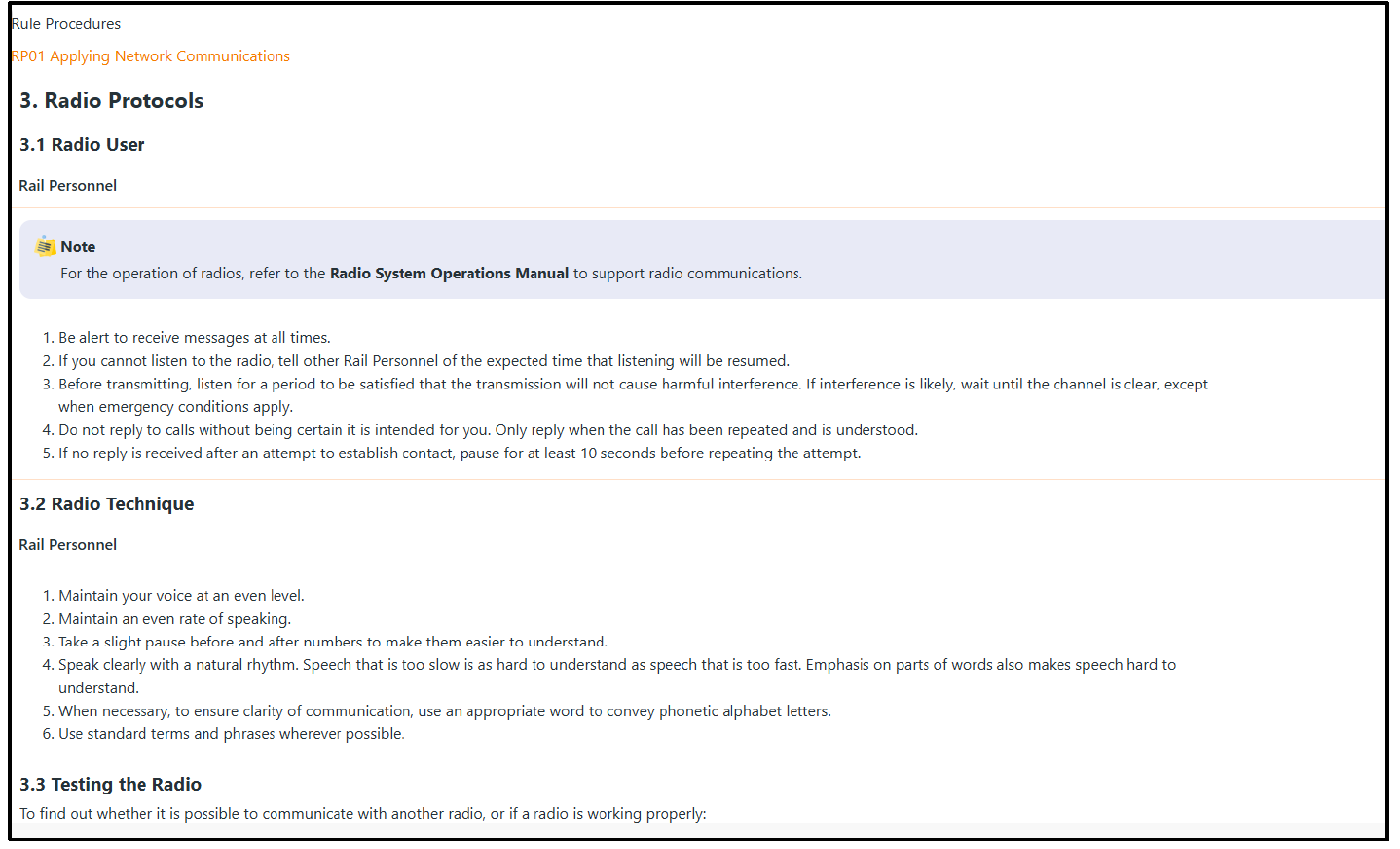
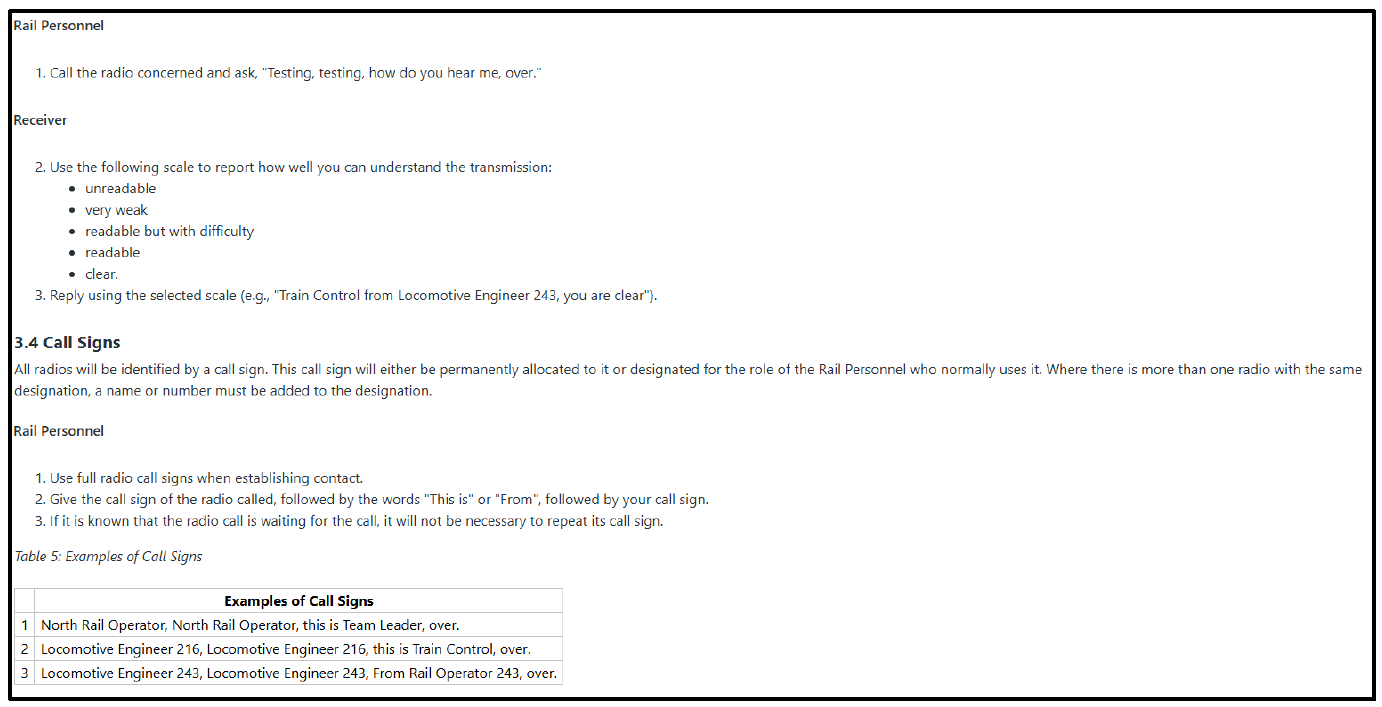
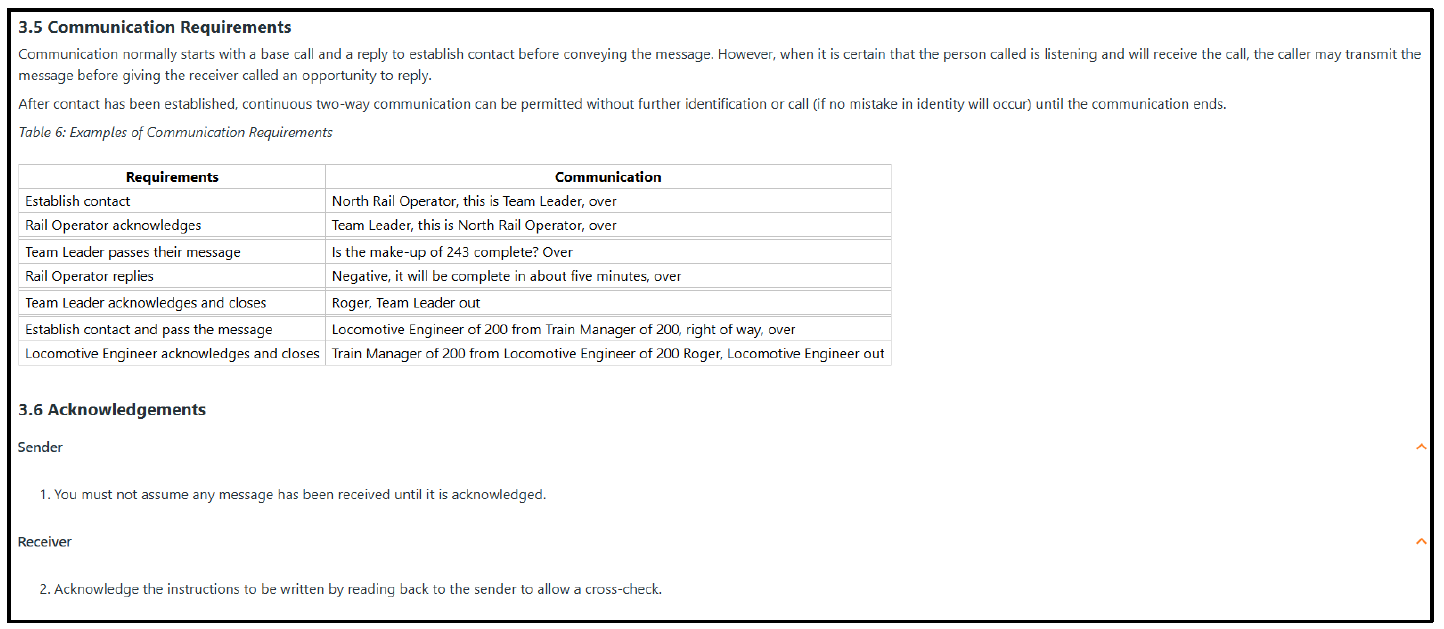
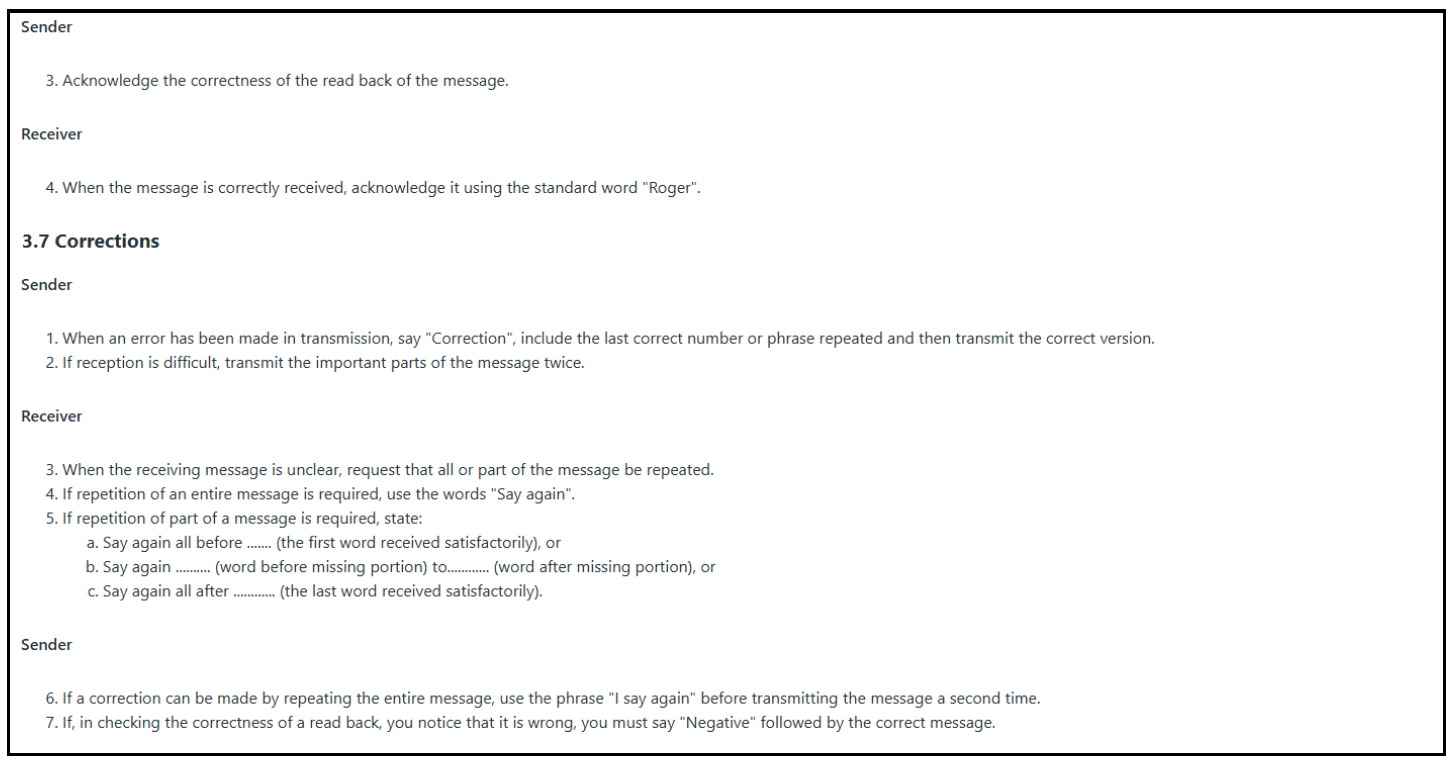
- KiwiRail has an expectation that radio communication is carried out with professionalism and discipline. Staff are required to communicate in accordance with KiwiRail Rule RP01, ‘Applying Network Communications’ (see Appendix 6). This sets out radio protocols, including how to make acknowledgements and corrections, that are designed to minimise misunderstandings.
- Recorded channels (those used primarily for safety-critical communications) are regularly audited for compliance.
- There is also an expectation that non-recorded channels be used with equal professionalism as auditing can be conducted by listening in to conversations.
- KiwiRail has also taken recent action to ensure that radios are used for all safety-critical communications except where circumstances prevent this occurring. Under these circumstances staff are permitted to use mobile phones.
- Where mobile phones are used, communication protocols must be in accordance with KiwiRail Rule RP01.
- However, because of the familiar nature of mobile phones, they are often used differently when compared to an open channel on a work radio. Although there is training for using work radios, there is no equivalent training for safe-working procedures while using a mobile phone.
- Because work-related mobile phone conversations are not recorded or audited, the same level of discipline expected from radio use may not always be followed.
- Leading up to the incident, all communication between the RPOs was conducted using mobile phones because radio communication was not possible.
- Had radio communication been available, it is very likely that KiwiRail’s communications procedure would have been followed, increasing the likelihood of the parties applying non-technical skills to challenge and/or correct each other.
- Effective communication is a key component of safety within the rail industry. In this incident, the use of good communication skills between the RPOs would have helped to establish a shared mental model of who was establishing blocking protection and for what areas.
Findings Ngā kitenga
-
The Commission found no evidence to suggest that a mechanical fault with the HRV or the train contributed to the accident.
-
Mobile phone use was necessary as the radio system did not provide the capability to communicate between the two RPOs’ locations.
-
The discussion of safety-critical information over mobile phones did not follow KiwiRail’s standard radio communications procedure. Confirmation of a mutual understanding was not made by either party.
-
KiwiRail’s instructions for calling train control before entry to a tunnel were ambiguous and it was unclear whether additional calls should have been made.
- If RPO1 had contacted train control before entering the tunnel for the second time, train control would have been made aware that WG1 was on track without protection. Had this occurred, it is virtually certain that action could have been taken to remove WG1 from the track and to prevent the train from entering the section.
- Had radio communication been available, any discussion on the radio between the two RPOs would have been conducted on an open radio channel. This would have provided an opportunity for train control, or other rail workers listening, to intervene if they realised there was a misunderstanding over the protection arrangements being discussed. Had such an intervention occurred, it is very likely the accident could have been avoided.
- Had radio communication been available to use, it is very likely that KiwiRail’s communications procedure would have been followed, increasing the likelihood of the parties applying non-technical skills to challenge and/or correct each other.
Safety issues and remedial action Ngā take haumaru me ngā mahi whakatika
General
- Safety issues are an output from the Commission’s analysis. They may not always relate to factors directly contributing to the accident or incident. They typically describe a system problem that could adversely affect future transport safety.
- Safety issues may be addressed by safety actions taken by a participant. Otherwise the Commission may issue a recommendation to address the issue.
- Three new safety issues were identified.
Safety issue 1: There was contradictory and ambiguous direction in KiwiRail’s procedures as to whether it was necessary for train control to be advised before the track workers entered the tunnel. This increased the risk of work being carried out within the tunnel without adequate protection being in place.
- On 19 June 2026, KiwiRail advised the Commission that the KiwiRail Rules and Standards team will review relevant Standard and Procedure documents to meet the recommendation, ensuring that they align and there is clarity around contacting train control.
- The Commission welcomes the safety action taken to date. However, the action is not yet complete. Therefore, the Commission has made a recommendation in Section 6 to address this issue.
Safety issue 2: Radio coverage within the tunnel was insufficient to allow direct communication between work groups. As a result, safety-critical information was discussed and misunderstood on a closed network without an opportunity for intervention by a third party.
-
On 20 March 2026, KiwiRail provided the Commission with a summary of the improvements made to radio communication in the Kaimai Tunnel:
Channel 2 (Train Control): Coverage has been extended out to the on-tracking pad at Whatakao. Channel change boards will be relocated further out to the 4LAB signal.
Channel 4 (Maintenance): A dedicated maintenance channel has been enabled for track staff. This repeater channel provides coverage from the Hemopo on-tracking pad, through the tunnel, to the Whatakao on-tracking pad.
Available on all Hi-Rail and portable VHF radios. Does not connect to Train Control.
Current Status: All systems are operational. Official changes and final testing were carried out 21st of December.
New Channel Change Board Locations:
Hemopo - Signal 8RAB ECMT 61.862 km
Whatakao - Signal 4LAB ECMT 73.858 km
- In the Commission’s view, this safety action has addressed the safety issue. Therefore, the Commission has not made a recommendation.
Safety issue 3: KiwiRail’s radio procedures were not implemented when using mobile phones as a primary means of communication. This led to insufficient information being exchanged and a misunderstanding of safety-critical information. As a result, a train entered a section of track that the work group incorrectly thought was protected from rail traffic.
-
On 20 March 2026, KiwiRail informed the Commission of the following:
The work around the MIS.71 review came out of a Working Group, of which actions are being tracked and assigned Action Owners. The exchange of information is part of this action, so this will be followed up on and TAIC informed of the progress of this action.
- One of those actions was ‘Review to formally record safe working arrangements between 2 RPOs/SPs.’
-
On 19 June 2026, KiwiRail informed the Commission of the following:
Amendments will be made to communication formats, ensuring relevant forms are populated to capture the details of protected work area limits. This involves the recording of the formal exchange of protected work area limits which will be recorded with any adjacent or overlapping site. This is for all communication methods including mobile phones. New forms will be used from 1 January 2027 to allow for change management in producing the updated books, completing rules updates and coaching our teams on the change.
- The Commission welcomes the safety action taken to date. However, the action is not yet complete. Therefore, the Commission has made a recommendation in Section 6 to address this issue.
Recommendations Ngā tūtohutanga
General
- The Commission issues recommendations to address safety issues found in its investigations. Recommendations may be addressed to organisations or people, and can relate to safety issues found within an organisation or within the wider transport system that could contribute to future transport accidents and incidents.
- In the interests of transport safety, it is important that recommendations are implemented without delay to help prevent similar accidents or incidents occurring in the future.
New recommendations
- On 30 July 2026, the Commission recommended that the Chief Executive of KiwiRail review the procedures that apply to track workers carrying out work within tunnels, to ensure they are clear and unambiguous as to the requirement to advise train control before entering a tunnel. [022/26]
-
On 18 August 2026, KiwiRail replied:
This recommendation is accepted.
The KiwiRail Rules and Standards team will review relevant standard and procedure documents to meet the recommendations ensuring that they align and there is clarity around contacting Train Control.
-
On 30 July 2026, the Commission recommended that the Chief Executive of KiwiRail take action to improve communication to ensure it includes the correct methods of communicating safety-critical information when using mobile phones. [023/26]
-
On 18 August 2026, KiwiRail replied:
This recommendation is accepted.
Amendments will be made to communication formats, ensuring relevant forms are populated to capture the details of protected work area limits. This involves the recording of the formal exchange of protected work area limits which will be recorded with any adjacent or overlapping site.
This is for all communication methods including mobile phones.
New forms will be used from 1 January 2027 to allow for change management in producing the updated books, completing rules updates and coaching our teams on the change.
Other safety lessons Ngā akoranga matua
- All personnel undertaking safety-critical roles should adhere to the principles underlying the application of non-technical skills, to ensure that they share the same mental models and have a clear understanding of what is required of themselves and others to complete tasks safely.
Data summary Whakarāpopoto raraunga
Details
Conduct of the inquiry Te whakahaere i te pakirehua
- On 6 April 2025, the New Zealand Transport Agency Waka Kotahi notified the Commission of the occurrence. The Commission subsequently opened an inquiry under section 13(1) of the Transport Accident Investigation Commission Act 1990 and appointed an Investigator-in-Charge\
- On 7 April 2025, a protection order was placed on the HRV involved in the collision.
- On 28 August 2025, Commission investigators carried out radio testing in Kaimai Tunnel and sidings to the east and west.
- The Commission obtained records and information from sources that included:
- interviews with three track workers and the locomotive engineer, and discussions with KiwiRail communications personnel
- train performance data from Train MP8
- train control voice recordings
- train control graphs
- internal KiwiRail investigation report
- radio system performance testing.
- On 29 April 2026, the Commission approved a draft report for circulation to seven interested parties for their comment.
- Two interested parties provided detailed submissions and four interested parties replied that they had no comment. One interested party did not respond. Any changes as a result of the submissions have been included in the final report.
- On 30 July 2026, the Commission approved the final report for publication.
Glossary Kuputaka
- Electronic protection
- A method of protection whereby the train controller uses the train control system to prevent signals being changed to proceed into a work area. Also referred to as ‘blocking’
- Hi-rail vehicle
- A vehicle fitted with equipment that gives the capability to travel on both road and rail.
- Protection
- Methods established to prevent rail traffic from entering a work area
- Rail protection officer
- The person in a work group who is responsible for all those working at the worksite. They authorise worker access to the track and trains to pass through the worksite once the track is confirmed clear as required
- Refuge
- A recess built into a tunnel wall to provide an area where people or equipment cannot be struck by rail traffic
- Safety-critical tasks
- Tasks that, if not performed correctly, may result in a mishap with potentially severe consequences
- Track fasteners (Pandrol clips)
- Components used to secure the rail to the rail base to prevent the track from moving
Citations Ngā tohutoru
Australian Transport Safety Bureau. (2017). Transport Safety Report, Research Investigation RI-2014-011 Safe work on track across Australia. Retrieved from https://www.atsb.gov.au/sites/default/files/media/5773636/ri-2014-011_final.pdf
KiwiRail. (2026). RP06 Using blocking. In Rule procedures (pp. 48-55). Retrieved from https://shield.kiwirail.co.nz/frontend/index.html#/rules/UUID-e8c8a616-2b49-47f4-8dd6-e527be0a7073
Luva, B., & Naweed, A. (2022). Authority gradients between team workers in the rail environment: a critical research gap. Theoretical Issues in Ergonomics Science, 23:2, 155-181.
Transport Accident Investigation Commission. (2024). Rail Inquiry RO-2023-103 Safe-working irregularity, 3.85 km mark, Johnsonville line – tunnel 5, 04 May 2023. Retrieved from https://taic.org.nz/inquiry/ro-2023-103
Appendix 1. Daily information bulletin
Appendix 2. KiwiRail Standard 14-STD-005, ‘SHE Working in tunnels’, Section 13 page 20
Appendix 3. KiwiRail Standard 14-STD-005, ‘SHE Working in tunnels’, Section 14 page 26
Appendix 4. KiwiRail Local Network Instructions ‘Kaimai Tunnel’, Section 8.8.1
Appendix 5. KiwiRail radio training
Appendix 6. KiwiRail radio protocols

Related Recommendations
On 30 July 2026, the Commission recommended that the Chief Executive of KiwiRail review the procedures that apply to track workers carrying out work within tunnels, to ensure they are clear and unambiguous as to the requirement to advise train control before entering a tunnel.
On 30 July 2026, the Commission recommended that the Chief Executive of KiwiRail take action to improve communication to ensure it includes the correct methods of communicating safety-critical information when using mobile phones.