Two people died when freight train ran into car at level crossing, cause by confusion for the car driver in complicated roadworks operation. Traffic management plans for roadworks at level crossings must identify all risks to road and rail vehicles. Work in the rail corridor must only be done with a permit from the rail access provider.
Executive summary Tuhinga whakarāpopoto


What happened
- At about 0340 on Saturday 7 December 2019, two family members left their home in Hamilton by car to begin a rostered shift at their place of employment in Morrinsville.
- The car journey to Morrinsville took them through an area of roadworks near the intersection of State Highway 26 and Piako Road, four kilometres southwest of their destination.
- The vehicle the two people were in was stopped briefly by a traffic controller holding a stop/go sign at the southern end of the roadworks while opposing traffic cleared the area. Their car was the first in a queue of cars waiting for the go signal. Once the opposing traffic was clear, the traffic controller moved the stop sign to the go position and the cars began moving through the work area towards Morrinsville.
- A short time after the queue of cars had proceeded past the traffic controller, a train travelling from Tauranga towards Hamilton entered the section of track that automatically activated the level crossing warning alarms.
- The driver of the car did not stop before the level crossing and proceeded on to the railway line directly in front of the approaching train.
- The train and car collided, resulting in the two car occupants suffering fatal injuries.
Why it happened
- The approved traffic management plan under which the roadworks were being conducted did not identify the risks to road and rail vehicles of the level crossing situated within the proposed work area. Safety briefings and risk-mitigation actions taken by the road crew focused on their own safety and did not adequately mitigate the risks for other users approaching the level crossing.
- The road was partially coned off to provide protection for the contractors who were painting the road markings approaching the level crossing. There was distracting activity being conducted and a vehicle with flashing amber beacons was parked next to the level crossing warning signals.
- The proximity of the vehicle with flashing amber beacons next to the level crossing alarms likely created confusion, hindering the effectiveness of the warning devices to alert road users that a train was approaching.
- The confusing scene created by the roadwork activity likely led the driver of the car to perceive, on being given a go signal by the traffic controller, that they had clearance to drive through the entire roadworks area including the level crossing.
- Safety for pedestrians and vehicles using level crossings is on the Transport Accident Investigation Commission’s (Commission’s) watchlist of serious transport safety concerns.
- The Commission recommended that Waka Kotahi NZ Transport Agency review its current auditing of agencies delegated to approve traffic management plans, to ensure that applicants developing traffic management plans near rail crossings have identified any rail crossings within the vicinity of proposed work areas and have consulted the rail access providers to ensure that any additional safety requirements in relation to the road/rail interface have been met.
- The Commission recommended that the Secretary for Local Government provide leadership to, and work with local authorities to ensure all traffic management plans near rail crossings are developed in consultation with the rail access providers and any additional safety requirements in relation to the road/rail interface are met.
What we can learn
- Roadwork activity in the vicinity of a level crossing has the potential to distract road users from the level crossing warning devices. In planning for such activity, consideration must be given to the increased risks for road users.
Who may benefit
- Road users, road controlling authorities, roading contractors and people involved with the planning and approval of work around road/rail interfaces may all benefit from the findings and recommendations in this report.
Factual information Pārongo pono
Narrative
- On 17 June 2018 a traffic management plan (TMP) titled Level Crossing Programme: SH26 Piako Road was prepared by an employee of HEB Construction Limited (HEB) as part of a level crossing improvement project that HEB was contracted to complete on behalf of KiwiRail and Waka Kotahi NZ Transport Agency (Waka Kotahi).
- On 10 September 2019 the TMP was approved as Corridor Access Request R616904 by an employee of Higgins Contractors Limited (Higgins), acting on delegated authority to approve TMPs from Waka Kotahi.
- On 23 September 2019 HEB contacted KiwiRail to request that a Permit to Enter (PTE) (a document provided by KiwiRail allowing work to be conducted within five metres of the rail corridor once certain conditions have been met) be issued for the State Highway 26/Piako Road level crossing (the crossing) to carry out work in the rail corridor.
- Correspondence between HEB and KiwiRail on this matter continued intermittently until 1 November 2019.
- On 1 November 2019 there was a final communication from the KiwiRail National Corridor Permit Manager to HEB, seeking clarification of the status of the PTE.
- There was no response to this request from HEB, and a PTE was not issued for the crossing before the accident occurred.
- At about 1700 on 6 December 2019, road contractors commenced work near the crossing. The work involved setting up road cones and signage to provide protection for vehicles and personnel involved in painting markings on the road as part of a crossing upgrade.
- At about 1830 a rail protection officer (RPO), who had been contracted by the road marking company, arrived on site to carry out duties related to marking the road within the confines of the rail corridor.
- At about 2030 the RPO reported to the site traffic management supervisor that they had witnessed an incident where a driver of a car had become confused with the road layout and driven on the incorrect side of the coned-off area.
- At about 2230 there was reportedly a second incident at the crossing that involved a near miss between a train and a car.
- At about 0130 on 7 December 2019, the RPO was no longer required for rail protection duties and departed the site. The traffic management equipment, including the road cones and vehicles, remained in place while further work was conducted outside the rail corridor.
- At about 0150 Train 320 departed Tauranga travelling towards Hamilton.
- At about 0340 the occupants of the car involved in the collision (the car) departed their home in Hamilton and travelled towards Morrinsville on their way to work.
- At about 0402 the car was stopped by a traffic controller holding a stop/go sign. The traffic controller was located within the roadworks, approximately 350 metres (m) from the crossing.
- The traffic controller’s duty was to stop cars approaching from the south end of the roadworks while cars were travelling through the single lane from the opposing direction.
- At about 0406 the car was given clearance by the traffic controller to proceed and began moving towards the crossing at an estimated speed of no more than 30 kilometres per hour (km/h).
- About 15 seconds before the car reached the crossing, the crossing alarm warning bells and alternating flashing red lights were activated by the approach of Train 320. Train 320 was travelling at 70 km/h, within the 80 km/h speed limit for the line.
- At 0407 the car entered the crossing directly in front of Train 320. The car was struck in the middle of the driver’s side by the locomotive (see Figure 3).
- The train driver immediately activated the train’s emergency braking system. The train came to a stop 500m west of the point of collision.
- Emergency services were called and the train driver disembarked from the locomotive to assess the situation. The right-hand side of the car was wedged into the front of the locomotive. Both car occupants had suffered fatal injuries.

Personnel information
- The train driver had received full certification in 2013. They had all current relevant qualifications for the role.
- The car driver held a learner’s licence.
Train/Vehicle information
- The train was carrying freight. It was 704 metres long and weighed 679 tonnes.
- The car was a small four-door saloon. No mechanical issues that may have contributed to the accident were found during an independent post-accident examination.
Meteorological information
- The accident occurred in the early hours of the morning. The weather conditions were still and clear. The area in which the accident occurred was lit by numerous artificial sources due to the roadwork activity.
Site and wreckage information
-
The car was removed by New Zealand Police to a secure storage facility, where it underwent a mechanical examination. No mechanical faults were found with the vehicle.
Medical and pathological information
- The train driver voluntarily supplied an alcohol breath-screening test to New Zealand Police at the scene. The test indicated a negative/clear result.
- Toxicology tests on the car driver also indicated a negative/clear result.
Previous occurrences
- There had been numerous reported near misses and several collisions at the crossing since 2005, including fatal collisions in 2012 and 2017.
Organisational information
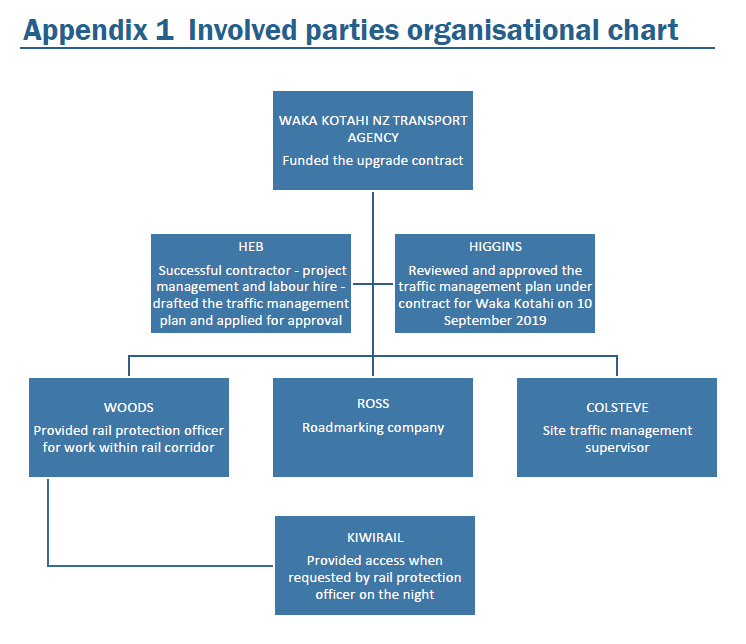
- Level Crossing Programme: SH26/Piako Road was a venture between Waka Kotahi, KiwiRail and third parties contracted by Waka Kotahi. See Appendix 1 for an organisational chart.
Analysis Tātaritanga
Introduction
- The upgrade to the crossing at State Highway 26/Piako Road was commissioned by Waka Kotahi to improve the safety features of the road/rail interface. The intersection itself was challenging to road users, as three separate 100 km/h roads joined in the vicinity of the rail crossing. This encouraged road users to concentrate on being prepared to follow give-way rules to avoid road accidents, rather than focus on the crossing, which was also a potential danger.
- The roadwork activity at the time of the accident included the crossing. Receiving a go signal from the traffic controller likely led the car driver to believe that they had clearance through the entire area of activity, whereas the traffic controllers on duty reported that they had the expectation that road users would stop if required for any level crossing alarms.
- The car driver held a learner’s licence but was described by family members as a confident and competent driver. The Transport Accident Investigation Commission (Commission) found no evidence that the driver’s level of experience contributed to the safety factors identified in this report.
- The following section analyses the circumstances surrounding the event to identify those factors that increased the likelihood of the event occurring or increased the severity of its outcome. It also examines any safety issues that have the potential to adversely affect future operations.
Safety issue: The TMP did not fully identify the risks to road and rail vehicles approaching the crossing.
- The roadworks being conducted were part of an upgrade to the crossing at that location and were being controlled by traffic controllers with stop/go signs.
- Road traffic was diverted into a single lane to provide a safe working area for road marking contractors, and the traffic controllers were present to ensure there were no conflicting movements of cars in the single lane. There was a temporary speed limit of 30 km/h in place within the area of the roadwork activity.
- The work had been approved by means of a TMP, which had been signed off by Higgins on behalf of Waka Kotahi in September 2019 (see Figure 4).
- The TMP included information regarding the positioning of warning signs, road cones and traffic controllers in relation to the proposed work.
-
The TMP approved by the contractor under delegated authority from Waka Kotahi did not identify the rail corridor and crossing within the work area. This was contrary to the advice in Waka Kotahi’s own publication, Traffic Control Devices Manual Part 9 (NZ Transport Agency, 2012), which stated in part:
Whenever both rail and road corridors are within a work site, any traffic management plan must consider implications of the work and associated controls on the safe operation of each corridor.
It is essential that critical features such as railway lines and traffic control devices (such as flashing light assemblies) are included on plans. This will ensure those involved in the design and approval of the plans fully consider the implications of the work on all traffic (including road and rail vehicles) through the site as required by CoPTTM [the Code of Practice for Temporary Traffic Management] (Waka Kotahi is responsible for setting the requirements for the safe and efficient management and operation of temporary traffic management on all roads in New Zealand. CoPTTM is the best-practice guideline for temporary traffic management in New Zealand).
- Although required by the TMP approving authority, the absence of any reference to the rail corridor meant that the planning of the proposed work did not consider the danger to road and rail vehicles approaching the crossing, and subsequently no added protection was required to be put in place while the work was being carried out.
- Vehicles were signalled through the roadworks area towards the crossing. Specific protection had not been put in place to ensure that road users would comply with crossing alarm warning devices as they normally would in the absence of any roadwork activity.
- A lack of specific protection for the crossing within the work area increased the risk to road and rail vehicles.
- The Commission has made a recommendation to address this issue in section 6.
Safety issue: Work within the rail corridor was undertaken without a permit to do so being obtained. As a result, potential risk-mitigation actions that were required prior to the issue of the permit were not completed. Not obtaining a permit increased the risk to road and rail users approaching the crossing.
- PTEs were granted by the National Corridor Permit Manager, who was the KiwiRail official responsible for reviewing requests by outside agencies needing to work within five metres of the railway corridor.
- Before a PTE was granted, a series of checks was to be made to ensure there was no unacceptable risk to KiwiRail assets and users of the rail corridor.
- On this occasion, the contractor requested that an existing PTE granted for a different location be extended to cover the State Highway 26/Piako Road crossing.
- The National Corridor Permit Manager questioned the request, as it did not follow the correct protocol. After a period of correspondence on the matter, communication ceased. The request was not followed through and a PTE was not issued for the crossing.
- The work requiring a PTE was the painting of yellow road markings (hatching) that denoted the danger area for road users close to the crossing. This work went ahead despite a PTE not having been issued (see Figure 5).

- The RPO contracted by the road markers contacted train control (train control is situated in Wellington Railway Station and is responsible for track authorisations and the safe movement of rail traffic) to request blocking (a method of preventing signals being cleared into an area, which is applied by a train controller on a train control system) for the area for the duration of the work. Due to the time of the evening there was little rail activity and therefore, although the work was not on a plan, it was treated as a routine ad hoc request for blocking and was granted by train control.
- Once the work had been completed, the RPO contacted train control to remove the blocking. At this point they were no longer required for protection duties so they departed the site hours before the accident occurred.
- The work taking place within five metres of the railway corridor without a permit had already been completed at the time of, and therefore did not contribute to, the accident. However, it is of concern to the Commission that an opportunity was lost for KiwiRail to have oversight of the planned work, had the contractor obtained a PTE.
- Not having oversight of the planned work meant that any risk-mitigation actions KiwiRail deemed necessary (for example, temporarily lowering the speed of trains through the crossing or promulgating the worksite on the daily information bulletin) could not be considered.
- A further opportunity was lost in that by reviewing the planned work KiwiRail may have deduced from the TMP that there had been an insufficient consideration of the risks posed by the crossing.
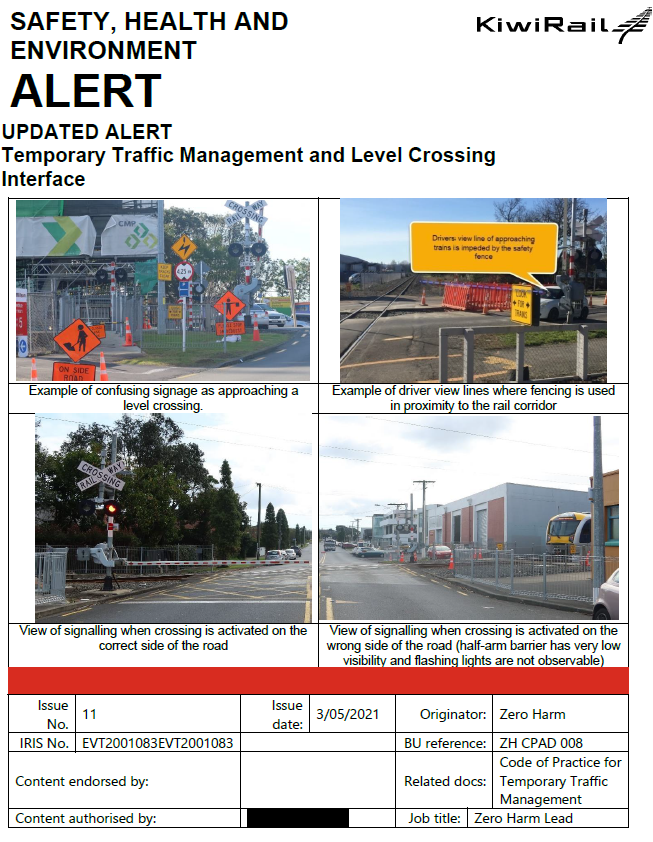
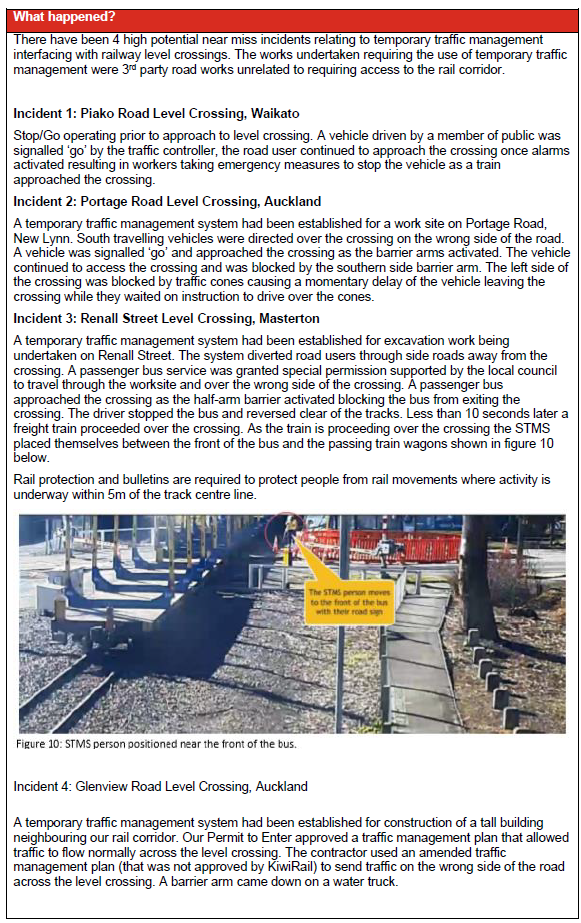
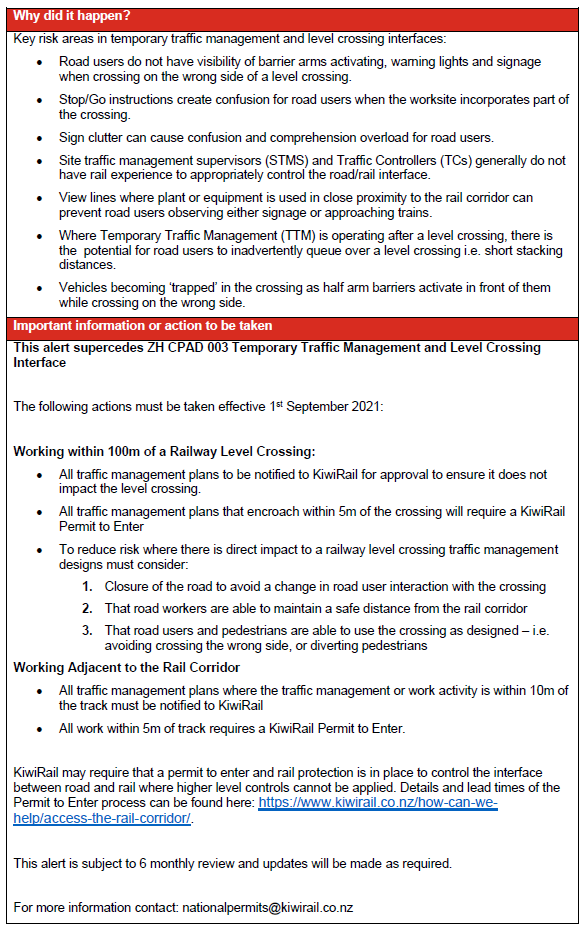
- KiwiRail has provided the Commission with documentation on actions it has taken since the incident. The documentation includes alerts to industry of the obligations for appropriate TMPs and the need for PTEs, and for updated checklists to be completed before PTEs are granted (see Appendix 2).
- KiwiRail has also instituted a new requirement for an RPO to be in place where a TMP or work activity impacts any of the warning devices on a crossing, or as otherwise determined necessary in the circumstances. The RPO will communicate directly with the traffic controllers.
- The Commission welcomes these actions. However, rail access providers are only able to provide additional protections if they are aware in advance of the work taking place. The current process, which places the onus on contractors to apply for PTEs after TMPs have been approved, increases the risk of work going ahead without rail access providers’ knowledge or approval.
- The Commission has made a recommendation to address this issue in section 6.
Safety issues and remedial action Ngā take haumanu me ngā mahi whakatika
General
- Safety issues are an output from the Commission’s analysis. They typically describe a system problem that has the potential to adversely affect future operations on a wide scale.
- Safety issues may be addressed by safety actions taken by a participant, otherwise the Commission may issue a recommendation to address the issue.
- The Commission identified two safety issues during the investigation.
The TMP did not fully identify the risks to road and rail vehicles approaching the crossing
- The TMP presented to the Waka Kotahi delegated authority for approval did not identify the crossing within the worksite. Waka Kotahi’s own instructions for working on or near level crossings gave clear directions to road controlling authorities (a body responsible for the care, control or management of roads within a given jurisdiction. Waka Kotahi is the road controlling authority for state highways; other roads are the responsibility of the local or regional councils) and rail access providers to consider the possible implications arising from rail and road vehicle interactions.
-
On 1 June 2021 Waka Kotahi advised the Commission:
CoPTTM uses a risk-based approach that relates the task to the specific location at which the work will be carried out. All of the requirements outlined in the CoPTTM (TCD [Traffic Control Devices] Manual part 8) also apply to TMPs with or near rail crossings. In addition to the guidance provided through CoPTTM, providers developing TMPs with or near rail crossing are also required to consult with railway authorities, who are best placed to confirm their additional TMP requirements have been met. Other than TCD part 8 section A7.4.2. requesting TMP providers to consult with railway authorities, there are no further specific reference to rail crossings within the current TCD. Given feedback through the CoPTTM Review and the number of incidents around rail crossings a guidance document (which would sit in Section I-10: Railway crossings) is currently being developed.
- The Commission welcomes the safety actions taken to date. However, it believes more action needs to be taken to ensure the safety of future operations. Therefore, the Commission has made a recommendation in section 6 to address this issue.
Work within the rail corridor was undertaken without obtaining a permit to do so. As a result potential risk-mitigation actions that were required prior to the issue of the permit were not completed. Not obtaining a permit increased the risk to road and rail users.
- The work taking place within five metres of the railway corridor without a permit had already been completed at the time of, and therefore did not contribute to, the accident. However, it is of concern to the Commission that, through the contractor not obtaining a PTE, an opportunity was lost for KiwiRail to have oversight of the planned work.
- KiwiRail has taken the following safety action to address this issue:
- updated internal checklists to prompt the requirement for a temporary TMP
- drafted an alert to industry, to be presented to road controlling authorities and contractors, emphasising the need for PTEs
- instituted a requirement for an RPO to be present when work could potentially affect level crossing protection equipment.
- The Commission welcomes the safety actions taken to date. However, it believes more action needs to be taken to ensure the safety of future operations. Therefore, the Commission has made a recommendation in section 6 to address this issue.
Other safety action
- The State Highway 26/Piako Road crossing was fitted with a half-arm barrier on completion of the upgrade for enhanced protection of road traffic. When activated by an approaching train, a half-arm barrier lowers across the road to provide a physical intervention for vehicles approaching the crossing (see Figure 6).

Appendix 1. Involved parties organisational chart
Appendix 2. KiwiRail alert to industry