
TAIC reports on the blackout and loss of propulsion on the Interislander ferry Kaitaki in January 2023. After a total loss of power, the ship drifted towards a lee shore in rough conditions. Crew stabilised situation and the ship later berthed safely. A degraded rubber expansion joint in the engine cooling system failed and triggered an automatic shutdown. The part had exceeded its service life. TAIC found six safety issues, including ageing asset management, engineering decision support, emergency response coordination, and national towage capability. It also found planning and practice for a major maritime emergency fell short of requirements. TAIC’s five recommendations target practical, system-wide improvements.
Executive summary Tuhinga whakarāpopoto


What happened
- On Saturday 28 January 2023, the KiwiRail Limited (KiwiRail) Interislander passenger ferry Kaitaki was in transit from Picton to Wellington on a scheduled service.
- When the Kaitaki was approximately one nautical mile off Sinclair Head, the vessel lost all electrical and propulsive power (blackout).
- Because of the vessel’s proximity to the coast and the strong onshore weather conditions, the master broadcast a Mayday call.
- The Rescue Coordination Centre New Zealand (RCCNZ) initiated its mass rescue operations escalation plan.
- As the incident unfolded, various agencies took steps to prepare for a potential maritime mass rescue.
- The Kaitaki was without propulsion for approximately one hour before the engines could be restarted and control returned to the bridge.
- The Kaitaki then proceeded under its own power to Wellington, escorted by two tugs.
- Near Wellington Heads (the entrance to Wellington Harbour between Pencarrow Head and Palmer Head), the vessel’s port-side main engine's gearbox developed a fault, resulting in a loss of propulsion on that side. Propulsion was quickly restored using a standby main engine.
-
The Kaitaki made its way without further incident into Wellington Harbour, berthing shortly after 2014 NZST.
-
RCCNZ maintained the mass rescue operation until the Kaitaki was safely berthed.
- On 5 May 2023, the Commission published a preliminary report (Transport Accident Investigation Commission, 2023) having identified a safety issue with the rubber expansion joints (REJ). Deterioration had occurred over time, starting from the date of manufacture, because of service conditions and ageing.
Why it happened
- When the Kaitaki was approximately one nautical mile off Sinclair Head, the starboard shaft generator tripped (automatically shut down because of overload). As a result, the vessel suffered a blackout.
- Shortly after, an REJ on the port auxiliary engine ruptured. This resulted in the loss of water from the high-temperature cooling water system, which provided cooling to all main and auxiliary engines.
- The loss of water pressure from the cooling system meant none of the four main engines could be restarted safely. As a result, propulsion could not be restored quickly.
What we can learn
- Rubber expansion joints deteriorate over time, starting from the date of manufacture, because of service conditions and ageing. To ensure their reliability, maintenance schedules must consider both their date of manufacture and date of installation.
- Ships’ crews should prioritise and practise escape and evacuation procedures to ensure the safety of all passengers and crew during emergencies.
- Regular practical drills and exercises are essential to continuously improve escape, evacuation and rescue plans.
Who may benefit
- Mariners, maritime operators, Cook Strait ferry operators, maritime regulatory agencies, maritime training institutes and providers, and agencies and operators involved in search and rescue operations may benefit from this report.
Factual information Pārongo pono
Background
- The KiwiRail Limited (KiwiRail) Interislander passenger ferry Kaitaki is a roll-on/roll-off (RoRo) ferry engaged solely on the Cook Strait. It operates multiple trips daily between Wellington and Picton. This route of approximately 50 nautical miles (NM) typically takes about three hours from berth to berth. The Kaitaki is the largest of Interislander’s three ships and is classed (a maritime classification society sets technical rules based on experience and research, confirms that designs and calculations meet these rules, surveys ships and structures during the process of construction and commissioning, and periodically surveys vessels to ensure they continue to meet the rules) with Lloyd’s Register.
- The Kaitaki’s installed power generation, and propulsion systems comprised:
- four main engines (forward, aft, port and starboard)
- two auxiliary engines (port and starboard)
- two shaft generators (port and starboard)
- an emergency generator.
- The four main engines are the primary power source for propulsion. The auxiliary engines and generators provide electrical power to the ship’s onboard systems.
Narrative
- At about 1415 (times in this report are in New Zealand Daylight Time (Coordinated Universal Time + 13 hours) and are expressed in the 24-hour format) on Saturday 28 January 2023, the Kaitaki departed Picton for Wellington on a scheduled passenger service. There were 784 passengers and 80 crew on board.
- At departure, three main engines were at constant revolutions, and the two auxiliary engines were on load (‘Taken on load’ means that the generator has been connected to the electrical distribution board and is beginning to supply power to shipboard equipment) (generating electricity and supplying power to various shipboard systems). Upon clearing East Head, Tory Channel, the master changed the engine configuration so that two main engines and the starboard shaft generator were on load.
- The master then began the weekly fire and emergency drill. The drill included a full crew muster at emergency stations, a simulated fire in the crew accommodation and a simulated abandon ship muster.
- At 1631, about an hour after the drill ended and while the Kaitaki was approximately 1 NM off Sinclair Head following the passage plan (this passage plan is long standing and aligns with other ferry operators and with the Required knowledge for Cook Strait endorsement produced by Maritime NZ (2018)), the starboard shaft generator tripped (a shaft generator trip should not on its own cause a blackout; the standby auxiliary engines should automatically engage to maintain power before the propulsion plant shuts down). The ship lost power briefly, until the emergency generator automatically started providing electrical power to emergency systems. The two main propulsion engines shut down a few minutes later. This resulted in the ship losing all electrical power (blackout).

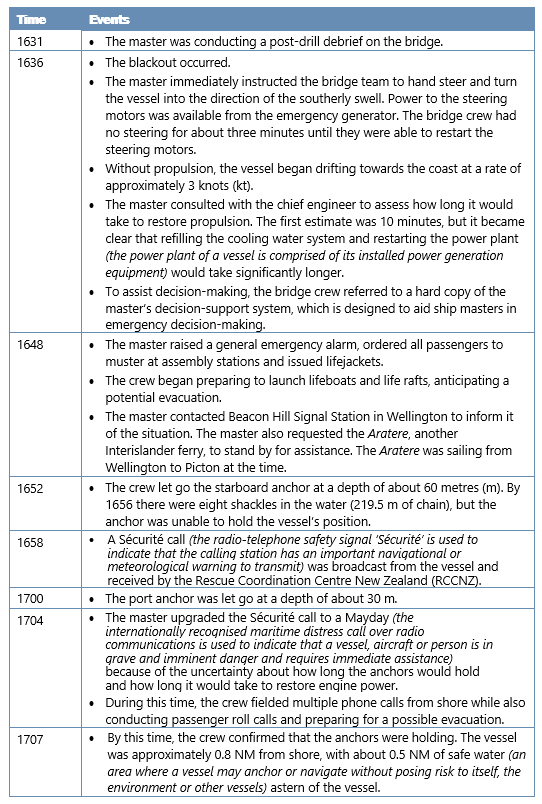
- Events leading up to the blackout followed the approximate timeline in Table 1 below.

Events in the engine room
- At about 1631, multiple circuit breakers in the engine control room tripped in rapid succession, indicating the starboard shaft generator was shedding load. Shortly after, the on-load starboard shaft generator tripped, causing a total loss of electrical power. The emergency generator automatically started, providing electrical power to emergency systems, including emergency lighting.
- The second engineer and the watchkeeping engineer were present in the control room at the time. The watchkeeping engineer quickly initiated the engineer’s alarm (a call to action to all engineering crew) and started the port auxiliary engine, followed by the starboard auxiliary engine. The port auxiliary engine was then taken on load by closing the circuit breaker and restoring normal electrical power to the vessel.
- At about that time several other engine crew, including the chief engineer, arrived in the engine control room.
- The crew began trying to restart the seawater cooling pump, which had shut down during the power loss.
- At 1633, the alarm panel in the engine control room registered a low-level alarm for the high-temperature cooling water. However, the watchkeeping engineer was in the engine room attempting to re-establish power and did not see the alarm.
-
At about that time, an engineer reported a ruptured REJ on the port auxiliary engine, with high-temperature cooling water leaking from the affected component (see Figure 4 and Figure 5). The leak resulted in the cooling water rapidly draining from the cooling system, passing through the ruptured REJ and into the engine room bilge system (a collection of pumps, pipes and tanks designed to remove water and other liquids that accumulate in the lowermost part of a ship's engine room). By the time the rupture was noticed, most of the water from the high-temperature cooling system had drained.

Figure 4: The ruptured REJ (left) and a serviceable REJ (right) - The four main engines and two auxiliary engines all used this high-temperature cooling water system. Low pressure from the system caused the port auxiliary engine to shut down, resulting in a second loss of electrical power. This was an automatic shutdown of the engines to prevent catastrophic damage to the two main propulsion engines. It was unclear whether the starboard auxiliary engine was carrying any electrical load at this time. However, the loss of cooling water pressure in the common cooling water system would have affected the starboard auxiliary engine, causing it to shut down too.
- At 1634, the forward main engine shut down. At 1636, the aft main engine shut down, resulting in a complete loss of propulsion and electrical power. The crew made multiple attempts to restart the auxiliary generators and the main engines. Although they knew of the ruptured REJ and cooling water leak, the crew continued attempting to restart the port auxiliary engine. They eventually shifted focus to the starboard auxiliary engine.

- The situation was further complicated by a loss of air pressure in the starting air reservoir, essential for starting the auxiliary generators. Repeated restart attempts depleted the reservoir and, with only one compressor available from the emergency generator switchboard, the start air system was slow to replenish.
- Once the engine crew had isolated the high-temperature cooling water system, they started to refill the high-temperature cooling water tank (also called the expansion tank). The engineers estimated that refilling the expansion tank and restarting the generators would take approximately 45 minutes.
- The loss of cooling water pressure meant the main engines could not be restarted safely and, as a result, propulsion could not be restored. The emergency generator continued to operate and provide electrical power for safety services.
- At about 1757, the engineers successfully restarted an auxiliary generator and two main engines.

Events on the bridge
- Events on the bridge followed the approximate timeline in Table 2.

Incident response
- At the time of the incident, New Zealand was responsible for one of the largest search and rescue (SAR) regions in the world (fulfilling its obligations under the 1979 International Convention on Maritime Search and Rescue), covering over 30 million square kilometres (km2).
- The coordination of search and rescue operations (SAROPs) for the region was divided into two categories, Category I and Category II. Category I SAROPs were coordinated at a local level by the New Zealand Police (Police), covering searches within New Zealand on land, inland waterways and close-to-shore marine searches (usually within 12 NM of New Zealand). Category II SAROPs were coordinated at a national level by RCCNZ. These operations typically involve missing aircraft, aircraft in distress, searches for activated emergency locator beacons and offshore maritime operations within New Zealand’s SAR region.
- The Police and RCCNZ (the SAR coordinators) can task different types of resources and assets provided by various agencies and private operators. These include helicopters, fixed-wing aircraft, vessels, land vehicles and people. Most SAR personnel are volunteers (according to New Zealand Search and Rescue (2023), the sector consisted of 11,091 personnel, of which 89% were volunteers).
- The National Crisis Management Centre (the National Crisis Management Centre is a facility designed for crisis management by central government, coordinating national responses to major emergencies) was already responding to serious flooding occurring in Auckland and was advised about the Kaitaki.
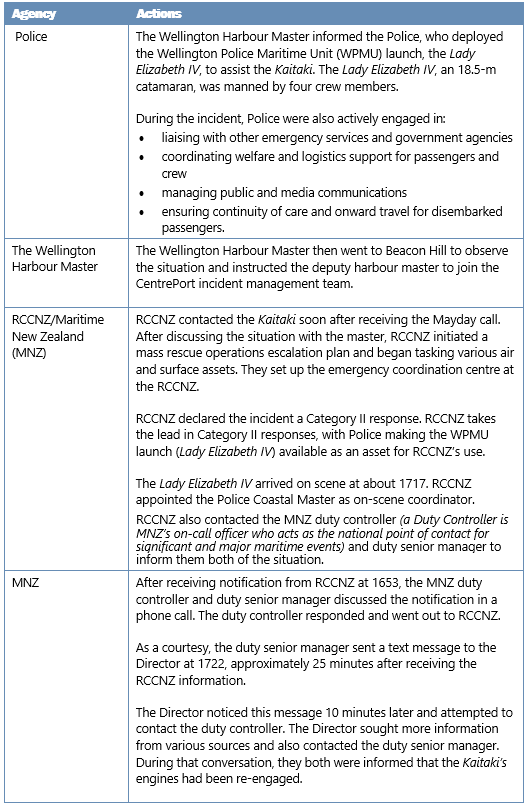
- Several agencies were involved in the response to the incident. The table below describes their actions and the coordinating role of the RCCNZ.


-
The Kaitaki was without propulsion for over one hour before the engines could be restarted and control of the engines returned from the engine room to the bridge ready for vessel manoeuvring.
- The crew weighed anchor (picking up the anchor), and the vessel made its way towards its berth in Wellington Harbour, under escort of the tugs and pilot boat. During this journey, while off Wellington Heads, the gearbox connected to the port-side main engine developed a fault that disabled the vessel’s port propulsion system. The issue was resolved when the standby main engine was started and engaged on the port shaft.
- After picking up a pilot near Steeple Rock, the master stood down the passengers from their emergency assembly stations and the Kaitaki made its way without further incident into Wellington Harbour. The ship was safely tied up to its wharf at 2123 and the Mayday was then cancelled (Maritime Operations Centre radio communications report logs, VHF call from Kaitaki to Wellington Maritime Radio).
- RCCNZ continued with its mass rescue operations plan while the Kaitaki was making way and stood down the response team only once the Kaitaki was safely alongside the wharf.
Vessel information
- MV Kaitaki is a RoRo ferry built in 1995 by Van der Giessen de Noord of the Netherlands. It previously operated under the names, Isle of Innisfree, Pride of Cherbourg, Stena Challenger and Challenger. The ship was operated by Irish Ferries (1995–2001) and P&O Ferries (2002–05) before entering service with Interislander in 2005. The ship was registered in Ireland (1995–2002) and the United Kingdom (2002–17) before being registered in Wellington and re-flagged to New Zealand. Irish Continental Group owned the ship until 2017, when KiwiRail bought it.
Crew information
- The master was first issued a certificate of competency, Standards of Training, Certification and Watchkeeping for Seafarers Convention II/2 master (unlimited), in 2013. The master joined Interislander in 2013 and had sailed as master on the Kaitaki since 2018.
- The chief engineer was first issued a certificate of competency, Standards of Training, Certification and Watchkeeping for Seafarers Convention III/1 & III/2 chief engineer (motorship only), in 2008. The chief engineer joined Interislander in 2017 and had sailed as chief engineer on the Kaitaki since then.
Ship operator
- Kaitaki is owned by KiwiRail Limited (KiwiRail). It is operated by Interislander, a wholly owned subsidiary of KiwiRail.
Meteorological information
- At the time of the incident, the wind was blowing from the south at 38 kt, gusting to 48 kt (sourced from MetService; wind speed recorded at Tongue Point weather station), and there was a 2.0–2.5 m southerly swell (sourced from master’s statement). The weather was severe but not uncommon in Cook Strait, which is one of the roughest sea areas in the world.
- Tides for 28 January 2023 were:
- high water 1127 (1.7 m)
- low water 1747 (0.6 m)
- high water 2349 (1.7 m) (sourced from Toitū Te Whenua Land Information New Zealand (LINZ))
-
RCCNZ requested a Search and Rescue Forecast from MetService, who issued a special forecast at 1739, which stated:
Wind: Southeast 35 knots gusting 45 knots, easing to southerly 30 knots gusting 40 knots this evening, and to southwest 20 knots early Sunday morning. Sea State: Very rough sea, easing this evening. Swell: Southerly swell 0.5 metres, rising to 1 metre. Sea Temperature: 16 degrees Celsius. Weather: Occasional rain, more persistent this evening. Possible sea fog from late evening. Remark: There is currently low-based cloud affecting the area. There is a risk that this may lower to sea fog from late this evening.
Maritime New Zealand’s Maritime Incident Response
- Maritime New Zealand (MNZ) operates the RCCNZ, which is the national coordination centre for maritime and aviation search and rescue operations within New Zealand's vast search and rescue region.
- MNZ also operates the Maritime Incident Response Team (MIRT), which plays a crucial role in responding to maritime emergencies. Its operations are aligned to the Coordinated Incident Management System (CIMS), New Zealand's incident response framework, that standardises interagency approaches.
- RCCNZ and MIRT utilise CIMS principles to ensure effective coordination and communication with other responding agencies during an incident, giving a unified and efficient response.
- MNZ’s incident response framework is based on three levels, which reflect an incident’s actual or potential seriousness: (1) minor/routine, (2) significant and (3) major. Seriousness is defined in terms of the consequences of the incident for:
- life
- environment
- economy (national and local)
- property
- the level of involvement or activity MNZ needs to undertake.
- In determining the seriousness of an incident, the MNZ framework uses the table shown in Table 4 (in the Maritime Incident Readiness and Response Strategy (MIRRS)).

- The MIRT procedures, as set out in the Integrated Maritime Incident Readiness and Response Strategy (MIRRS), state that, after receiving a notification from RCCNZ, the duty controller makes an initial assessment of the response required. If they assess that a MIRT is required, they contact the Director of MNZ to recommend a MIRT is established (in this context, ‘established’ is the term used in MNZ’s documentation to refer to standing up the MIRT and has a defined start and finish). The Director then decides whether a MIRT should be established, in discussion with the duty controller and other relevant people (Maritime New Zealand, 2022).
- The Director, having established a MIRT, appoints a MIRT controller (a person appointed to lead the Maritime Incident Response Team, once established by the Director) and, if needed, the National On-Scene Commander (for oil pollution response) is called up. The Director will make the decision based on the characteristics of the incident and skills needed. The MIRT controller has delegated powers under sections 248 and 249 of the Maritime Transport Act 1994 (sections 248 and 249 provide powers to the Director of MNZ in relation to hazardous ships, structures and operations).
- The MIRT controller mobilises the MIRT, which leads to an activation phase in which staff with appropriate capabilities (for example, legal, policy, salvage and other aspects under the CIMS framework) are called into the response. This phase requires staff to relocate from wherever they are to the appropriate response hubs, which takes time. See Figure 7 below for the MIRT decision tree.

- MIRT’s three core functions, undertaken in various combinations depending on the scenario, are:
- monitoring – developing and maintaining situational awareness to determine what is occurring in the incident
- oversight – understanding the actions, or proposed actions, by the main parties, considering governmental and New Zealand perspectives on these actions, and forming a view as to their appropriateness
- intervention – considering options for intervention, using available powers and influence if actions are inappropriate or insufficient, and executing and managing the approved intervention.
- Figure 8 shows how MIRT integrates with MNZ’s incident response structure during a major maritime incident.

- In response to a significant or major maritime incident, the Director will establish the MIRT and appoint a MIRT controller, who has delegated powers under sections 248 and 249 of the Maritime Transport Act 1994, to:
- mobilise the MIRT
- advise the Director throughout the incident and keep them fully informed
- establish the National Coordination Centre in accordance with CIMS principles, where MNZ is the lead agency in a response.
- MIRT’s role in a major maritime incident response also involves:
- facilitating the efficient and effective management of a national-level incident response function
- assisting, identifying and assembling resources, and coordinating with other agencies
- dealing with any ship or structure the Director deems hazardous, or the Director determines requires further assistance because of the complexity of an incident
- engaging regularly across government with other response organisations, so all response efforts are aligned, supplemented and utilised within the response.
International Safety Management Code certification
- The International Convention for the Safety of Life at Sea (SOLAS) 1974, as amended, is an international maritime treaty that sets minimum safety standards for ship construction, equipment and operation. New Zealand is a signatory to the SOLAS convention and is obligated to implement its provisions. One of these provisions is the International Safety Management Code (ISM Code) (the International Management Code for the Safe Operation of Ships and for Pollution Prevention (International Maritime Organization, 2013)), incorporated into New Zealand law via the Maritime Transport Act 1994 section 17(4)(a) and Maritime Rules Part 21 – Safe ship management systems.
-
The ISM Code requires both the ship operating company and the ship itself to comply with their safety management system (SMS). An SMS is a structured and documented system that describes how the company and ship are operated to ensure:
-
compliance with mandatory rules and regulations
-
applicable codes, guidelines and standards are taken into account.
-
The objectives of a good-practice SMS are ensuring:
-
safe practices in ship operations and a safe working environment
-
all risks to ships, personnel and the environment are assessed, and appropriate safeguards are implemented
-
the safety management skills of personnel ashore and aboard ships continuously improve, including preparing for emergencies.
-
Interislander, and the ship Kaitaki, held appropriate ISM Code certificates.
Analysis Tātaritanga
Introduction
- The Kaitaki experienced a sudden, complete loss of electrical and propulsion power, with 784 passengers and 80 crew on board. Despite the vessel initially drifting towards shore, the crew’s actions arrested the drift, re-established power and safely navigated the vessel back to port. The incident underscores the importance of effective emergency procedures and the role of experienced maritime professionals (on board and on shore) in mitigating maritime risks.
- The following section analyses the circumstances surrounding the incident to identify factors that increased either the likelihood of the incident occurring or the severity of its outcome. It also examines any safety issues that could adversely affect future operations.
- Other non-contributory safety issues that could adversely affect future operations are also discussed.
Rubber expansion joints
Safety issue 1: Rubber expansion joints (REJs) deteriorate over time, not only because of service conditions but also because of age, starting from the date of manufacture. Therefore, maintenance schedules must consider both the date of manufacture and the date of installation to ensure REJ reliability.
- Ships’ machinery comprises an increasingly sophisticated and complex network of components. Individual components must be designed, constructed, operated, maintained and replaced in a systematic manner to reduce the likelihood of unexpected failures.
- The ISM Code requires ship operating companies to have an approved SMS. The SMS must, among other things, ensure that the operator identifies critical equipment and systems (ISM Code section 10.3 defines critical equipment and technical systems as those ‘the sudden operational failure of which may result in hazardous situations’) and puts in place ‘specific measures aimed at promoting the reliability of such equipment or systems’.
- In 2007, Interislander commissioned a Failure Mode and Effect Analysis (FMEA) of the Kaitaki’s credible failure scenarios that could result in loss of control of the ship. FMEA is a risk analysis technique used to assess potential failures in a system and the equipment that makes up that system. FMEA information is vital for understanding how to prevent failure, promote reliability and respond when failure occurs.
- The 2007 FMEA identified that the failure of an REJ (referred to variously as ‘Rubber compensator’ or ‘donut’ in the FMEA report) would lead to a loss of high-temperature cooling water pressure. The loss of pressure would result in:
- uncontrolled shutdown of running main and auxiliary engines
- electrical blackout.
- While there are varying recommendations from manufacturers, Interislander’s FMEA recommended that ’rubber compensators (donuts) are changed irrespective of condition after 2 years’ service’.
- REJs begin to deteriorate from their date of manufacture. Over time, the rubber hardens and becomes more susceptible to cracking and delamination. The REJs associated with the engines’ high-temperature cooling water system were a safety-critical component on board the Kaitaki. Replacing them in accordance with the manufacturer’s instructions or FMEA recommendations is critical to ensure reliability.
- The REJ that ruptured was installed on the Kaitaki in 2018 and had been in service for about five years. Date markings on the REJ indicate it was manufactured in 2005, making it around 18 years old. The nature of the failure of Kaitaki’s REJ, in particular cracking and delamination, was consistent with deterioration owing to age.
- Had Interislander implemented the FMEA recommendations, most importantly replacing all REJs every two years, it is very likely that the reliability of the REJs would have been assured and this incident would have been avoided.
- Following from this, it is essential that vessel operators establish an effective framework for risk assessment and subsequent risk reduction. This framework should include the identification and assessment of the unique risks associated with each vessel in their fleet, and the implementation of measures to mitigate those risks. These assessments and mitigations must explicitly consider several key factors:
- the age of the vessel
- adherence to contemporary best practices in ship design and operations
- the severe environmental conditions routinely encountered in Cook Strait.
Safety management system
Safety issue 2: Interislander had not established and/or implemented processes in its safety management system to ensure that each ship’s risks were assessed and mitigated so far as reasonably practicable. This resulted in the ship’s engineers being unfamiliar with emergency responses associated with risks specific to the vessel.
Decision support system for the master
- SOLAS (SOLAS Part 1 Chapter III Regulation 29 – Decision Support Systems for Masters of Passenger Ships) requires passenger ships such as the Kaitaki to have a master’s decision-support system on the navigation bridge. The decision-support system must consider all foreseeable emergency situations and provide master’s with decision-support for handling any combination of emergency situations.
- The Kaitaki had hard copies of its decision-support system on the navigation bridge and in the engine control room. The Kaitaki's bridge team was generally familiar with this system and used it in drills and exercises.
- Overall, with the assistance of the master’s decision-support system, the master and bridge team responded appropriately and in a structured way to this emergency.
Decision-support system for the engineers
- While the master and bridge team responded appropriately and in a structured way to this emergency, the engineering team’s response to the power and propulsion failure was less structured. An engineer on board described the scene as ‘Organised chaos, everybody was everywhere trying to do everything.’ Various crew members attempted to restart the main engines and the auxiliary engines. The attempts may have been successful sooner if the response had been more structured and focused on stabilising the systems necessary to operate the auxiliary engine, restore power and then attempt to restore main propulsion.
- A lack of communication further hampered the recovery efforts. When the first blackout occurred, several engineers were attempting to reset tripped circuit breakers by toggling them on and off. They were unaware that others were simultaneously trying to start the pumps locally, which required the circuit breakers to be on.
- The master’s decision-support system is one element of an emergency response plan; it is developed to assist the master and the bridge team and is mandatory under SOLAS regulations. There is no such requirement for engineers.
- On board the Kaitaki, an engineers’ decision-support system was included as an appendix to the master’s decision-support system documentation and was available in the engine room. That documentation included descriptions of procedures developed by the previous owner to respond to the loss of high-temperature cooling water, as this was a known potential failure that had occurred twice before. The Commission found no evidence that the engineers were familiar with, or had implemented or exercised, the engineers’ decision-support system to assist in managing engineering or machinery-related emergencies.
- By not implementing the engineers’ decision-support system, the engineers missed an opportunity to resolve the mechanical failure sooner. A more structured and well-exercised engineer's response would have likely resolved the mechanical failure and returned propulsion sooner. This would have been critical had the ship’s anchors not arrested the drift towards the shore. Time was a crucial factor, and if the ship had not been arrested by its anchors, a very serious marine casualty (defined in the International Maritime Organization’s (IMO’s) Casualty Investigation Code as a total loss of the ship, a death or severe damage to the environment (International Maritime Organization, 2008)) was virtually certain.
- This incident highlights the need for effective implementation of a decision-support system to assist crew in responding to an emergency, like that required for the master and bridge team under SOLAS regulations.
- The Commission has made a recommendation on decision-support systems for engineers.
Risk management of an ageing fleet
Safety issue 3: Management of risks associated with ageing Cook Strait ferries has not kept pace with the increasing risk. Implementing strategies to mitigate evolving risk is important to ensure the continued safe operation of ferries across the Cook Strait.
- The ISM Code requires ship operating companies to establish a risk management system (systematic process of anticipating, evaluating, and addressing potential risks specific to maritime operations to safeguard personnel, the environment, vessels and cargo while ensuring effective operations) for identifying and managing hazards. In addition to eliminating or preventing hazards from causing harm, risk management should also identify potential emergency scenarios specific to the vessel and assist in developing response processes. Risk management and other SMS elements must comply with regulations and consider applicable industry codes and standards. The SMS, including risk management processes, must continuously improve (ISM Code section 1.2.2 requires an SMS to ‘continuously improve safety management skills of personnel ashore and aboard ships, including preparing for emergencies related both to safety and environmental protection’).
- Risk assessment is the product of identified hazards’ consequences, likelihood and exposure. In considering the evolving risk of a Cook Strait ferry grounding, the Commission noted:
- older passenger ferries do not benefit from the safety in design, residual damage stability or structural strength compared with newer ferries; the potential consequences of a grounding may be higher for an older ferry
- older passenger ferries are more likely to suffer mechanical failure unless they are sufficiently maintained
- In 2022, Interislander reported that it transports about 850,000 passengers, 240,000 cars and up to $14 billion worth of freight annually. These figures are forecast to increase, which means increasing exposure of passengers and freight to risk.
- As described in the international standard for risk management ISO 31000 (Risk Management – Guidelines) risks can emerge, change or disappear as an organisation’s context changes. As ships age, their machinery, equipment and systems become less reliable, increasing operational risk.
- To manage changes in risk appropriately, operators must continuously improve their risk management practices. This includes preventive actions (such as regularly reviewing risk assessments), enhancing planned maintenance systems and mitigation actions (such as improving response planning, training and resourcing for maritime incidents like groundings).
- Interislander had not reviewed its FMEA since its initial publication in 2007. In this case, the management of risks associated with ageing Cook Strait ferries had not kept pace with the increasing risk.
- The Commission has made a recommendation to improve the management of risk associated with ageing ferries.
Safe return to port
- The International Maritime Organization (IMO) recognises the difficulty of safely evacuating large numbers of ships’ passengers, who often include the elderly and children, and the search and rescue challenge this presents.
- SOLAS Chapter II-1 sets out minimum safety standards in the construction, equipment and operation of ships. Good passenger ship design, construction, maintenance and operation should be continuously improving to reduce the risk of a serious incident. Nevertheless, maritime incidents do occur. The likelihood of an incident increases as a ship ages and its reliability decreases, unless maintenance protocols and methodology develop with it.
- In 2000, the IMO began a comprehensive review of passenger ship safety with the aim of identifying opportunities to improve the way large passenger ships are designed and built. The review emphasised:
- prevention of a casualty from occurring in the first place
- that future passenger ships are designed with improved survivability so that, during an incident, people can stay safely on board as the ship proceeds to port.
- In 2006, the Maritime Safety Committee (MSC) (the MSC deals with all matters related to maritime safety and maritime security that fall within the scope of the IMO, covering both passenger ships and all kinds of cargo ships. This includes updating the SOLAS Convention and related codes, such as those covering dangerous goods, life-saving appliances and fire safety systems) adopted a package of amendments to SOLAS, namely SOLAS Chapter II-2, Regulation 21-Casualty threshold, safe return to port and safe areas (International Maritime Organization, 2006). The amendments apply to passenger ships constructed after 1 July 2010 that are over 120 metres in length. The purpose of this regulation is to establish design criteria for a ship's safe return to port under its own propulsion after an incident (specifically a fire), and to provide functional requirements and performance standards for safe areas.
- During the safe return to port phase of an incident, people escape to a ‘safe area’ on board the ship. Safe areas are spaces where basic services such as food, water, sanitation, medical care, lighting and ventilation are available. The safe return to port principle requires that some essential systems are operational for three hours to support the ‘orderly evacuation’ of the vessel.
- The Kaitaki was built in 1995, well before the 2010 application date, and therefore does not, nor is obligated to, comply with this regulation. Despite this, the master's response during the incident aligned with a principle of safe return to port to the extent achievable given the Kaitaki's design. Passengers were prepared for a potential evacuation but remained on board, reflecting a core tenet of safe return to port that prioritises keeping individuals on the ship unless it becomes demonstrably unsafe.
- When assessing the introduction of ferries to the Cook Strait trade, consideration should be given to design, construction and operation that is consistent with the principles of safe return to port. The context of RoRo passenger ships operating in Cook Strait should be taken into account.
Escape, evacuation and rescue
- Ferries such as the Kaitaki are designed to carry large numbers of passengers. In emergencies, the safe and efficient escape, evacuation and rescue of people are crucial to prevent harm and fatalities.
- An Escape, Evacuation and Rescue Analysis (EERA) is a risk analysis methodology used to understand the best response options for major accidents on a ship. The objective of an EERA is to understand how passengers and crew escape the scene of an emergency, are evacuated from the ship and are rescued to a place of safety.
- In 2016, the IMO issued the MSC.1/Circ.1533 revised guidelines on evacuation analysis for new and existing passenger ships (International Maritime Organization, 2016). These guidelines made evacuation analysis mandatory for RoRo passenger ships constructed on or after 1 July 1999, and for other passenger ships carrying more than 36 passengers constructed on or after 1 January 2020. Because the Kaitaki was built in 1995, four years before the SOLAS regulation threshold, it was not required to comply with these guidelines.
- Furthermore, current maritime rules in New Zealand do not require compliance with these IMO guidelines. There is no evidence that MNZ has actively shared these guidelines with Interislander and other ferry operators in New Zealand.
- While compliance was not mandatory for the Kaitaki, these guidelines represent best practice for ensuring passenger safety. On passenger vessels that do not comply with the guidelines, crew may not have undergone the rigorous analysis needed to understand and optimise escape, evacuation and rescue procedures in major accidents. In an emergency, the ship's systems and procedures for getting people to safety might not be as effective as they could be, potentially increasing the risk of harm or fatalities. Further, if a ship's watertight integrity is breached, the lack of a comprehensive EERA could make it more difficult to evacuate passengers and crew safely during an incident, increasing the risk of casualties.
- Since the incident, Interislander has commissioned a second EERA and created an Emergency Towing Booklet for the Kaitaki. While Interislander has taken safety action, the Commission has made a recommendation to MNZ on this matter.
Emergency response
Safety issue 4: When New Zealand suffers a major maritime event involving the evacuation and rescue of a large number of people from a ship, an appropriate level of preparedness and coordination between agencies is required. A lack of continuous improvement and exercise of a mass rescue operation escalation plan reduces the likelihood that the response will be coordinated and effective.
- This section examines the preparedness and coordination between agencies for the Kaitaki incident.
- The United Nations Convention on the Law of the Sea, Article 98 places obligations on ship masters to render assistance. These obligations are expanded in SOLAS Chapter V Regulation 33 – Distress situations: obligations and procedures. Mayday is an IMO Standard Marine Communications Phrase (IMO Resolution A.918(22)). All mariners and maritime regulators should be well acquainted with the critical importance of prompt action when receiving a distress message.
- Historically, New Zealand suffers a major maritime incident roughly every 10 years. In 1968, the sinking of the inter-island ferry Wahine resulted in the loss of 51 lives and exposed critical vulnerabilities in maritime safety and emergency preparedness during severe weather conditions. More recently, the grounding and total loss of the container ship MV Rena in October 2011 (see Transport Accident Investigation Commission (2014) for details) resulted in widespread environmental pollution. It required complex salvage operations, highlighting ongoing vulnerabilities of our response systems.
- To prepare for an effective response to an incident, all organisations that might be involved need a comprehensive understanding of their operational context, unique responsibilities, the scalability of available resources (both internal and whole-of-government) and legal obligations.
-
Preparation, planning, resourcing and response to maritime emergencies require a sound understanding of foreseeable maritime emergency scenarios. Preparedness relies on expert maritime support to understand the nature of the emergency and whether the response is adequate.
International planning frameworks
- IMO and the International Civil Aviation Organization (ICAO) have produced the three-volume International Aeronautical and Maritime Search and Rescue (IAMSAR) Manual for maritime and aviation search and rescue (International Maritime Organization and the International Civil Aviation Organization). The IAMSAR Manual provides a common aviation and maritime framework for organising SAR services. The IAMSAR Manual has three volumes:
- Volume I discusses the global SAR system framework of national and regional SAR systems and cooperation with neighbouring states
- Volume II assists personnel to plan and coordinate SAR operations and exercises
- Volume III helps personnel on board aircrafts and vessels with performance of SAR and on-scene coordinator functions.
- The International Maritime Rescue Federation (IMRF) (an international non-government organisation that supports SAR organisations to develop and improve maritime SAR capacity worldwide. It does this by providing guidance, facilitating training, and enabling SAR providers to share knowledge and expertise between members across the IMRF community. Its work is vital to raising standards and improving overall global SAR capability) has published summary guidance on Mass Rescue Operations (International Maritime Rescue Federation, 2022, updated 2025). The IMRF’s guidance supports the information included in the IAMSAR Manual about a consistent international Mass Rescue Operations (MRO) response.
New Zealand planning frameworks
-
Once passengers and crew have been evacuated from a ship, the master has much less control over the situation. The success of a rescue operation relies on external assistance and the effectiveness of New Zealand’s maritime response framework.
-
The CIMS is New Zealand’s national response framework. The purpose of CIMS is to enable New Zealand to respond effectively to a broad range of incidents, including mass rescue. It aims for coordination across functions and organisations by:
- establishing a common structure, functions and terminology
- tailoring the framework to specific circumstances
- allowing organisations to develop their CIMS-aligned processes and procedures
- taking into account each organisation’s unique responsibilities, resources and legislative authority. (Officials’ Committee for Domestic and External Security, Department of the Prime Minister and Cabinet, 2019)
- However, CIMS does not provide a detailed blueprint for executing a maritime emergency response, as that is not its purpose. Maritime emergencies often involve unique challenges, such as the requirement for personnel with incident management skills, specialised teams, technical knowledge of vessel operations and salvage, and an understanding of the complexities of the maritime environment.
- If the Kaitaki had grounded, the master would have required external assistance. This assistance would have involved moving people from the ship to a place of safety ashore, as well as conducting salvage operations and responding to any pollution outcomes. To do this successfully, external assistance providers need to have a shared mental model of the nature of the assistance required and how it would be provided. At the time of the incident there was a lack of common understanding and coordination among the various stakeholders. Additionally, there was limited capability to carry out this operation safely in the prevailing severe weather conditions, close to a rugged shoreline with large breaking waves.
Maritime New Zealand’s Incident Readiness and Response Strategy
- Maritime New Zealand developed the MIRRS and MIRT structures in response to the Murdoch Report (an independent review into MNZ’s response to the MV Rena incident on 5 October 2011 (Murdoch, 2013)). During the Kaitaki incident, RCCNZ notified the duty controller of the ship’s incapacitation, which qualified as a major incident using MNZ’s definitions. The duty controller made an assessment that a MIRT was not required. When the Director became aware of the event, they made the decision not to establish the MIRT as the response was underway and the engines were re-engaged.
Harbour master
- Beacon Hill Signal Station (Beacon Hill) had listened to a VHF radio conversation between the ferries Aratere and Kaitaki about the developing situation. Beacon Hill understood the seriousness of the situation and alerted the Wellington Harbour Master. The harbour master then alerted CentrePort and continued to monitor the unfolding situation from Beacon Hill, delegating their deputy to liaise with CentrePort.
- The Police and RCCNZ are the only two legally constituted authorities with responsibility for maritime search and rescue coordination in New Zealand. However, the harbour master plays an important role in coordinating and contributing to any emergency response effort within their port area. Their responsibilities in such an event may include:
- acting as the point of contact and liaising with emergency services, at least at the initial stages of the incident
- maintaining focus on navigational safety throughout the incident
- overseeing any necessary pollution-control measures.
- While the harbour master was in contact with various agencies throughout the incident, including Interislander’s Designated Person Ashore (the Designated Person Ashore plays a vital role in monitoring the safety and pollution-prevention aspects of the vessel operation and is responsible for following the requirements of a safety management system and all mandatory guidelines), it was unclear how they were integrated into the incident’s overall response structure. It is important the harbour master's role in a major maritime incident, such as a grounding or collision, is adequately defined and understood by all stakeholders responding to the incident.
The New Zealand Police
- Police maintain emergency response plans for maritime incidents and regularly participate in interagency exercises, including those involving mass rescue scenarios.
- Police personnel involved in maritime operations received specific training in:
- on-scene coordinator responsibilities
- search and rescue operations
- the CIMS
- The Police Coastal Master of the Wellington Police Maritime Unit (WPMU) recalled being notified of the incident by the harbour master. The WPMU launched the Lady Elizabeth IV (see Figure 9) as soon as a fourth crew member was on board. They noticed that the two tugs were also making their way to sea.
- Shortly after the Kaitaki’s master declared Mayday, RCCNZ declared the incident a Category II response. RCCNZ takes the lead in Category II responses, with Police making the WPMU launch available as an asset for RCCNZ’s use.

- When selecting an on-scene coordinator it is important for SAR coordinators to consider the operational profile of all available assets. The Police Coastal Master was appointed on-scene coordinator by RCCNZ. The WPMU launch, Lady Elizabeth IV, was purpose-built for Cook Strait operations and well-equipped for SAR, but experienced challenging environmental conditions on the day of the incident.
- The Interislander ferry, Aratere, also responded to the Mayday and was stationed about 1.3 nautical miles (NM) southwest of the Kaitaki. The Aratere master was qualified and available to undertake the task of on-scene coordinator. The Aratere would have been a stable platform with a large crew resource available to assist in that role.
CentrePort
- CentrePort first became aware of the evolving emergency when the harbour master contacted the port’s marine manager. Recognising the seriousness of the situation, the marine manager and the CentrePort chief executive officer worked through the relevant issues together before contacting the tugs, confirming both tugs were fully manned for extended operations (four crew each), and sent them to the incident.
- CentrePort controlled the two tugs. It confirmed to the Commission that the tugs had limited capacity for rescue and were unsuitable for towing outside harbour limits (the Kaitaki incident occurred outside the harbour limits) in the prevailing conditions on the day.
RCCNZ’s Mass Rescue Operations Escalation Plan
- RCCNZ has a Mass Rescue Operations (MRO) Escalation Plan. It defines an MRO as one requiring immediate assistance for large numbers of people in distress and needing more capabilities than are normally available to SAR authorities.
- Given the MRO Escalation Plan is part of the MIRRS, the Commission considers that review of the MRO Escalation Plan should be conducted as part of the scheduled MIRRS update. This should be done by MNZ working jointly with the Ministry of Transport. Together, they should develop an enduring Emergency Offshore Response Capability and operating model with a corresponding interagency and stakeholder periodic exercise programme. The Commission has made a recommendation on this matter (see Section 6).
Interagency drills and exercises
-
SOLAS Chapter V Regulation 7 states:
Passenger ships to which chapter I applies shall have on board a plan for co-operation with appropriate search and rescue services in the event of an emergency. The plan shall be developed in co-operation between the ship, the company, as defined in regulation IX/1, and the search and rescue services. The plan shall include provisions for periodic exercises to be undertaken to test its effectiveness. The plan shall be developed based on the guidelines developed by the Organization.
- The IMRF states that ‘Preparing for MROs necessitates inclusive planning, clear role definitions, and joint training among all parties involved, not merely authorities. Risk assessments must be continuous, with planners identifying vulnerabilities and addressing deficiencies in personnel and equipment. Plans should remain adaptable and undergo regular reviews and tests.’ (Source)
- It was unclear whether the drills or exercises periodically undertaken by Interislander and RCCNZ tested the effectiveness of their emergency response plans' interactions as required by SOLAS Chapter V Regulation 7.
- Interislander has conducted drills on an ad hoc basis to assess their preparedness for emergencies such as fires, abandon ship or man overboard situations. However, there appear to be shortcomings in several areas when assessed against the requirements of SOLAS Chapter V, Regulation 7 and Maritime Rules Part 23 – Operating procedures and training. These regulations mandate cooperation with search and rescue services (RCCNZ) in the form of a plan that includes periodic exercises to test its effectiveness.
- Interislander has conducted 11 exercises over the past 10 years, with three involving RCCNZ. Records show that Interislander and RCCNZ conducted various joint workshops, but they did not fulfil the specific requirements for SAR exercises under SOLAS Chapter V, Regulation 7; they lack the practical, on-site elements necessary to adequately test the cooperation plan and its effectiveness in a real-world scenario.
- Nationally, there is a need to ensure maritime response coordination and integration is at an appropriate level at all ports in New Zealand. The Commission considers that more needs to be done to ensure all parties involved in an incident response have a common understanding of the response plan and their role in it, and that they are ready to execute it. The Commission considers it is important that MNZ updates the MIRRS to provide a structured system of continuous improvement to assure that all lessons from maritime incidents are captured.
- The Commission has made a recommendation to address this safety issue (see Section 6).
Maritime Incident Response Team
Safety issue 5: Duty controllers require access to specialised maritime subject matter expertise. They also need decision-making processes to be able to respond effectively to maritime incidents.
The Maritime Incident Readiness and Response Strategy (MIRRS)
- In March 2013, an independent review of Maritime NZ’s response to the MV Rena incident on 5 October 2011 (Murdoch, 2013) was published. Following this review, MNZ developed the MIRRS. This MIRRS has been refreshed four times between 2015 and 2022, incorporating lessons from exercises and incident reviews, as well as keeping alignment with CIMS updates. The MIRRS sets the strategic intent and direction for how MNZ maintains and enhances its readiness for effective response to an incident. It defines what MNZ’s role is as a national regulatory response agency. MIRRS supports the development of an integrated emergency response involving:
- the MIRT
- the Marine Pollution Response Service (MPRS), which manages oil spills
- Maritime Incident Readiness and Response (MIRR), formed in 2019 to work with MIRT, improving response capability to other maritime incidents
- RCCNZ, which manages the search and rescue response.
Maritime Incident Response Team (MIRT)
- MIRRS requires the Director of MNZ to establish the MIRT in response to information received from the duty controller of any significant or major maritime incident, such as that involving the Kaitaki. MIRRS also requires the MIRT to have Standard Operating Procedures for mobilisation and demobilisation of an incident response.
- Maritime New Zealand has advised the Commission that the key competencies of a duty controller include that they:
- are trained in the CIMS framework
- are trained in the MIRRS, response plans, processes, role cards and mobilisation steps
- hold the right personality attributes and exercise sound judgement.
- The MIRRS identifies that the MIRT controller appointed by the Director leads the MIRT function in a mass rescue operation involving a ferry or cruise ship.
- The MIRT structure is aligned with CIMS but also includes investigation and salvage functions.
The MIRT response to the Kaitaki incident
- The RCCNZ promptly notified the duty controller of the Kaitaki’s incapacitation, and the duty controller responded and went out to RCCNZ. The duty controller advised the Commission that having appraised the situation, they saw only two possible outcomes:
- the ship would make it safely into port
- the ship would not make it into port, necessitating a rescue operation.
- The duty controller stated that if the situation deteriorated to a mass rescue, there was time to bring in more people and grow the response.
- While the MIRT was not established, a number of MNZ staff informally fulfilled some of the functions of the MIRT roles to help support the response.
- The incident was ongoing and there was no certainty that there would not be another incident as the Kaitaki attempted to return to port over the next 3 hours and 2 minutes. In fact, as the vessel was passing Wellington Heads on its return to port, a gearbox connected to the port-side main engine developed a fault, disabling propulsion power on that side. The issue was resolved when a standby main engine restored propulsion power to the port side. The Kaitaki master kept the passengers and crew at emergency muster stations until the ship was within harbour limits.
- The formal establishment of the MIRT (even after the engines were re-engaged) would have resulted in the Director appointing a MIRT controller, who then would have mobilised the MIRT to support the response to the incident in the following ways:
- establish a dedicated team, with clear roles and responsibilities, to gather information to support the incident controller (being the MIRT controller)
- share information with the Director of MNZ to keep them fully informed throughout
- arrange additional staff to support the RCCNZ if needed
- identify and source available resources to support the response.
- The MIRT controller has the delegated powers of the Director of MNZ to intervene if insufficient and inappropriate actions occur (for example, to issue instructions to vessels of convenience to take specific action).
- A not-under-command (the Convention on the International Regulations for Preventing Collisions at Sea (1972) defines the term ’vessel not under command’ as meaning a vessel which, through some exceptional circumstance, is unable to manoeuvre and is therefore unable to keep out of the way of another vessel) passenger ship, close to a lee shore in a gale, with 864 passengers and crew on board would be considered a major maritime incident. It would require the establishment of a MIRT because of the following factors:
- severe risk of grounding or allision (in which a moving vessel strikes a stationary object, such as rocks) with rocks
- potential for catastrophic vessel damage
- high probability of significant loss of life
- extremely challenging and dangerous rescue and evacuation conditions
- substantial risk of large-scale oil pollution.
- The MIRT is a response structure rather than a standing team. The process to establish the MIRT takes time as each member of the MIRT is identified and contacted, then brought together.
- Establishing the MIRT at the earliest opportunity facilitates the efficient and effective management of aspects of a significant or major maritime incident (including rescue, environmental protection and salvage) by keeping the Director of MNZ fully informed. While RCCNZ continued leading the search and rescue response until the Kaitaki was berthed alongside, not establishing the MIRT would have affected MNZ’s ability to respond promptly, had the situation escalated further.
- The Commission considers the duty controller role would benefit from the holder having a decision-making process to guide them, as well as timely access to expert maritime advice, so they can promptly respond to a significant or major incident.
Post-incident debriefs
- New Zealand’s capability to respond to a major maritime incident has improved since the MV Rena grounding, which led to the creation of the MIRT structure. However, there are opportunities to learn from each maritime incident, including the near grounding of the Kaitaki.
- Maritime New Zealand planned and conducted a series of internal debriefs, as well as external meetings with other agencies and the operator, to review what occurred on the day of the incident. The debriefs identified what went well and what could have been done better. Several safety actions resulted from those debriefs.
- MNZ informed the Commission of the following Kaitaki debriefs:

- Lessons regarding the MIRT were identified via these debriefs. From the evidence provided to the commission, the only debrief that specifically addressed the role of the incident controllers in the Kaitaki event was the ‘Incident Controller catch-up’. This was a one-hour regular meeting, and one of the seven agenda items was ‘Update post Kaitaki/Maersk debrief’, which combined the debriefs of the two incidents and included two discussion prompts: out-of-hours guidelines, and MIRR refresh.
- The Incident Controller catch-up meeting notes showed the discussion focused on the initial notification process and the lessons to be taken from that. The notes also demonstrated that they considered the incident was largely resolved when the Kaitaki engines were re-engaged. As discussed in previous sections of this report, the risk of a catastrophic outcome remained significant until such time as the vessel was safely berthed.
- The MIRT is an important response structure for MNZ that assures effectiveness for its overall response to a significant maritime casualty. The MIRT system has not been established frequently because of the extraordinary nature of the conditions that trigger it. Further, the people filling the various roles are required to execute procedures and responsibilities that are different from their normal working roles.
- Because of the importance of the role of the MIRT and its infrequent deployment, any opportunities to identify lessons should be maximised by a robust post-incident debrief.
- A structured debrief process would methodically analyse each stage of the MIRT process and could uncover additional lessons.
Emergency towage and salvage
Safety issue 6: New Zealand does not have sufficient, readily available emergency towage and salvage capability to adequately manage the foreseeable risk of a ship becoming disabled and escalating to a marine casualty with consequential fatalities or serious harm and/or serious harm to the environment.
- At 1636, when the Kaitaki lost all power, the wind was blowing from the south at about 38 kt, gusting to 48 kt, and there was a 2.0–2.5 m southerly swell. The weather was severe but not uncommon in Cook Strait, one of the roughest sea areas in the world (Maritime New Zealand, 2018).
- The ship lying off a lee shore meant that the prevailing weather was pushing the ship towards the shore. The ship’s bridge team estimated it would have run aground in 12 minutes, if the anchors had not arrested the drift.
- The actual and forecast wind, seas and currents significantly increased the complexity of evacuating passengers and crew from the ship, if needed. The calculated time for low tide was 1747, which meant that the current was expected to change (Land Information New Zealand notes, ‘The tidal streams in and around Cook Strait are unreliable and mariners are warned to exercise every precaution when navigating in the vicinity'). This would have changed the external environmental forces and about as likely as not affected the way the anchors were holding the ship.
- Severe weather also increased the complexity of safely securing the two harbour tugs for an emergency tow. Moreover, had the tugs been made fast and attempted to tow the vessel from danger, it is very likely to have resulted in a secondary incident. This is because:
- the Kaitaki and tug crews’ training did not include emergency towage using the harbour tugs
- the harbour tugs were not designed, constructed, equipped or certified for ocean emergency towage
- the Kaitaki’s bitts (mooring points on board a vessel) had a lower maximum breaking strength compared with the tug ropes, which could have resulted in the bitts on the vessel failing before the parting of the towline.
- Unlike other nations, including Australia, the United States and many European states, New Zealand doesn’t have dedicated emergency towage capability. The need for this capability has been previously reviewed by the government, and again as a result of this incident.
- Newer ferries, built after 2010 to the latest standards, may to some extent mitigate New Zealand’s current lack of emergency towage capability available at short notice in Cook Strait.
- CentrePort has two harbour tugs (see Figure 10) that are ideally suited for their tasks: primarily the safe berthing, unberthing and manoeuvring of ships within the port. The ports of Picton and Nelson, on the other side of Cook Strait, are similarly equipped with harbour tugs
- Harbour tugs lack the characteristics required of an emergency towage vessel. Nonetheless, CentrePort, appreciating the seriousness of this evolving incident, directed both tugs to the Kaitaki to offer any assistance they could safely provide.

- In New Zealand, the most capable tugs with the most appropriately trained crews have operated offshore Taranaki, supporting the oil and gas industry. The capability and number of offshore support vessels (OSVs) in New Zealand have depended on oil and gas activity. The enduring downturn of this industry has reduced the capability and number of OSVs in New Zealand.
- The lack of local emergency towage and salvage capability has been well understood for many years. Several studies have examined this issue, all reaching the same conclusion: the potential response to hazards that require emergency towage, or salvage, should be commensurate with the risk, and appropriate to the evolving risk context
- The Commission has made a recommendation about towage and salvage (see Section 6).