Two aircraft came within 20 feet of each other on final approach at night at Ardmore Airport. TAIC report highlights safety lessons for pilots, aircraft owners, engineers, and aerodrome operators at busy unattended aerodromes. It shows how communication, visibility, and access to shared procedures can make all the difference and makes recommendations to improve night flying safety across New Zealand.
Executive summary Tuhinga whakarāpopoto


What happened
- On 3 October 2023 aircraft ZK-JED, a twin-engined Beech 76 Duchess, (the Beech) and ZK-WFS, a single-engined Cessna 172, (the Cessna), were flying at night at Ardmore Airport.
- While on final approach to the runway, the Beech passed over the top of the Cessna. The pilot of the Cessna reported that the Beech passed above them “within 20 feet”. The Cessna discontinued the approach and initiated a go-around. Both aircraft subsequently landed normally.
Why it happened
- The pilot flying and the instructor on the Beech were unaware of their proximity to the Cessna in the circuit.
- The external aircraft lighting on the Cessna met the regulatory requirements for night flying. However, the pilots of the Beech said they found it difficult to clearly identify the Cessna in the circuit.
- The two aircraft flew different vertical profiles on final approach to land which increased the risk of one aircraft not seeing the other. Contributing to the different vertical profiles flown was that a local altitude restriction for Ardmore Airport was published in their operations manual and not in the Aeronautical Information Publication New Zealand (AIPNZ) available to all pilots.
- There were potentially two opportunities for radio transmissions to have identified developing conflict between aircraft.
What we can learn
- ‘See and avoid’ is the primary method for ensuring aircraft separation at unattended aerodromes. It is underpinned by pilots actively listening to all radio calls, processing the details of calls, and then using these to check their mental model of each aircraft’s position in the approach sequence. Pilots should request a repeat of any transmission that they cannot understand.
- Conspicuity of aircraft flying at night can be enhanced by modern lighting, such as light emitting diode (LED) lighting.
- Aerodrome operators must ensure that all locally agreed procedures are published in the approved documentation accessible to all pilots.
Factual information Pārongo pono
Narrative
- On the evening of 3 October 2023 ZK-WFS, a single-engined four-seat Cessna 172 (the Cessna), was engaged in a private flight. The Cessna departed Ardmore Airport (Ardmore) at 1945 (times are in New Zealand Daylight Time (New Zealand Standard Time + 1 hour), which is coordinated universal time (UTC) +13 hours, and expressed in 24-hour format) to conduct a scenic flight over Auckland CBD before returning to Ardmore to carry out some circuits (see Appendix 1) for night-flying currency. There were three people on board: one pilot and two passengers.
- On the same evening ZK-JED, a twin-engined four-seat Beech 76 Duchess (the Beech) was conducting a training flight at Ardmore. There were three pilots on board. One pilot was an instructor, who was rated and qualified on the Beech. The other two pilots were both qualified to fly the Beech at night, and were using the flight to gain night-flying and aircraft-type experience on the Beech. They considered they would gain more benefit by taking it in turns to receive instruction.
- The pilots of the Beech reported that they completed a thorough briefing on the aims of the exercise, night-flying techniques, and techniques specific to the Beech. The first flight took off at 2027 with a pilot flying under instruction and the instructor, with the third pilot in the rear seat. They completed five circuits, comprising four touch-and-go landings and one full stop landing, completing the final landing at 2056.
- The crew changed over, with the rear seat passenger swapping positions with the pilot and taking over as the pilot flying under instruction.
- The circuit layout is shown in Figure 4 and is explained further in Appendix 1. The prevailing wind was south-westerly, and pilots were using runway 21 at Ardmore (aerodrome runways are designated by the first two digits of their magnetic direction. At Ardmore, the magnetic direction of the runways are 025° and 205°, and are rounded to 03 and 21).

- At the time of the incident there were four other aeroplanes in or around the circuit:
- ZK-FCO (FCO), a two-seat Cessna 152 with one person on board flying night circuits
- ZK-FGD (FGD), a Cessna 152 with one person on board returning from a flight over Auckland city
- ZK-OAT (OAT), a Cessna 172 with three people on board returning from a flight to Hamilton
- ZK-TAN (TAN), a Cessna 172 with one person on board returning from a local night flight.
- The Beech started the second session of circuit training at 2108. FCO was in the circuit and the Cessna returned from its scenic flight and joined the circuit at 2109. FCO, the Cessna and the Beech all flew a circuit in sequence, each completing a touch-and-go and continuing in the circuit.
- At 2111 FGD called (throughout this report the statement “XXX called” means a pilot onboard aircraft with registration XXX made a radio transmission) that they were joining the circuit inbound from Clevedon on a long final. They completed a touch-and-go, and then joined downwind for a full- stop landing.
- At 2113 OAT called that they were inbound from Drury to join the circuit from the overhead position.
- At 2117 TAN called that they were inbound from Clevedon to join overhead for the circuit. They would eventually be positioned behind FCO, the Cessna and the Beech as the fourth aircraft. Figure 5 shows a snapshot of the six aircraft in the circuit area at 2118. This was the second circuit flown by the Cessna and the Beech. The Beech made their downwind call late, calling “late downwind turning base”.

- At 2121 the Cessna turned downwind for their third circuit and called to say they were downwind and number 4. This sequence was correct; with OAT on final, FGD on base, and FCO downwind and in front of the Cessna (see Figure 6).

- At 2122 OAT called that they were clear of the apron having completed their full-stop landing. FGD now led the sequence and was just about to make a full-stop landing and then clear the runway.
- At 2123 the Beech called that they were on base leg, number 2 to the aircraft on final, and they intended to do a touch-and-go landing (see Figure 7). They had not made a downwind call.

- Eighteen seconds later the Cessna called that they were on final and were number 2 (see Figure 8).

- At 2124, and eight seconds after the preceding call, FCO called that they were on short final for a touch-and-go landing.
- At 2124 the Beech called that they were on final for a touch-and-go landing (see Figure 9).

- At 2125, and twelve seconds after the preceding call, the Cessna called that they were going around from their approach and that they had a really near-collision on short final.
- The Beech completed the touch-and-go landing and positioned in the circuit for a further approach. The Cessna completed the go-around manoeuvre and then sequenced behind the Beech. While downwind the Cessna made two attempts to call the Beech and tell them that they had flown over them by 20 feet (ft) on short final but the Beech was unable to understand the transmissions. Both aircraft completed full-stop landings and taxied clear of the runway to their different parking positions. The pilots did not interact.
- The pilot of the Cessna submitted an occurrence report to the Civil Aviation Authority of New Zealand (CAA) the following day. The Ardmore operator initiated an investigation after staff reported listening to recorded radio transmissions that referred to a near mid-air collision (playback of radio transmissions is described in paragraph 2.31). The pilot and instructor of the Beech did not submit an occurrence report as they remained unaware that they had flown in close proximity to another aircraft.
Personnel information
- The pilot of the Cessna held a Commercial Pilot Licence (CPL) and valid Medical Certificate. They had logged 256 flying hours and had completed the CPL test in March 2023. They reported that they were well rested, had no health issues and were alert at the time of the incident.
- The pilot in the left seat of the Beech (pilot flying) on the flight starting at 2108 held an Airline Transport Pilot Licence (ATPL) with valid Medical Certificate. The pilot was an airline pilot with extensive instructing experience and over 21,000 flying hours. However, they had not flown a light aircraft at night for a considerable period. They reported that they were well rested, healthy and alert at the time of the incident.
- The pilot in the right-hand seat (instructor) of the Beech held an ATPL with valid Medical Certificate. The instructor had military and airline experience with 14,700 flying hours and was also a qualified instructor and examiner on this aircraft type. They reported that they were well rested, healthy and alert at the time of the incident. They were nominated as pilot in command of the flight.
- Ardmore Flying School (the flying school) operated the other four aircraft flying in the circuit at the time of the incident. The details on the other pilots flying in the circuit that evening were as follows:
- the one pilot flying FCO held a Private Pilot Licence (PPL) and was flying solo circuits at night as part of the training syllabus for their CPL
- the one pilot flying FGD held a PPL and was flying solo at night to Auckland city and return as part of the training syllabus for their CPL
- the one pilot flying TAN held a PPL and was flying their first solo night flight away from Ardmore as part of the training syllabus for their CPL
- the three pilots onboard OAT comprised a pilot who held a PPL and was training for their rating to fly at night under instruction from a flying instructor. The third pilot was another instructor observing from a rear seat.
Aircraft information
- ZK-JED was a Beech 76 Duchess, a twin-engined low-wing monoplane with retractable tricycle landing gear. The aircraft was fitted with two Lycoming O-360 engines. It had a published cruise speed of 155 kt.
- ZK-WFS was a Cessna 172, a single-engined high-wing aeroplane with fixed landing gear. The aeroplane was fitted with a Lycoming O-360-A4K engine. It had a published cruise speed of 105 kt.
Meteorological information
-
The pilots interviewed reported the weather during the evening was fine and clear, with good visibility and no cloud detected, and a light south-westerly wind. End of daylight was at 1953.
Aerodrome information
- Ardmore is a general aviation aerodrome located 28 kilometres (km) southeast of Auckland central city and 17 km east of Auckland International Airport. Ardmore is New Zealand’s second busiest aerodrome (Reported Movements Summary Table, Part 139 certificated aerodromes for the period July 2022 to June 2023 available under Movements Overview) with a wide range of aircraft operating there, including light aircraft conducting training, helicopters, business jets, recreational and historic aircraft. There was no air traffic control service at Ardmore. However, Ardmore was one of two aerodromes in New Zealand that utilised UNICOM to provide limited traffic information to pilots operating at the aerodrome. This service was available during the day only (operational between 0800 and 1800 all year).
- The Aeronautical Information Publication New Zealand (AIPNZ) is the source of aeronautical information (for more details see here). AIPNZ includes information on regulatory and airspace requirements for flying in New Zealand as well as detailed information on each aerodrome.
- The AIPNZ stipulates a standard downwind circuit height of 1000 ft above an aerodrome’s elevation. Ardmore is at an elevation of 111 ft above mean sea level (AMSL). The nominal circuit height is therefore rounded to 1100 ft AMSL. Nevertheless, the AIPNZ pages for Ardmore stated that a night circuit altitude was not to be below 1300 ft AMSL (AIPNZ Aerodrome charts, Ardmore NZAR AD 2 – 51.2). The difference in altitude was to provide additional terrain clearance from the Hunua Ranges. The AIPNZ also stated that airspeed within the circuit was not to exceed 120 kt (or minimum safe cruising speed if greater than 120 kt) (AIPNZ Aerodrome charts, Ardmore NZAR AD 2 – 31.1).
- Ardmore was operated by Ardmore Airport Limited (aerodrome operator). Their Airport Operations Manual (AOM) paragraph 3.1.1 stated the maximum number of fixed-wing aircraft in the circuit at night was six. AOM section 4.3 covered Unattended Operations, when UNICOM was not active. Paragraph 4.3.2 listed the radio calls to be made in the circuit:
- commencing the downwind leg prior to the upwind threshold, broadcast call-sign, position, altitude and intentions
- establishing on final approach, broadcast call-sign, position and intentions.
Paragraph 4.3.2 also stated that turns were only to be made above 800 ft AMSL (Ardmore Airport Limited, Airport Operations Manual, section 3.13).
- The aerodrome operator used a DART (Dynamic Automatic Radio Transmission) system to record all radio transmissions on the 118.1 mHz Ardmore Traffic/UNICOM frequency. The system converted the radio transmissions into individual wav files. These files were played back by UNICOM staff to generate movement information to submit to CAA, to generate landing charges, and to assist in any safety management investigation by the aerodrome operator.
- The aerodrome has an APAPI visual approach guidance system fitted for both runways (AIPNZ Aerodrome charts, Ardmore NZAR AD 2 –52.1 (explained further in Appendix 4). APAPI is light system that provides visual guidance to aid the pilot to fly an optimal approach glidepath that, when followed, will result in a pilot crossing the runway threshold at a prescribed 'eye height' above the runway. The runway thresholds at Ardmore are displaced (see Appendix 4). The system needs to be regularly checked and calibrated to ensure that it indicates the correct approach path. The last independent inspection at Ardmore was in August 2023.
Circuit training
- To maximise runway use and exposure to different flight manoeuvres in a given flight time, pilots use a manoeuvre called a touch-and-go landing when flying in the circuit. This is an operation in which an aeroplane lands and then takes off on a runway without stopping or exiting the runway, essentially joining two manoeuvres into one. This achieves shorter runway occupancy and shorter duration, meaning more cycles can be completed in a given time period (see Skybrary for further detail. Skybrary Aviation Safety is an ICAO partnership website). A full-stop landing is one in which the aircraft lands, reduces speed and may then taxi clear of the runway.
Aircraft lighting rules
- CAR Part 91 stipulates aircraft external lighting regulatory requirements for New Zealand-registered aircraft. CAR Part 91, subpart C, clause 91.233 requires that for an aircraft to be flown at night it must be fitted with position lights and an anti- collision light system. Further details on the regulatory requirements for position lights and anti-collision light systems are included in CAR Part 91, Appendix A.
- The United States Federal Aviation Authority (FAA) and Australia’s Civil Aviation Safety Authority (CASA) have similar rules. FAA has additionally issued an Advisory Circular (See Appendix 5 for further details on CAR Part 91 and associated Appendix A, CASA and FAA rules and advisories associated with aircraft lighting) that, to aid in collision avoidance, recommends aircraft be fitted with high-intensity anti-collision white strobe lights, visible in all directions.
Right-of-way rules
- CAR Part 91, subpart C, clause 91.229 covers right-of-way rules as follows:
- A pilot of an aircraft—
- must, when weather conditions permit, regardless of whether the flight is performed under IFR or under VFR, maintain a visual lookout so as to see and avoid other aircraft; and
- that has the right of way, must maintain heading and speed, but is not relieved from the responsibility of taking such action, including collision-avoidance manoeuvres based on resolution advisories provided by ACAS, that will best avert collision; and
- that is obliged to give way to another aircraft, must avoid passing over, under, or in front of the other aircraft, unless passing well clear of the aircraft, taking into account the effect of wake turbulence; and
-
A pilot of an aircraft in flight or on the surface must—
- give way to any aircraft that is in the final stages of an approach to land or is landing; and
- when the aircraft is one of 2 or more heavier-than-air aircraft approaching an aerodrome for the purpose of landing, give way to the aircraft at the lower altitude; and
- not take advantage of right-of-way under subparagraph (2) to pass in front of another aircraft, which is on final approach to land, or overtake that aircraft full version of CAR 91.233.
- A pilot of an aircraft—
Automatic Dependent Surveillance – Broadcast
- Automatic Dependent Surveillance – Broadcast (ADS-B) is a means by which aircraft can transmit and/or receive data such as identification and position. It is an onboard system that is ‘automatic’ because no external stimulus is required, ‘dependent’ because it relies on onboard systems to provide ‘surveillance’ information, and the data is ‘broadcast’. It utilises global positioning system (GPS) to calculate location and ground speed.
- In New Zealand it became mandatory in December 2022 for aircraft to be fitted with ADS-B OUT in order to operate in controlled airspace, meaning aircraft must have the onboard equipment to transmit the ADS-B signal. Ardmore is not controlled and therefore ADS-B OUT is not required. However, most pilots flying aircraft equipped with ADS-B will still turn the transmitting unit on and are encouraged by aerodrome operators to do so for monitoring purposes.
- ADS-B IN is a system that displays information from other ADS-B equipped aircraft on a screen on the aircraft’s instrument panel. It can be fitted to new aircraft with a suitable GPS navigation display and uses an external antenna and integrated display. ADS-B IN can also be retrofitted to older aircraft. However, the antenna is then usually internal with potential to not receive all transmissions and is therefore less accurate than the integrated units. The information from the retrofitted unit has to be displayed on some form of add-on screen, such as an iPad or mobile phone.
Previous mid-air collisions
- The Commission has investigated three fatal mid-air collisions since 2008. The collisions all occurred over or near unattended aerodromes.
Paraparaumu, 17 February 2008
- On 17 February 2008, a light aeroplane and a small helicopter collided over Paraparaumu Aerodrome. A student pilot in the aeroplane and an instructor and student pilot in the helicopter sustained fatal injuries (Transport Accident Investigation Commission. (2009). Aviation Inquiry AO-2008-001 Cessna 152 ZK-ETY and Robinson R22 ZK-HGV, mid-air collision, Paraparaumu, 17 February 2008).
- The pilot of the aeroplane was following a standard joining procedure for a sealed runway that took it into the path of the helicopter, which was operating in an opposing circuit direction for a parallel grass runway. The investigation determined that the three pilots had probably been concentrating on flying their aircraft and planned manoeuvres to the detriment of listening and maintaining an effective lookout. The pilots of both aircraft had made appropriate radio calls that should have alerted the other pilot as to their position and intended flightpath, but neither of them responded to the other’s call and no one appeared to have seen the other in time to take any avoiding action.
- The Commission made a number of recommendations to the CAA to improve safety including the need for effective visual scanning and active listening.
Feilding, 26 July 2010
- On 26 July 2010, two light aeroplanes collided near Feilding Aerodrome. An instructor and a student in one of the aeroplanes sustained fatal injuries. A student pilot in the second aeroplane was able to make an emergency landing onto the side of the runway (Transport Accident Investigation Commission. (2013). Aviation Inquiry AO-2010-008 Cessna 152 ZK-TOD and Cessna 152 ZK-JGB, mid-air collision near Feilding, Manawatu, 26 July 2010).
- The instructor and the student were practising a joining procedure when their aeroplane collided with the second aeroplane that was in the process of departing to a training area. The investigation determined that the pilots of the two aeroplanes had made the appropriate radio calls announcing their locations and intended flight paths. However, the pilots appeared not to have comprehended the relevance and importance of the other’s calls and did not take appropriate action in time to avoid the collision.
- The Commission made a number of recommendations to the CAA to improve safety including educating pilots on the importance and limitations of the principle of ‘see and avoid’ as a final defence against a collision, and of the transmitting of and listening to radio calls. The Commission also requested that the CAA review aircraft anti-collision lighting systems and markings to determine if they could increase the visibility of aircraft and, if so, promote their use.
Masterton, 16 June 2019
- On 16 June 2019, two light aeroplanes collided on approach to land at Masterton Aerodrome. The pilots of both aeroplanes sustained fatal injuries.
- The pilot of one of the aeroplanes was flying in the circuit and the pilot of the second aeroplane was returning to land following a parachute jump flight. The collision occurred on final approach to the runway. The investigation determined that the pilot of the aeroplane returning to land flew a non-standard and non-compliant procedure to join the circuit, which they had been trained to do as it had become the accepted practice at this aerodrome.
- The Masterton report summarised the following factors that were common to these three accidents:
- the collisions occurred at unattended aerodromes
- each collision involved an aircraft that was re-joining
- the weather conditions on each occasion were good
- pilots made appropriate radio calls, updating their location and intentions
- all the pilots were familiar with the aerodrome and procedures
- one of the pilots involved in each of the collisions held a commercial pilot licence (CPL) or higher qualification.
- The Commission made a number of recommendations to the CAA to improve safety, including the need to improve the effectiveness of ‘see and avoid’ as a way to avoid mid-air collisions through the promotion of the skills required, including the need to actively listen to radio calls.
Safety campaigns
- ‘Work together, stay apart’ is an industry-wide safety campaign launched by CAA in June 2023 to reduce the likelihood of mid-air accidents and the number of near-collision and air-proximity events within the circuit at unattended aerodromes. The campaign refers to the three accidents above pointing out that these fatal accidents happened at each of the pilot’s home airfields. Safety seminars and educational roadshows have been delivered at flying clubs and schools across New Zealand. Some of the key focus areas of the campaign are:
- circuit joining procedures
- basic airmanship and give way rules
- situational awareness, listen out, look out
- clear, concise and accurate radio communications.
- The Australian Transport Safety Bureau (ATSB) website publishes the SafetyWatch list, which covers safety concerns that have arisen from their investigation findings and from occurrence data reported by industry. As at December 2023, there were six current SafetyWatch items, one of which was reducing collision risk around non-towered airports. The webpage links to three recent ATSB investigations into mid-air collisions as well as to ATSB’s A pilot’s guide to staying safe in the vicinity of non-controlled aerodromes. In 2016, ATSB also released an aviation short investigation bulletin Near collision special edition which provided details of 10 near-collision events in the period February to May 2016 reported to the ATSB. Effective communication is one of the lessons highlighted in the bulletin.
Analysis Tātaritanga
The following sections analyse the circumstances surrounding the event to identify those factors that increased the likelihood of the event occurring or increased the severity of its outcome. They also examine any safety issues that have the potential to adversely affect future operations.
Near-collision event
- The pilot of the Cessna submitted an occurrence report to the CAA on 4 October 2023 (the day after the incident) stating that another aeroplane passed approximately 20 ft overhead of their aircraft. The Commission obtained CCTV footage of the final approach path from the aerodrome operator. The footage showed the lights of one aircraft passed directly over the other before the overtaken aircraft turned and climbed away.
- At interview the pilot of the Cessna said that about 5 seconds after they heard another aircraft call that they were on final they saw aircraft lights shining on their nose cowling, and then saw the wheels of an aircraft pass within 20 ft of their aircraft. They responded by immediately initiating a go-around.
- Data from ADS-B positively identified the two aircraft and showed that they passed within 6.6 metres (m) laterally of each other. The two aircraft were approximately 100–200 ft above the ground and 900 m from the runway threshold as this point. The pilot flying and instructor on the Beech did not submit an occurrence report as they were unaware of the proximity of the other aircraft.
Loss of situational awareness
- Both the pilot flying and instructor on the Beech were able to recall that during their session of flying there were four aircraft in the circuit, two aircraft joining, and two aircraft completing full-stop landings. The instructor said that they were diligent in completing clearing and checking turns, a technique used to look out for other aircraft during a turn. During the circuit that resulted in the incident, the pilot flying the Beech identified FCO as the number one aircraft and their Beech as the number two aircraft. This sequence was agreed with the instructor. However, the Beech was actually third in the sequence at that stage with FCO leading, followed by the Cessna, as shown in Figure 7.
- Situational awareness requires an accurate understanding of the current operational environment in order to anticipate a future state. Situational awareness relies on three processes:
- perception of what is currently happening within the environment
- comprehension of what that means in relation to the task at hand
- the ability to apply that understanding to anticipate what will happen in the future.
Building an accurate awareness involves perception; that is, scanning the environment to gather information using one’s senses. If information is not detected or if it is misperceived, situational awareness will be affected.
- Following the event, the pilot flying the Beech recalled that they had been unable to visually see the other aircraft (which they later determined was the Cessna) during the incident circuit, although they may have seen the aircraft in previous circuits. The pilot flying and instructor heard radio transmissions from one aircraft that they said they were unable to understand but assumed that this aircraft was behind them. Without an accurate perception of the information within their operating environment, both the pilot flying and the instructor developed an inaccurate mental model of the circuit, and their situational awareness became compromised.
Vertical approach path
- The standard vertical path that aircraft fly on a straight-in approach is 3° to a touchdown point located 1000 ft beyond the runway threshold. This optimises terrain clearance, aircraft handling and speed control, runway use and passenger comfort. On this profile the aircraft would cross the runway threshold at 50 ft. As noted in paragraph 2.32, Ardmore has an APAPI visual guidance system, which was set to approximately these parameters (see Appendix 4).
- Student pilots are taught to fly circuits using a steeper approach path of approximately 4°, which keeps the aircraft closer to the runway and allows for a glide approach should an engine fail. Additionally, pilots flying a touch-and-go landing are also taught to adjust the touchdown aiming point from 1000 ft into the runway to closer to the runway threshold. This allows enough remaining runway to accelerate and get airborne again. A senior instructor confirmed to Commission investigators that the above techniques were those taught at the flying school.
- The CCTV footage showed the landing lights of both aircraft. One aircraft appeared on a lower and flatter approach path while the other gradually gained on this aircraft from above, eventually passing it. The lower aircraft then initiated a climb.
- In their interviews the pilot flying and instructor of the Beech described their approach path flown. This was similar to that described by the flying school in paragraph 3.9. The instructor on board the Beech was experienced in flying at Ardmore.
- As stated in paragraph 2.30, Ardmore had an operating procedure in its AOM stating that turns were only to be made above 800 ft AMSL. The pilot of the Cessna was not aware of this procedure and reported that they were turning from base to final at 600 ft AMSL as they would have in a standard circuit.
- The pilot of the Cessna said that they followed the APAPI guidance, flying with one white and one red light visible; that is, they flew a 3° approach path to touchdown (see Appendix 4 for explanation of APAPI visual display guidance). The pilot of the Cessna also stated that they had done all their training at other airfields and had limited night experience at Ardmore. The manager of a flying school based at an airfield neighbouring Ardmore told the Commission that they trained their pilots to use Ardmore as the alternate if their runway lights didn’t turn on at their aerodrome, and to follow the APAPI guidance when flying the approach to Ardmore.
- The projected vertical profiles of the two aircraft from turning final to the touchdown aiming point are represented in Figure 10. The data provided from ADS-B uses rounded altitude information and therefore cannot be used to calculate an accurate vertical profile, so these have been created based on the pilots’ recollection.

- The Beech 76 aircraft has a long nose and high instrument-panel coaming. While flying downwind or on base this would not restrict vision of other aircraft in the circuit, but once established on final the forward lower field of vision for the pilot flying and instructor on the Beech was restricted. The Cessna turned final at 600 ft and was following the APAPI and therefore was flying a flatter approach profile. The Beech was descending from behind the Cessna but on a steeper profile with the Cessna under their nose. Once both aircraft were lined up on the final approach to the runway, the combination of the Beech’s restricted forward visibility and the lower trajectory flown by the Cessna meant that it was very unlikely that the pilot flying and instructor in the Beech would see the Cessna.
Aircraft speed in the circuit
- Ardmore’s AOM stated that airspeed was not to exceed 120 kt (or minimum safe cruising speed if greater than 120 kt). At interview, the pilot flying the Beech said that they were aware of and tried to stick to the speed limit of 120 kt. The instructor said that they planned to fly downwind at 100 kt. Figure 11 shows the ground speeds of the six aircraft in the circuit at the time of the incident. The speed of the Beech was, as expected for a twin-engined aeroplane, consistently faster than the other aeroplanes when flying in the circuit.

- It is also important to note that the data depicted in Figure 11 is calculated ground speed recorded from ADS-B. Appendix 6 details the difference between the stated speed limit as an indicated airspeed (IAS) and the speed read-outs from ADS-B that are ground speed (G/S). Effectively a limit of 120 kt IAS equates to 140 kt G/S when accounting for the wind and temperature on the evening of the incident (as calculated in Appendix 6). The pink shaded area of Figure 12 depicts the times when the Beech exceeded 140 kt, demonstrating that it was a small proportion of the flight profile.

- The pilot of the Cessna said that they did not know that the Beech was a twin- engined aircraft and therefore faster. There was no requirement for aircraft to state their aircraft type when they make the downwind or turning final radio call. The speed variance between the Beech and the other aircraft in the circuit, rather than the instances of the Beech exceeding the circuit speed limitation, led to changes in the spacing between aircraft and therefore likely contributed to the occurrence.
Radio transmissions
- Before start up or taxi it is common for aircraft to do a radio check. This involves the pilot transmitting the words “radio check”, which means ‘what is my signal strength and how do you hear me?’ The operator’s base station or another aircraft will typically respond with a number ranging from five to one, five meaning ‘loud and strong signal’ reducing to one which means ‘very poor signal’. The Cessna made a radio check call before taxi and another aircraft responded, “strength five”.
- As described in paragraph 2.31, the aerodrome operator had installed a DART radio recording system. The receiver and antenna were located at the aerodrome operator’s office, which is 600 m away from the Ardmore tower. UNICOM staff advised that occasionally there was a difference in what was heard and recorded between the two locations. For example, a radio transmission heard by the duty UNICOM person was not always recorded on the DART system.
- Radio transmissions in the circuit are ‘all stations’ and nobody specifically responds or acknowledges a transmission. Therefore, receipt of the transmission by another aircraft cannot be confirmed (Sometimes referred to as a ’blind transmission’, it usually informs other traffic about location and intentions, to help other pilots update their mental picture and promote safety of flight). Ardmore Radio was fitted with an aerodrome frequency response unit (AFRU), or beep-back, which generated an audible beep when a transmission lasting more than four seconds was made. This allowed the person making the transmission to confirm that they were using the correct radio frequency and the equipment was serviceable. However, it did not confirm that a transmission was understandable.
- When the Commission investigator reviewed the DART recordings of transmissions made by the Cessna it was noted that some were quieter when compared to other aircraft transmissions, but they were generally intelligible. The Cessna made the going around call at 2125, and the pilot flying and instructor on the Beech both reported at interview that they heard that call but couldn’t recall the aircraft call sign and didn’t know the location of the aircraft.
- After completing the go around and when both aircraft were established on downwind, the Cessna made two attempts to contact the Beech and tell them that they had been involved in a near miss. However, the Beech was unable to understand these transmissions, responding “say again” to the first, and “you’re barely readable” to the second.
- The flying school has a duty flying instructor responsible for monitoring students doing night circuits or night cross country. To help fulfil that role they had a base- station radio, and they were monitoring the Ardmore mandatory broadcast zone (MBZ) radio frequency. While monitoring their four aircraft flying that evening, they heard the radio transmission of the Cessna going around and the subsequent calls made by the Cessna to the Beech.
- All pilots involved in the occurrence confirmed that they were using headsets for radio communications. This was recommended practice because of the noisy environment in an aircraft. When using a headset, the placement of the microphone boom arm is important; it should be placed close to the mouth so that the microphone transmits speech rather than ambient noise. It was also reported that on some aircraft there can be variance in quality of radio transmission and reception, depending on the aircraft/headset combination (Report on near miss at night in Ardmore Circuit between Beech Duchess ZK-JED and Cessna 172 ZK-WFS on 3 October 2023 initiated by Ardmore Airport Limited, p 11.)
- The pilot flying and instructor onboard the Beech were engaged in a training flight and therefore would be talking to each other as they flew. During training flights pilots are encouraged to stop talking whenever there is a radio transmission so that the radio call can be understood. This is also a feature of multi-crew airline flying in which both pilots on the Beech had extensive experience. Workload on a training exercise on the twin-engined aircraft would be high and this about as likely as not accounted for the missed downwind radio call by the Beech on their third circuit and the late call on the second circuit.
- Commission investigators could not determine which transmissions the Beech received and why they were unable to understand the transmissions made by the Cessna after the go-around.
Active listening: two missed opportunities
Safety issue: The effectiveness of ‘see and avoid’ as a defence against mid-air collisions relies on pilots actively listening and processing radio transmissions from other aircraft. In cases where this does not occur, pilots may form incorrect mental models and this can result in aircraft coming into close proximity with each other, particularly at busy unattended aerodromes, increasing the risk of collision.
- In three mid-air collisions that the Commission investigated (see paragraphs 2.40 to 2.52) a lack of active listening was identified as a contributing factor. The concept of ‘see and avoid’ at unattended aerodromes is underpinned by effective radio communications. This includes listening to the radio transmissions about the position of other aircraft and adapting or updating the pilot’s mental image of the sequence in the circuit.
- There were potentially (bearing in mind paragraph 3.27) two instances at which the developing conflict could have been identified by the pilots using the radio calls made. The first instance was at 21:23:34, when the Beech called “base, number two to the aircraft on finals” (see Figure 7). At this stage the Cessna was number two to FCO and therefore in front of the Beech, which was actually number three. The pilot of the Cessna, knowing they were following one other aircraft, could have challenged the call from the Beech by saying that they thought that they were number two, thus questioning the Beech’s view of the sequence.
- The second instance happened 18 seconds later, when the Cessna called “finals, full stop number two” (see Figure 8). The Beech had just previously called that they were number two. So if another aircraft was now calling that they were number two, that contradicted the Beech’s previous call of the sequence. This was different from their mental model of their position in the sequence and should have been queried by the Beech.
- The pilots flying the other aircraft in the circuit that evening were all inexperienced and in the early stages of night flying. Therefore, it is likely that they would have been focused on their own separation and had limited capacity to monitor separation between other aircraft. While active listening is an essential requirement to build an accurate mental model, increased workload can negatively affect auditory processing (This can be because of increased task demands decreasing an individual’s ability to detect the auditory stimuli and/or a reduction in attentional resource to effectively process the relevant information, regardless of its importance. For an overview of literature see Baldwin, C. L. (2012). (Document removed from website) CRC Press).
- In both instances discussed above a radio call potentially contradicted the pilot’s perception of the sequence. When pilots are actively listening to the calls from the other aircraft they can assess where the other aircraft are in the sequence relative to their position. If they identify a potential conflict, they can challenge the other aircraft by making a radio call to ask for more information to clarify the sequence and thereby avoid an incident. Similarly, if a radio call from one aircraft was not clear, other aircraft should have asked for it to be repeated so that relevant information could be absorbed into each pilot’s mental model of the sequence. There were very likely two missed opportunities following radio transmissions for the pilots of the Cessna and the Beech each to resolve their position relative to the other aircraft.
Aircraft exterior lighting
Safety issue: Aircraft fitted with older-style lighting can be more difficult to see at night. This reduces the effectiveness of ‘see and avoid’ as a defence against mid-air collisions.
- The Commission investigations into the three mid-air collisions (see paragraphs 2.40 to 2.52) found that the pilots of the aircraft involved did not see the opposing aircraft in time to avoid a collision. The ability to visually detect another aircraft is therefore also critical in helping avoid a mid-air collision. The exterior lighting of the Cessna consisted of standard navigation lighting (wingtip red and green and rear white) and a tail fin mounted anti-collision light system. The wing mounted navigation lights are only visible to another aircraft when approaching head on or from the side. The aircraft’s switch panel had a position for wing-tip strobe lights, but it was blanked off as strobe lights were not fitted. This aircraft was manufactured in 1973, and the aircraft owner reported that aircraft of this era had strobe lights only as an additional option.
- The other four aircraft in the circuit on that evening were all operated by the flying school. The flying school operated 12 Cessna C172s with strobe lights fitted, and 4 C152s that did not have strobe lights. The flying school representative said that they tried to prioritise the C172 aircraft for night flying. On the evening of the incident OAT and TAN were both C172 aircraft fitted with strobe lights. However, because of aircraft scheduling, the Cessna C152 aircraft, FCO and FGD, were also used that evening and neither had strobe lights fitted. The flying school no longer operates the C152 aircraft. The Beech had strobe lights fitted.
- The aircraft lighting regulatory requirements of CAA, FAA and CASA are noted in paragraphs 2.34–2.36 and further explained in Appendix 5. In summary, all three regulatory bodies require a position and anti-collision light system be fitted and operating on aircraft flying at night. FAA Advisory Circular (AC) 90-48E additionally recommends that aircraft should be fitted with high-intensity anti-collision white strobe lights, visible from all directions, to aid in collision avoidance. This is guidance rather than a regulatory requirement.
- The exterior lighting fitted to the Cessna was in accordance with CAA rules. However, the aircraft had the older-style anti-collision light with lower illumination levels. Retrofitting strobe lighting to older aircraft would potentially require new wiring and incur considerable cost. An alternative would be to replace the existing anti-collision light system with light-emitting-diode (LED) lighting. These are available for many aircraft types and use existing wiring and switches. This would increase conspicuity of the aircraft.
- The pilot flying and instructor of the Beech reported that they did not see the other aircraft until after it initiated the go-around, and they did not know it was the Cessna. The pilot flying the Beech said that the clarity of radio transmissions combined with being unable to identify strobe lighting from the other aircraft meant it was difficult to insert that aircraft into their mental model. Based on details provided by the pilot flying and instructor on the Beech, the Commission concludes that they had clear sight of FCO, assumed they were following that aircraft as number two, and flew a path to sequence behind that aircraft. If the external lighting fitted to the Cessna had been more conspicuous, it is likely that both pilots in the Beech would have seen the Cessna on the downwind or base legs and adjusted their sequence accordingly.
Published procedures
Safety issue: Locally agreed procedures at some aerodromes are not published in the AIPNZ documents used by all pilots. Pilots unaware of these procedures can fly a path that potentially conflicts with those of pilots following the local procedures and lead to a close-proximity event or accident occurring.
- The varying vertical paths flown by the two aircraft is discussed in paragraphs 3.8-3.15. Contributing to the different approach profiles flown was that one of the pilots was not a regular flyer at Ardmore and did not know about the local procedure that at night all turns should be made above 800 ft, as stated in the Ardmore AOM (see paragraph 2.30).
- To operate from a specific aerodrome a pilot reviews the procedures and restrictions for that aerodrome in the AIPNZ. However, the Ardmore local procedure requiring turns at night be made above 800 ft was not included in the AIPNZ Ardmore information pages.
- Ardmore, like many aerodromes across New Zealand, has a proactive user group. It meets regularly to discuss operations at Ardmore and can develop and agree procedures that are at variance to standard practice, such as the circuit height, but are based on local safety experience. It is important that locally agreed procedures are promulgated into the AIPNZ for all pilots to access.
Use of technology
- ADS-B technology (discussed in paragraph 2.37) is fitted to many aircraft and the aerodrome operator estimates that 80% of aircraft operating within Ardmore MBZ have it fitted. If an ADS-B IN display is also installed in an aircraft, it can display other ADS-B-fitted aircraft to the pilot. However, ADS-B IN will not display all traffic as it only displays aircraft fitted with ADS-B.
- ADS-B IN, like other traffic collision-avoidance systems, is a good tool for helping to increase awareness and avoid conflict with other aircraft. However, it can suffer from clutter and spurious warnings in the circuit and, as noted above, it will not display all aircraft in the circuit. Further, it has the potential to distract a pilot in the high- workload environment of the circuit, with a pilot focusing on the internal display rather than looking outside, thereby reducing the effectiveness of ‘see and avoid’ as a defence against mid-air collision.
- Following this incident, the Ardmore Airport User Group discussed at their meeting the option to make installation and use of ADS-B mandatory for aircraft operating in the Ardmore circuit. It was agreed by all attendees that pilots should be maintaining a visual lookout at all times and not be relying solely on ADS-B, which is a useful tool but can be a distraction. Implementation of mandatory ADS-B at Ardmore was rejected by the User Group.
Appendix 1. Aerodrome traffic circuit
The aerodrome traffic circuit consists of five segments and four turns (see Figure 13). The names of some segments (upwind, crosswind and downwind) are derived from the fact that aircraft normally take off and land into the wind. The upwind leg is sometimes called ‘departure’ as this is the path of an aircraft after becoming airborne. The downwind leg is the segment when the aircraft is flying parallel to the runway but in the opposite direction to landing (Source). A similar diagram appears in AIPNZ.

This is an example of a left-hand aerodrome traffic circuit as used for Admore’s runway 21.
At Ardmore, the choice of runway (03 or 21) is determined by wind direction – wherever possible aircraft land into wind, ie the headwind.
The default pattern is always left-hand turns. In this way the pilot, seated on the left, can keep the runway in sight. Some aerodromes promulgate a right-hand circuit, for reasons such as noise abatement or terrain considerations; for example, Ardmore stipulates a right-hand circuit for runway 03.
The circuit is normally flown at 1000 ft above ground level. Ardmore aerodrome elevation is 111 ft so the circuit height is 1100 ft above mean sea level (AMSL). However, the aerodrome operator has prescribed a minimum night-circuit altitude of not below 1300 ft AMSL (AIPNZ Aerodrome charts, Ardmore).
Appendix 2. Radio transmissions
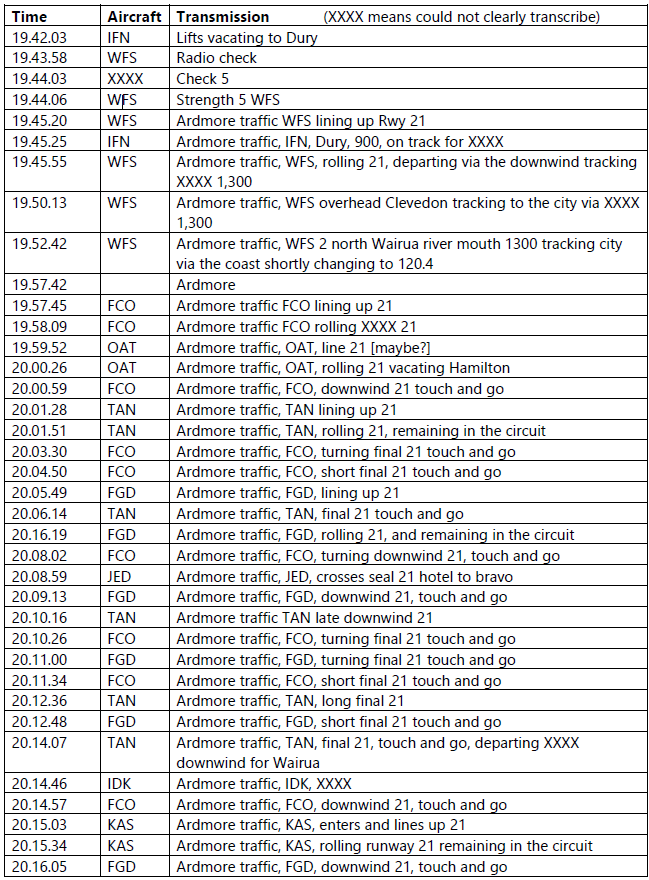
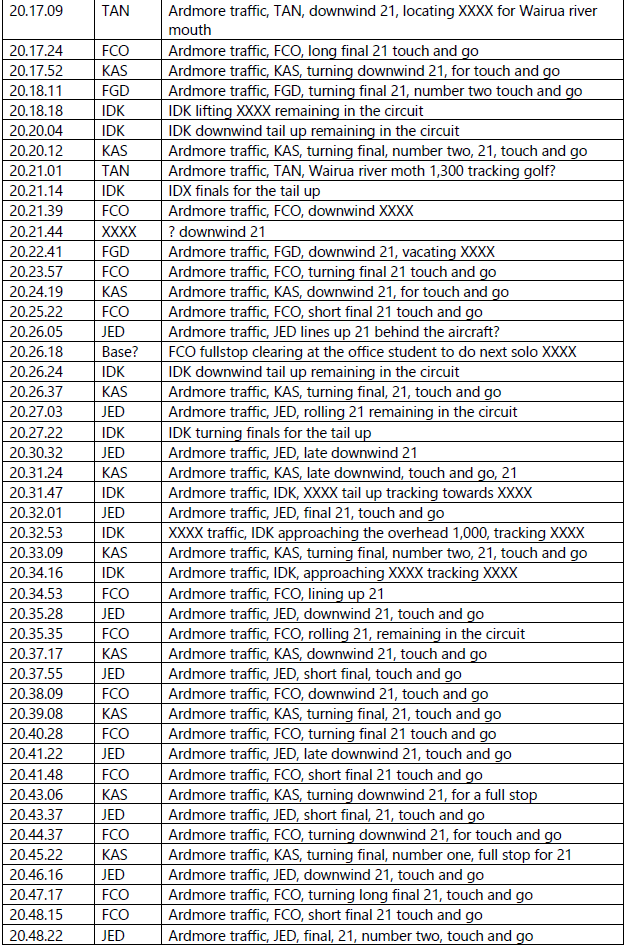
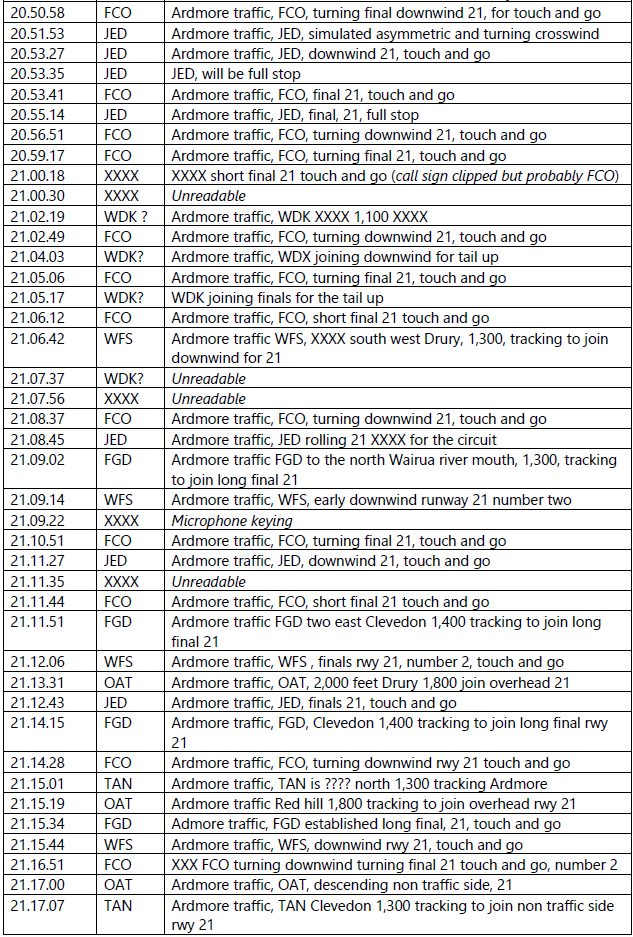
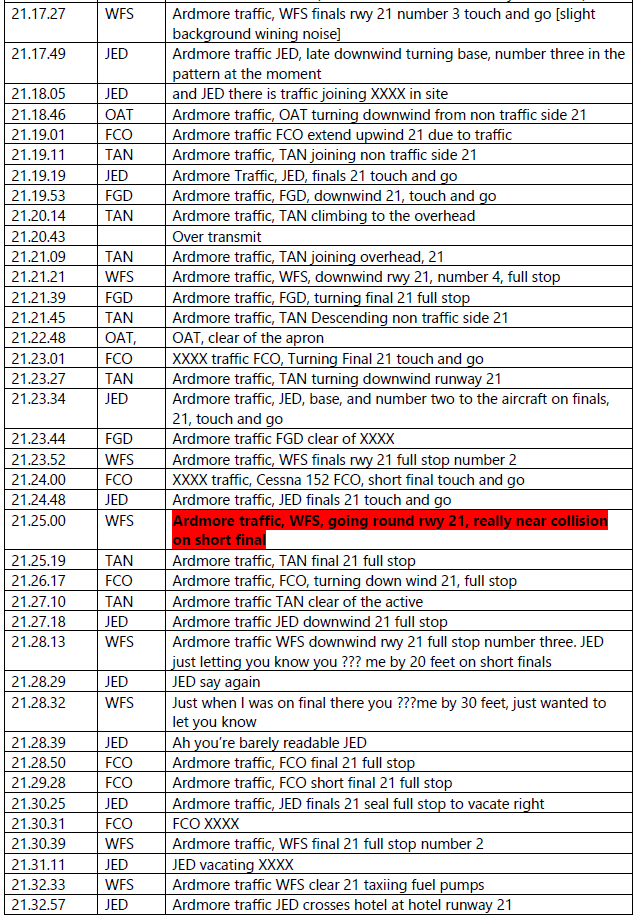
UNICOM Radio transmissions on 3 October 2023, transcribed by the Commission from recordings provided by Ardmore Airport Ltd
Appendix 4. Runway threshold and APAPI
The runway threshold is the beginning of the runway. A displaced threshold is a threshold located at a point on the runway other than the designated beginning of the runway. This reduces the length of runway available for landings in that direction. The reason for having a displaced threshold is usually to allow for any obstruction that impinges on the vertical component of the approach path to the runway (for example buildings or trees).

Figure 14 shows the approach path to the runway in red infringed by trees. By displacing the threshold the approach path in blue is above the obstacle on approach by the approved margin.
Both runways at Ardmore have displaced thresholds. Runway 21’s threshold is displaced by 112 m and runway 03’s threshold is displaced by 105 m.
A precision approach path indicator (PAPI) uses four lights, installed in a row abeam the runway adjacent to the touchdown point, typically 1000 ft from the runway threshold. If the aircraft is on the correct approach profile, the PAPI displays two white and two red lights. If the aircraft is high, the display is three white and one red light. If the aircraft is low the display is three red and one white light. Standard glidepath is 3° and standard threshold crossing height is 50 ft, but these can be varied at individual airfields to account for terrain and local features such as a road passing under the final approach profile.
APAPI is an abbreviated PAPI with two lights (rather than four) – one white and one red light indicates that the aircraft is on the correct profile.
Both runways at Ardmore are fitted with APAPI set at 3°and a threshold crossing height (TCH) of 46 ft) (AIPNZ Aerodrome charts, Ardmore NZAR AD2 – 51.2).

Appendix 7. Ardmore Airport Safety Alert